
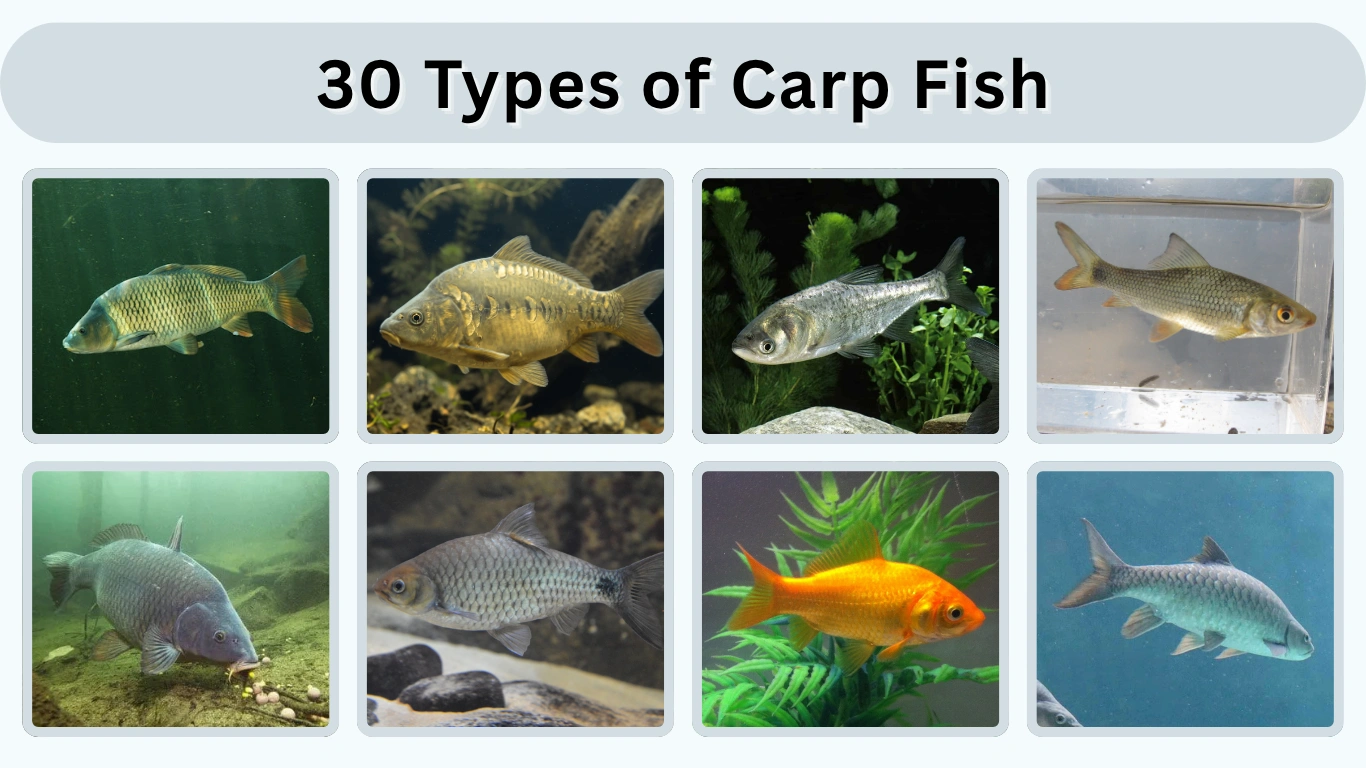
Carp fish are among the most diverse and widely distributed freshwater species in the world. Found across Asia, Europe, and beyond, they play an important role in ecosystems, aquaculture, and recreational fishing. From well-known species like common carp and koi to lesser-known varieties, each type has unique characteristics and habitats. This guide explores 30 different types of carp fish, helping you understand their identification, behavior, and distribution. Whether you are an angler, fish enthusiast, or researcher, this list provides a clear overview of carp diversity.
1. Common Carp
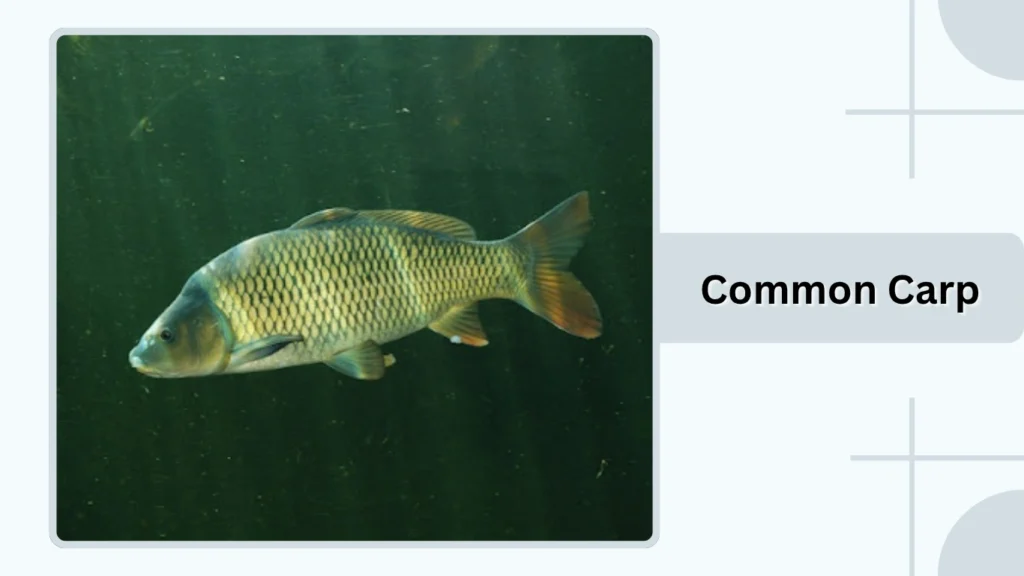
The common carp is one of the most widespread and recognizable freshwater fish in the world. Native to Europe and Asia, it has been introduced globally due to its adaptability and value as a food and sport fish. It thrives in lakes, rivers, and ponds with slow-moving or still water.
Identification
- Large, deep-bodied fish with a robust shape
- Color ranges from golden brown to dark bronze
- Two pairs of barbels (whisker-like organs) near the mouth
- Large, regular scales covering the body
- Long dorsal fin with a serrated leading edge
Habitat
Common carp prefer warm, slow-moving waters such as lakes, ponds, and lowland rivers. They are highly adaptable and can survive in a wide range of conditions, including waters with low oxygen levels and varying temperatures.
Behavior
This species is known for its bottom-feeding habits, often stirring up sediment while searching for food. Common carp are omnivorous, feeding on aquatic plants, insects, and small invertebrates. They are also known for their strong fighting ability, making them popular among anglers.
Size
Common carp can grow quite large, often reaching lengths of 24 to 48 inches. In ideal conditions, some individuals can exceed 60 pounds, making them one of the largest freshwater fish species commonly found in many regions.
Distribution
Originally native to Europe and Asia, common carp have been introduced to nearly every continent except Antarctica. They are now found in freshwater systems worldwide and are considered both a valuable fish and, in some areas, an invasive species.
2. Mirror Carp
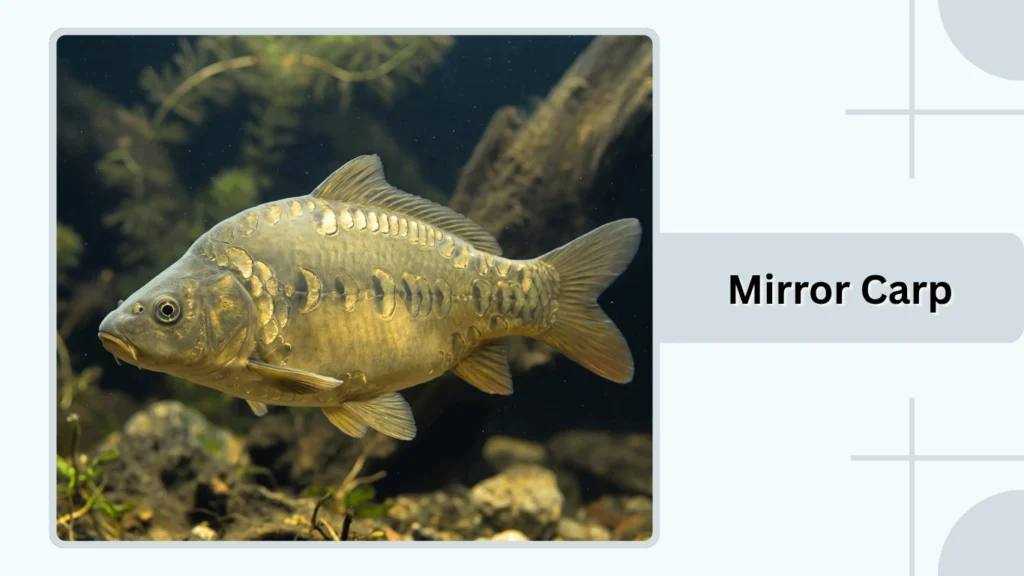
Mirror carp are a unique variety of common carp known for their irregular scale pattern. Instead of having fully covered scales, they display scattered, large, reflective scales that give them a “mirror-like” appearance. They are popular among anglers due to their distinctive look and strong fighting ability.
Identification
- Irregular, patchy scales with smooth skin in between
- Large, shiny scales that reflect light
- Similar body shape to common carp (deep and robust)
- Color ranges from bronze to dark brown
- Two pairs of barbels near the mouth
Habitat
Mirror carp inhabit the same environments as common carp, including lakes, ponds, and slow-moving rivers. They prefer calm, warm waters with plenty of vegetation and soft bottoms where they can feed easily.
Behavior
Like other carp species, mirror carp are bottom feeders. They search for food by disturbing sediment and feeding on insects, plant matter, and small aquatic organisms. They are cautious fish, often making them challenging to catch.
Size
Mirror carp can grow large, often reaching similar sizes to common carp. Many individuals weigh between 20 to 40 pounds, though larger specimens exceeding 50 pounds are not uncommon in well-managed waters.
Distribution
Mirror carp are found worldwide due to stocking and aquaculture practices. Originally developed through selective breeding in Europe, they are now present in many freshwater systems across different continents.
3. Leather Carp
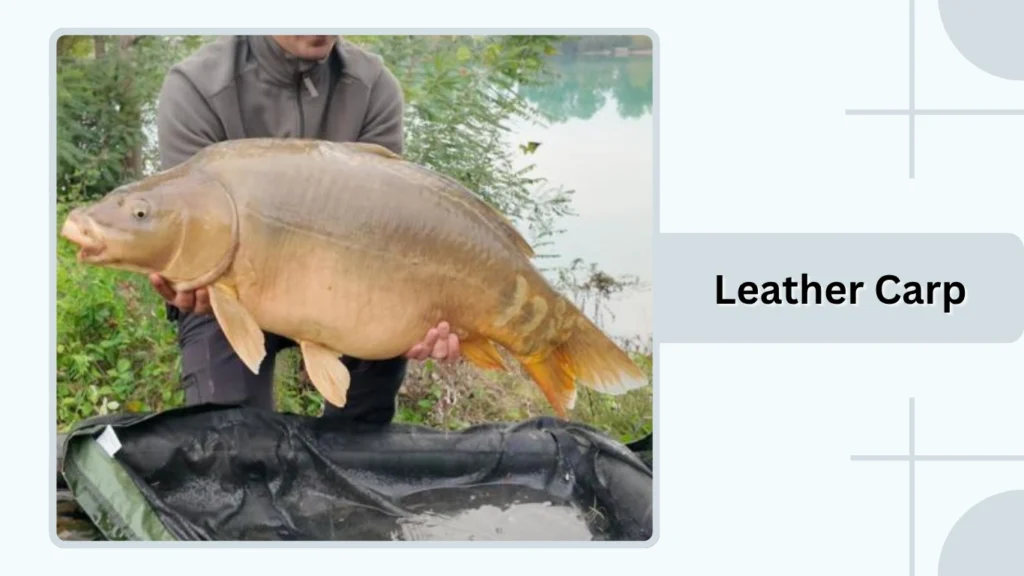
Leather carp are another distinct variety of common carp, known for having very few or almost no scales. Their smooth, leathery skin gives them a unique appearance compared to other carp types. They are less common than mirror or common carp but are still valued in aquaculture and sport fishing.
Identification
- Smooth body with little to no scales
- Thick, leathery skin texture
- Deep, robust body similar to common carp
- Color ranges from dark brown to olive
- Two pairs of barbels near the mouth
Habitat
Leather carp live in calm freshwater environments such as ponds, lakes, and slow-moving rivers. They prefer warm waters with soft, muddy bottoms where they can easily forage for food.
Behavior
These carp are bottom feeders, using their barbels to detect food in sediment. Their diet includes plant material, insects, and small aquatic organisms. They tend to be less active than scaled carp but are still strong swimmers when hooked.
Size
Leather carp can grow large, often reaching weights between 20 to 40 pounds. In optimal conditions, they may grow even bigger, similar to other carp varieties.
Distribution
Leather carp are found in stocked waters around the world, especially in Europe and Asia. They are primarily the result of selective breeding and are less common in wild populations compared to other carp types.
4. Grass Carp
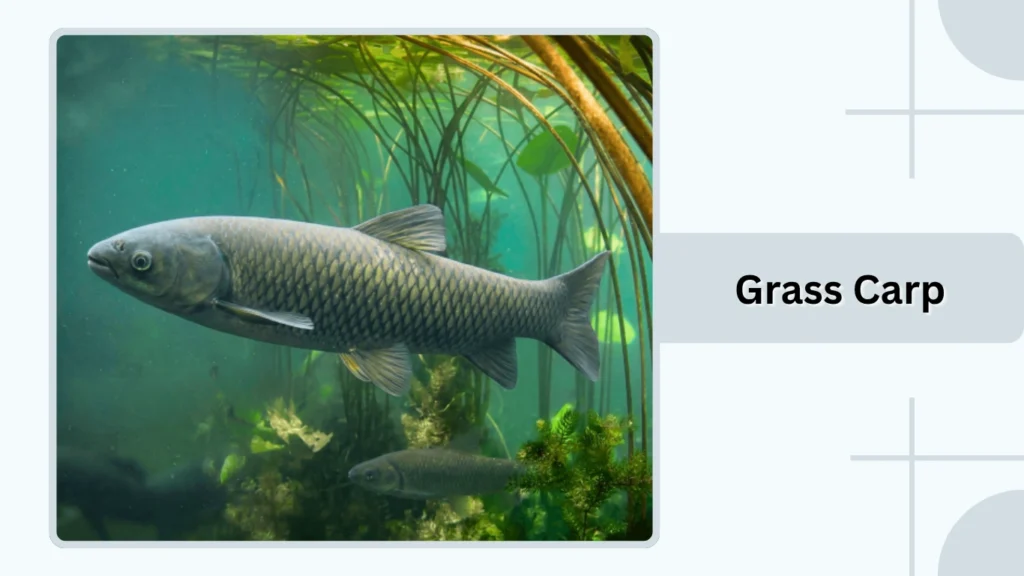
Grass carp are a large freshwater species known for their role in controlling aquatic vegetation. Native to East Asia, they have been widely introduced in many countries for water management purposes. They are herbivorous and play an important role in maintaining balanced aquatic ecosystems.
Identification
- Long, torpedo-shaped body
- Olive to dark green coloration on the back
- Silvery sides and lighter belly
- Large scales with dark edges
- No barbels around the mouth
Habitat
Grass carp prefer large, slow-moving rivers, lakes, and reservoirs with abundant vegetation. They thrive in warm freshwater environments where plant life is plentiful, as it forms the majority of their diet.
Behavior
Unlike most carp, grass carp are primarily herbivores. They feed on aquatic plants and algae, often consuming large amounts daily. They are generally less aggressive feeders and tend to swim in open water rather than staying at the bottom.
Size
Grass carp can grow very large, often reaching lengths of 3 to 4 feet. They commonly weigh between 20 to 40 pounds, but some individuals can exceed 70 pounds under ideal conditions.
Distribution
Originally from East Asia, grass carp have been introduced worldwide, especially in North America and Europe. They are commonly stocked in lakes and ponds to control excessive plant growth and are considered invasive in some regions.
5. Silver Carp
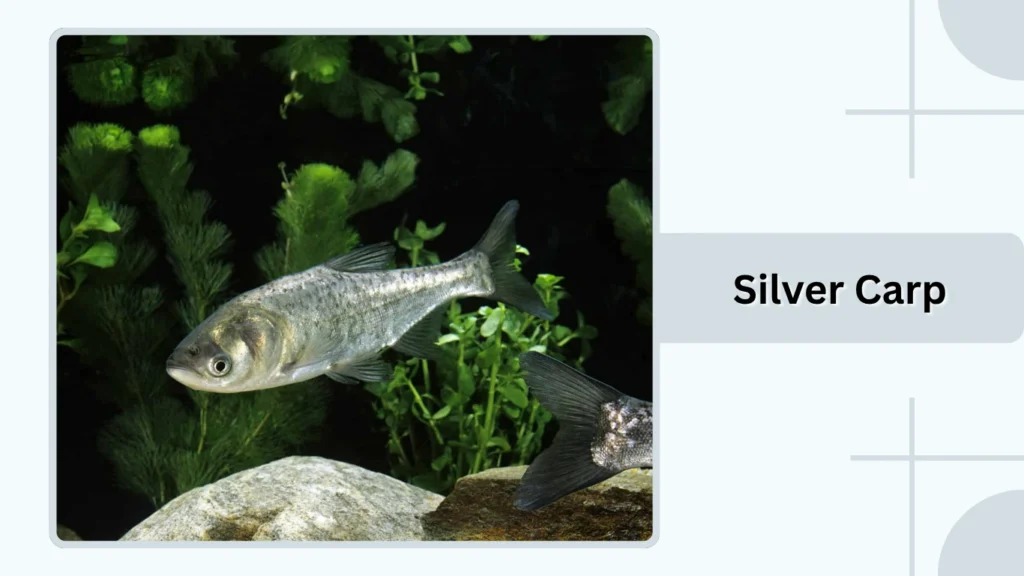
Silver carp are fast-growing freshwater fish known for their filter-feeding behavior. Native to East Asia, they have been widely introduced in many parts of the world. They are especially known for their tendency to jump out of the water when disturbed, making them both unique and challenging to manage.
Identification
- Deep-bodied fish with a laterally compressed shape
- Silver coloration with a lighter underside
- Small scales and smooth appearance
- Large head with eyes positioned low on the head
- No barbels around the mouth
Habitat
Silver carp prefer large rivers, lakes, and reservoirs with slow to moderate water flow. They thrive in nutrient-rich waters where plankton is abundant, as this is their primary food source.
Behavior
Silver carp are filter feeders, consuming plankton by straining water through their gills. They are highly active and are famous for leaping out of the water when startled by noise or boat movement, which can pose risks in some areas.
Size
Silver carp grow rapidly and can reach lengths of up to 3 feet. They commonly weigh between 20 to 40 pounds, though larger individuals have been recorded.
Distribution
Originally native to China, silver carp have been introduced across Asia, North America, and parts of Europe. In some regions, they are considered invasive due to their rapid population growth and impact on native species.
6. Bighead Carp
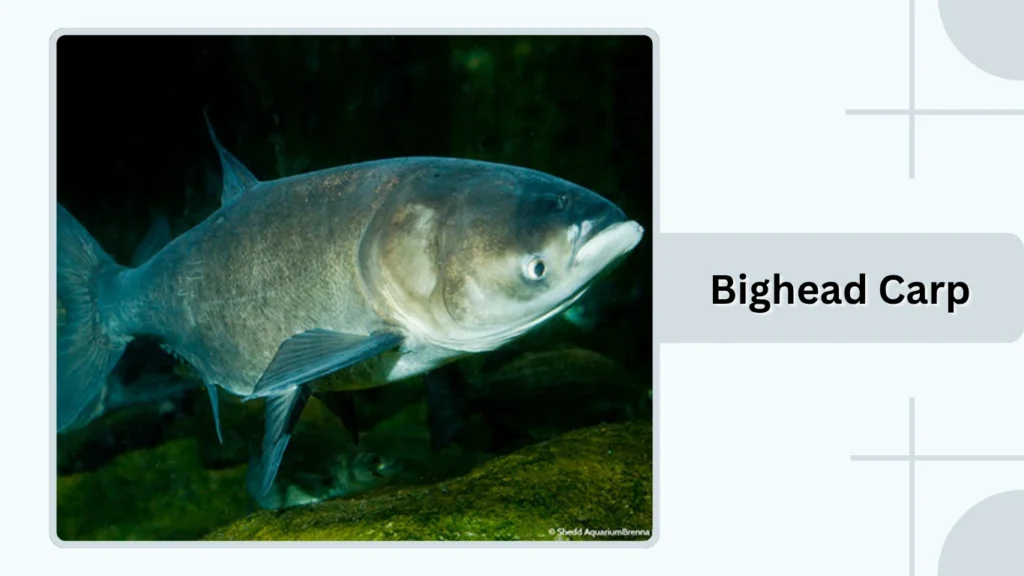
Bighead carp are large freshwater fish closely related to silver carp, known for their massive heads and filter-feeding habits. Native to East Asia, they have been introduced in many regions for aquaculture. They are important for controlling plankton levels but can become invasive in certain ecosystems.
Identification
- Very large head compared to body size
- Gray to dark silver coloration
- Small scales with a smooth body
- Eyes positioned low on the head
- No barbels around the mouth
Habitat
Bighead carp prefer large rivers, lakes, and reservoirs with slow-moving or still water. They thrive in nutrient-rich environments where plankton is abundant.
Behavior
These fish are filter feeders, consuming zooplankton and phytoplankton. They spend much of their time in open water and often swim in groups. Unlike some carp species, they do not feed along the bottom.
Size
Bighead carp can grow extremely large, often reaching weights of 40 to 80 pounds. Some individuals may exceed 100 pounds in ideal conditions, making them one of the largest carp species.
Distribution
Originally from East Asia, bighead carp have been introduced to many countries, including the United States and parts of Europe. In some areas, they are considered invasive due to their rapid growth and competition with native fish species.
7. Crucian Carp
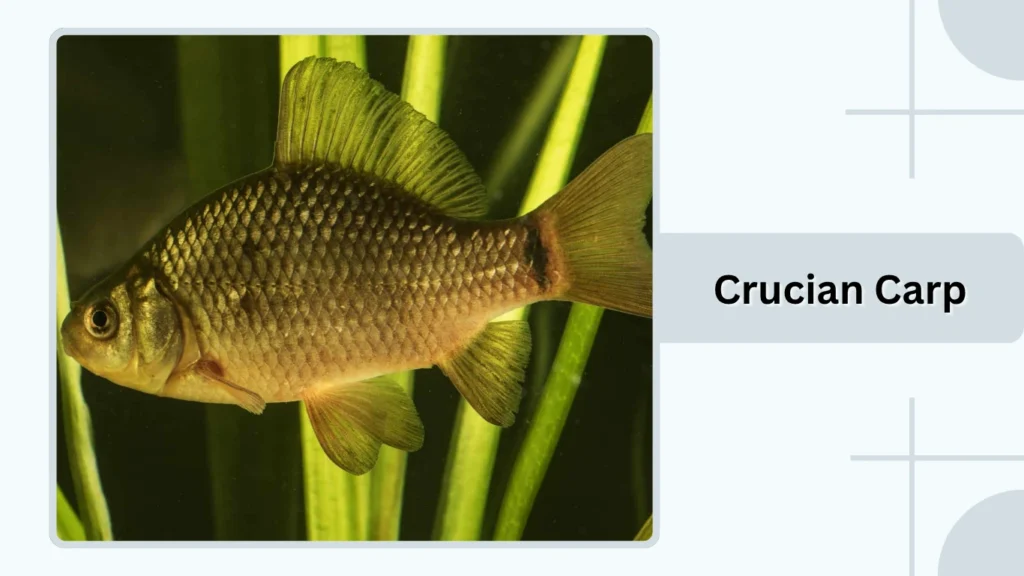
Crucian carp are hardy freshwater fish known for their ability to survive in low-oxygen environments. They are smaller than many other carp species but are highly adaptable, making them common in ponds and slow-moving waters across Europe and Asia.
Identification
- Deep, rounded body shape
- Golden to bronze coloration
- Small, evenly distributed scales
- No barbels around the mouth
- Rounded fins, especially the dorsal fin
Habitat
Crucian carp prefer still or slow-moving waters such as ponds, lakes, and marshes. They can survive in environments with very low oxygen levels, including muddy and heavily vegetated waters where other fish may struggle.
Behavior
These fish are omnivorous and feed on small invertebrates, plant matter, and organic debris. They are known for their remarkable ability to tolerate harsh conditions, even surviving in frozen ponds by slowing their metabolism.
Size
Crucian carp are relatively small compared to other carp species. They typically grow to about 6 to 12 inches in length and weigh a few pounds, although larger specimens can occasionally be found.
Distribution
Crucian carp are native to Europe and parts of Asia. They have been introduced to other regions but are most commonly found in their native range, where they are valued for both recreational fishing and ecological resilience.
8. Koi Carp
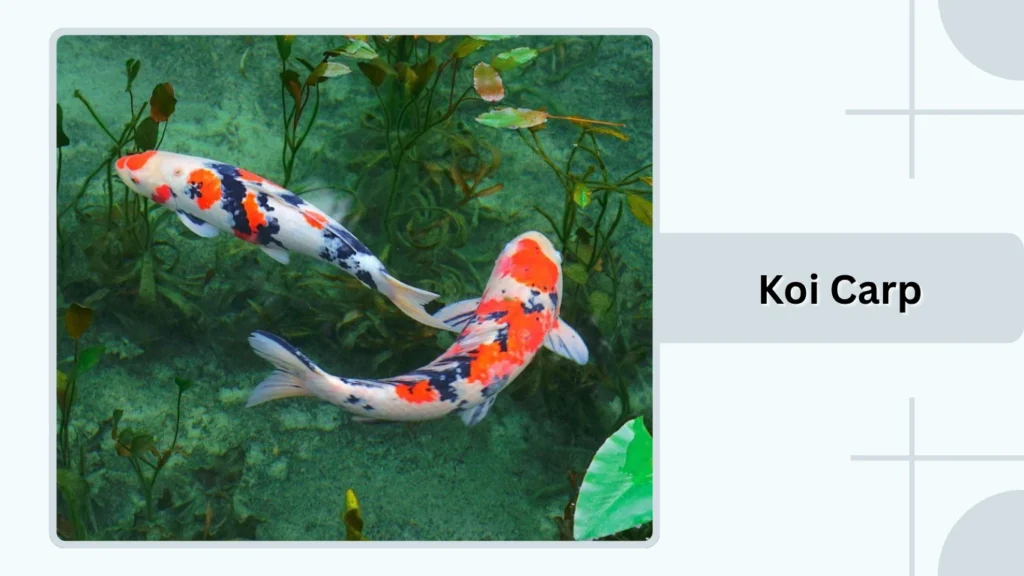
Koi carp are ornamental varieties of common carp, famous for their vibrant colors and patterns. Originally bred in Japan, they are widely kept in decorative ponds and are admired for their beauty and symbolic meaning in many cultures.
Identification
- Bright, multi-colored patterns (white, red, orange, black, yellow)
- Smooth, symmetrical body shape
- Large, visible scales
- Two pairs of barbels near the mouth
- Long, flowing fins in some varieties
Habitat
Koi carp are typically found in artificial ponds, garden water features, and controlled freshwater environments. They require clean, well-oxygenated water and are often maintained in managed conditions rather than wild habitats.
Behavior
Koi are calm and social fish, often interacting with humans, especially when fed regularly. They are omnivorous and eat a variety of foods, including pellets, plants, insects, and small aquatic organisms.
Size
Koi carp can grow quite large under proper care, commonly reaching lengths of 24 to 36 inches. Some high-quality specimens may grow even larger in optimal pond conditions.
Distribution
Although originally developed in Japan, koi carp are now found worldwide in ornamental ponds and aquaculture systems. They are not typically considered wild fish but are globally popular in decorative settings.
9. Amur Carp
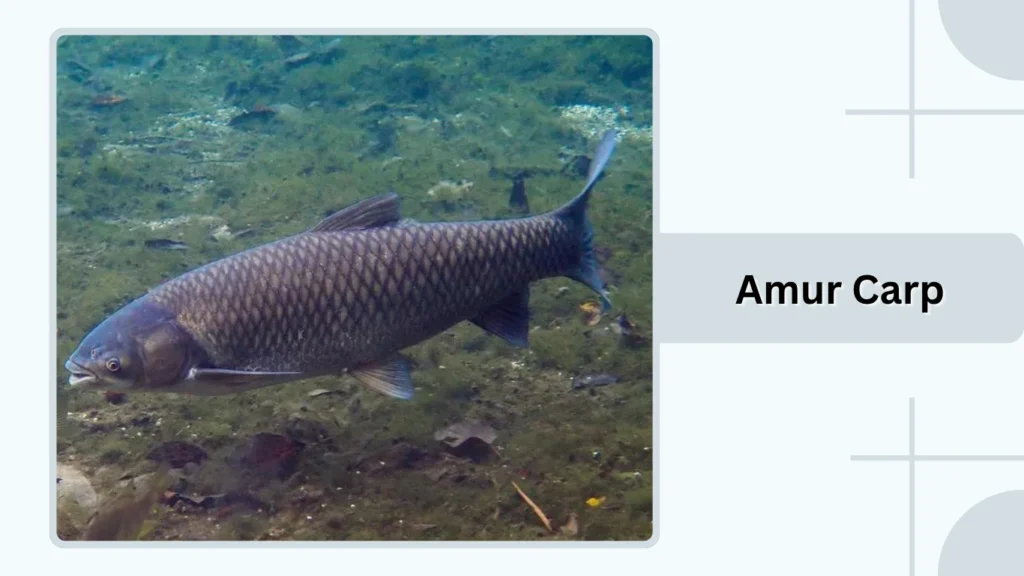
Amur carp is another name often used for the wild form of common carp found in the Amur River basin. It is known for its adaptability, strength, and importance in both natural ecosystems and fisheries. This carp is closely related to domesticated varieties but retains more natural traits.
Identification
- Streamlined, elongated body
- Bronze to dark brown coloration
- Fully covered with regular, uniform scales
- Two pairs of barbels near the mouth
- Strong, forked tail fin
Habitat
Amur carp inhabit large rivers, floodplains, and connected lakes. They prefer slow-moving or still waters with muddy or sandy bottoms where food is abundant.
Behavior
These carp are bottom feeders, consuming a mix of plant material, insects, and small aquatic organisms. They are strong swimmers and often migrate within river systems, especially during spawning periods.
Size
Amur carp can grow quite large, typically reaching lengths of 2 to 3 feet. In favorable conditions, they may exceed 40 pounds, similar to other wild carp populations.
Distribution
Native to the Amur River region between Russia and China, this carp has spread to other areas through natural movement and human introduction. It is now found in various freshwater systems across Asia and beyond.
10. Black Carp
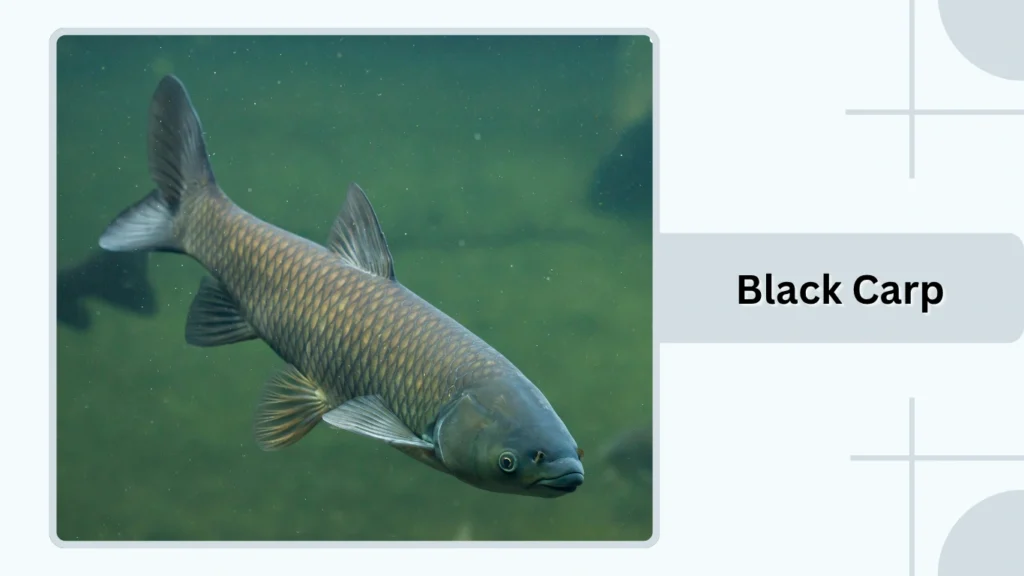
Black carp are large freshwater fish known for their strong jaws and specialized diet. Native to East Asia, they are often introduced to control populations of snails and other mollusks. Their powerful feeding ability makes them unique among carp species.
Identification
- Dark gray to black coloration
- Long, cylindrical body shape
- Large, strong pharyngeal teeth (for crushing shells)
- Small scales with a smooth appearance
- No barbels around the mouth
Habitat
Black carp prefer large rivers, lakes, and reservoirs with slow-moving water. They are commonly found in deeper areas where their preferred prey, such as snails and clams, are abundant.
Behavior
Unlike many carp species, black carp primarily feed on mollusks. They use their strong teeth to crush shells and consume the soft tissue inside. They are generally less active feeders compared to filter-feeding carp.
Size
Black carp can grow very large, often reaching lengths of up to 5 feet. They commonly weigh between 30 to 70 pounds, though larger specimens have been recorded.
Distribution
Originally native to China and neighboring regions, black carp have been introduced to other parts of the world, including North America. In some areas, they are considered invasive due to their impact on native mollusk populations.
11. Rohu
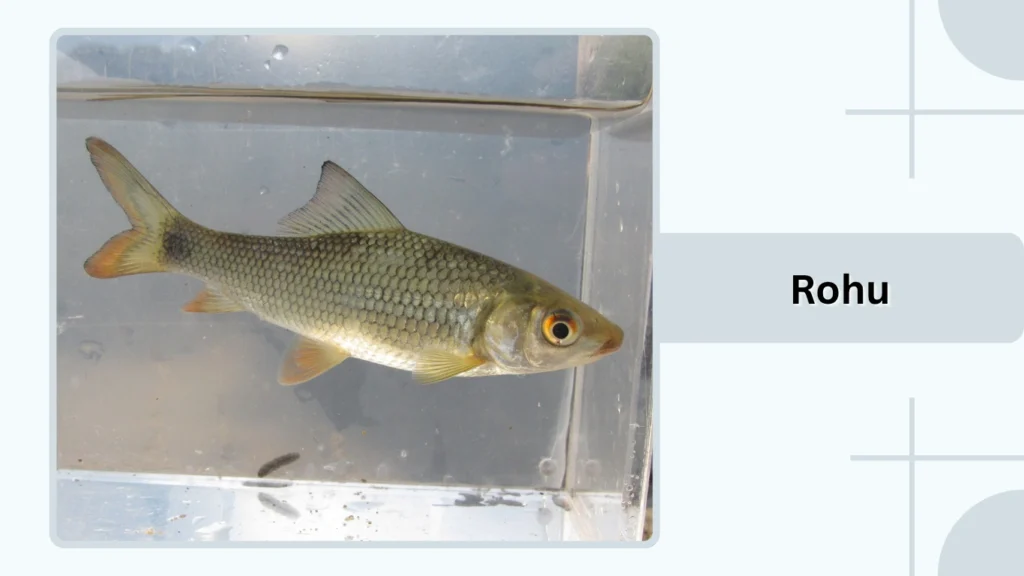
Rohu is one of the most important freshwater carp species in South Asia, widely known for its role in aquaculture and as a popular food fish. It is native to rivers and lakes of the Indian subcontinent and is valued for its fast growth and good taste.
Identification
- Elongated body with a slightly arched back
- Silvery body with a bluish or dark upper side
- Large, distinct scales
- Small head with a slightly downturned mouth
- No barbels around the mouth
Habitat
Rohu prefers rivers, reservoirs, and large ponds with warm freshwater. It thrives in environments with moderate water flow and abundant natural food sources.
Behavior
This species is mainly a column feeder, feeding in mid-water rather than at the bottom. It consumes plant material, algae, and small organisms. Rohu is often cultured alongside other carp species in polyculture systems.
Size
Rohu can grow quite large, typically reaching lengths of 2 to 3 feet. Under good conditions, it may weigh between 10 to 20 pounds or more.
Distribution
Rohu is native to countries like India, Bangladesh, Pakistan, and Nepal. Due to its economic importance, it has been introduced to other regions for aquaculture purposes.
12. Catla
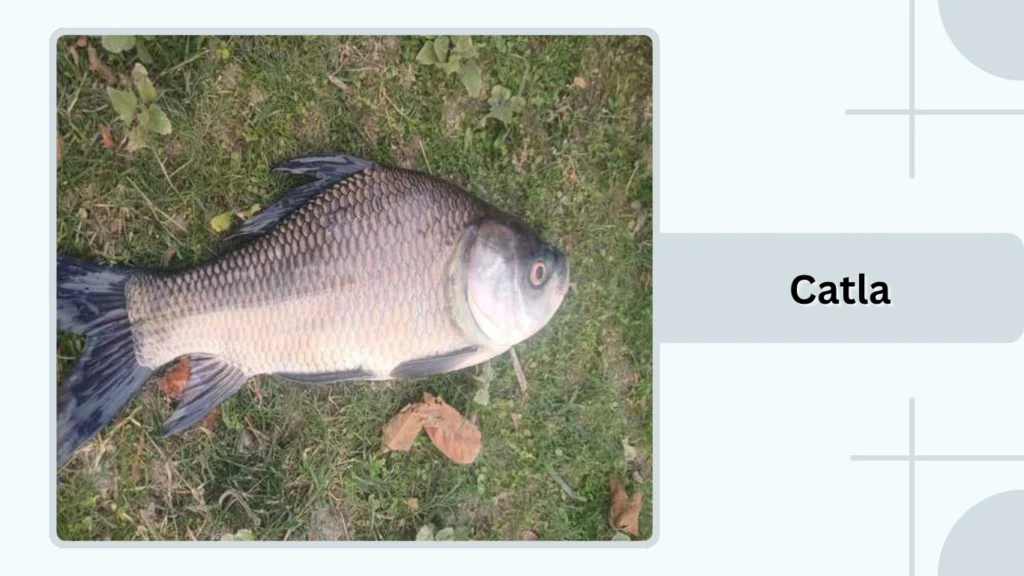
Catla is a major carp species widely cultivated in South Asia, especially in India and Bangladesh. It is known for its fast growth rate and importance in freshwater aquaculture. Catla is easily recognized by its large head and upward-facing mouth.
Identification
- Large, broad head with a prominent forehead
- Deep-bodied fish with a slightly compressed shape
- Silvery body with a darker upper side
- Large scales covering the body
- Upturned mouth without barbels
Habitat
Catla prefers large rivers, lakes, and reservoirs with plenty of open water. It thrives in warm freshwater environments and is commonly raised in fish farms and ponds.
Behavior
Catla is primarily a surface feeder, consuming plankton and organic matter from the upper layers of water. It often swims in groups and is commonly cultured with other carp species in aquaculture systems.
Size
Catla grows rapidly and can reach impressive sizes. It commonly attains lengths of 3 to 4 feet and can weigh between 20 to 40 pounds under ideal conditions.
Distribution
Catla is native to the Indian subcontinent, including India, Bangladesh, Nepal, and Pakistan. It has been introduced to other countries for aquaculture due to its high commercial value.
13. Mrigal
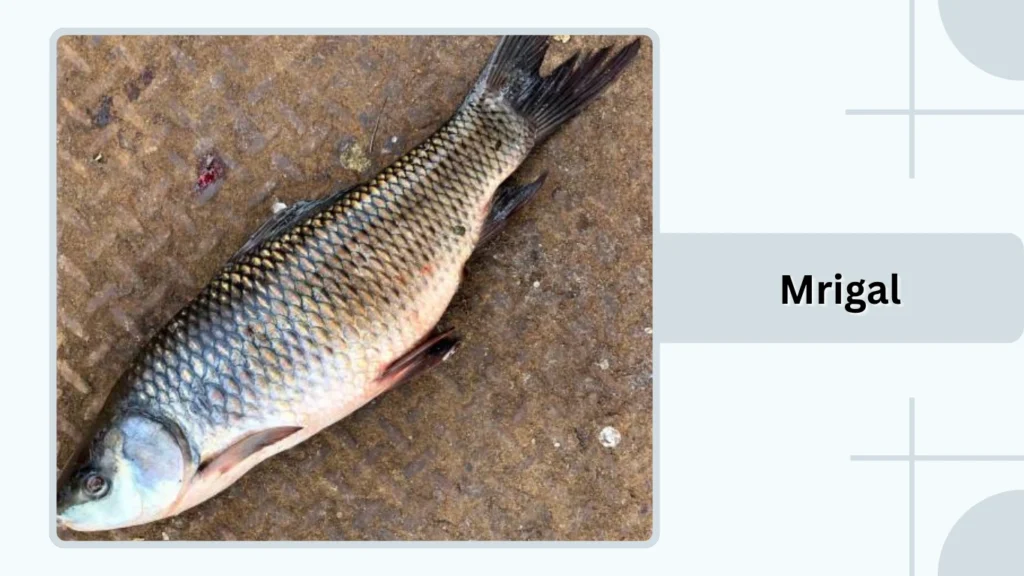
Mrigal is a widely cultivated carp species in South Asia and is an important part of freshwater aquaculture systems. It is commonly raised alongside rohu and catla in polyculture farming due to its feeding habits and steady growth rate.
Identification
- Elongated, streamlined body
- Silvery coloration with a darker back
- Medium-sized, evenly spaced scales
- Small head with a slightly downward-facing mouth
- No barbels around the mouth
Habitat
Mrigal prefers rivers, canals, and ponds with soft bottoms. It thrives in warm freshwater environments and is commonly found in managed fish farms as well as natural water bodies.
Behavior
This species is a bottom feeder, feeding mainly on detritus, organic matter, and small organisms found in the sediment. Its feeding behavior complements other carp species in aquaculture systems.
Size
Mrigal typically grows to about 1.5 to 3 feet in length. It usually weighs between 5 to 15 pounds, though larger sizes are possible under optimal farming conditions.
Distribution
Mrigal is native to the Indian subcontinent, including India, Bangladesh, and Nepal. It has also been introduced to other regions for aquaculture due to its economic importance.
14. Golden Carp
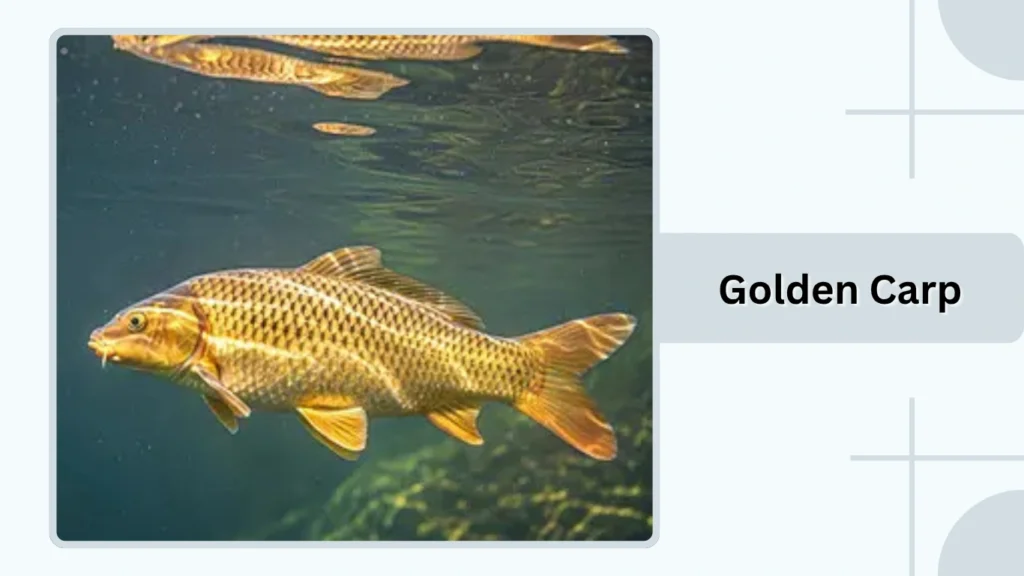
Golden carp are a visually striking variety of carp known for their bright golden or yellow coloration. They are often found in ornamental settings but can also exist in the wild as a color variation of common carp. Their appearance makes them popular among fish enthusiasts.
Identification
- Bright golden to yellow body color
- Smooth, elongated body shape
- Medium to large scales
- Two pairs of barbels near the mouth
- Slightly lighter underside
Habitat
Golden carp inhabit freshwater environments such as ponds, lakes, and slow-moving rivers. They are commonly found in both natural waters and decorative ponds where water conditions are stable.
Behavior
Like other carp, golden carp are omnivorous bottom feeders. They search for food in the sediment, consuming plant matter, insects, and small aquatic organisms. They are generally calm and adaptable.
Size
Golden carp can grow to sizes similar to common carp, typically reaching 2 to 3 feet in length. In favorable conditions, they may weigh over 20 pounds.
Distribution
Golden carp are found worldwide, mainly due to selective breeding and introduction. They are especially popular in Asia and Europe, both in the wild and in ornamental fish keeping.
15. Wild Carp
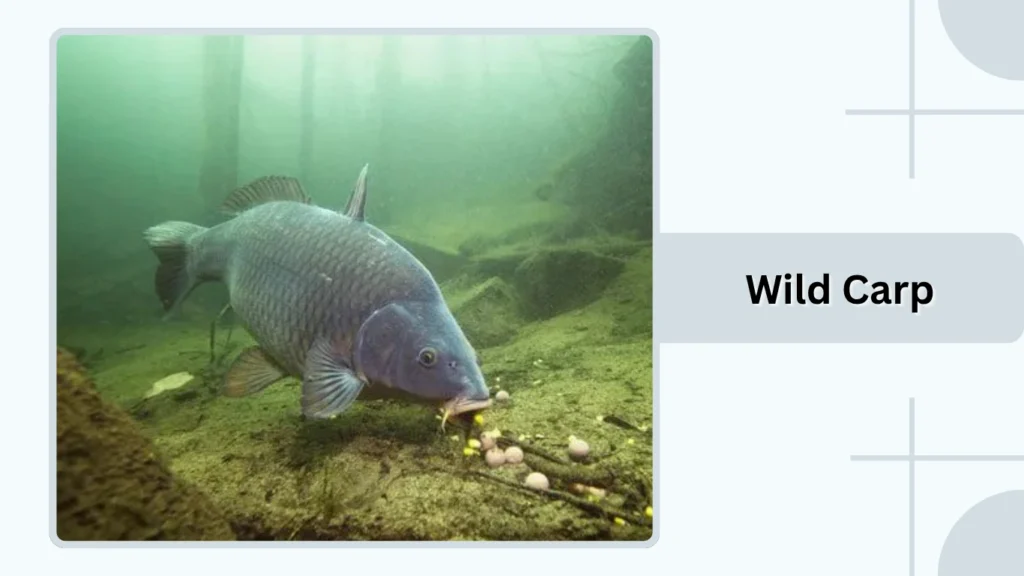
Wild carp refer to naturally occurring populations of common carp that have not been selectively bred. They are typically more streamlined and hardy than domesticated varieties, making them well-adapted to natural environments and survival in the wild.
Identification
- Streamlined, torpedo-shaped body
- Bronze to dark brown coloration
- Fully covered with regular, uniform scales
- Two pairs of barbels near the mouth
- Strong and muscular build
Habitat
Wild carp are found in rivers, lakes, floodplains, and reservoirs. They prefer slow-moving or still waters with muddy or sandy bottoms where food is abundant.
Behavior
These carp are bottom feeders and are often more cautious than domesticated varieties. They feed on plant material, insects, and small aquatic organisms, usually becoming more active during low-light conditions.
Size
Wild carp can grow large, often reaching lengths of 2 to 3 feet. In ideal conditions, they may weigh between 20 to 40 pounds or more.
Distribution
Wild carp are found across Europe, Asia, and many introduced regions worldwide. They have spread widely due to human activity and are considered invasive in some ecosystems.
16. Israeli Carp
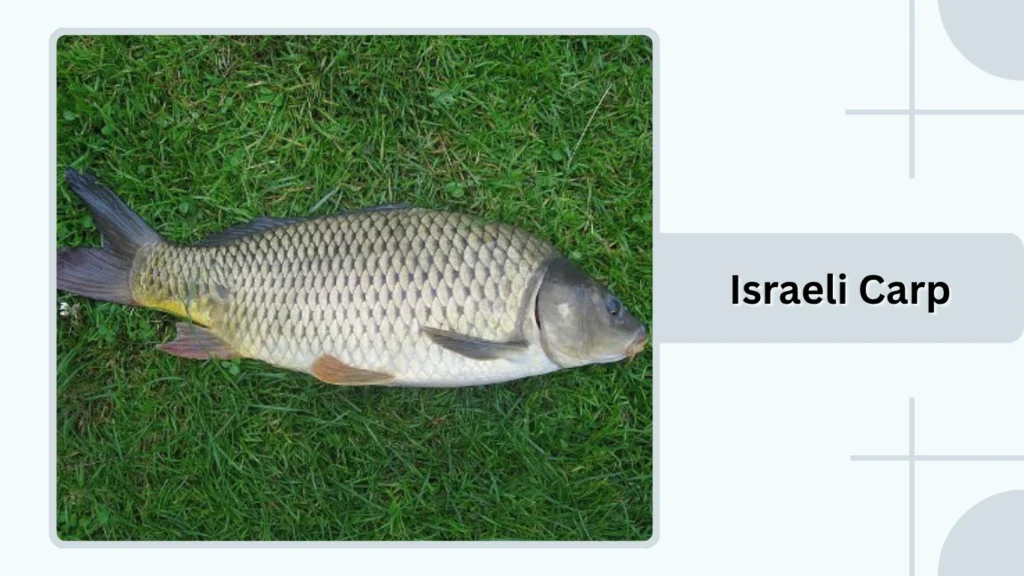
Israeli carp is a selectively bred strain of common carp developed for aquaculture. It is valued for its fast growth, adaptability, and resistance to disease. This variety is widely farmed for food production and is known for performing well in controlled environments.
Identification
- Deep-bodied and slightly rounded shape
- Silver to gray coloration with a lighter belly
- Regular, evenly distributed scales
- Two pairs of barbels near the mouth
- Thick and muscular body structure
Habitat
Israeli carp are commonly found in fish farms, ponds, and managed freshwater systems. They prefer warm, still or slow-moving waters with good oxygen levels. While primarily raised in aquaculture, they can also survive in natural lakes and reservoirs.
Behavior
These carp are active bottom feeders, consuming a mix of plant material, algae, and small aquatic organisms. They are known for their adaptability and ability to thrive in high-density farming conditions, making them ideal for commercial fish production.
Size
Israeli carp grow quickly under proper conditions. They typically reach weights of 10 to 20 pounds within a few years, though larger individuals can develop in optimal environments.
Distribution
Originally developed in Israel through selective breeding programs, this carp variety is now widely distributed across Asia, Europe, and parts of Africa. It is mainly found in aquaculture systems rather than wild populations.
17. Siamese Carp
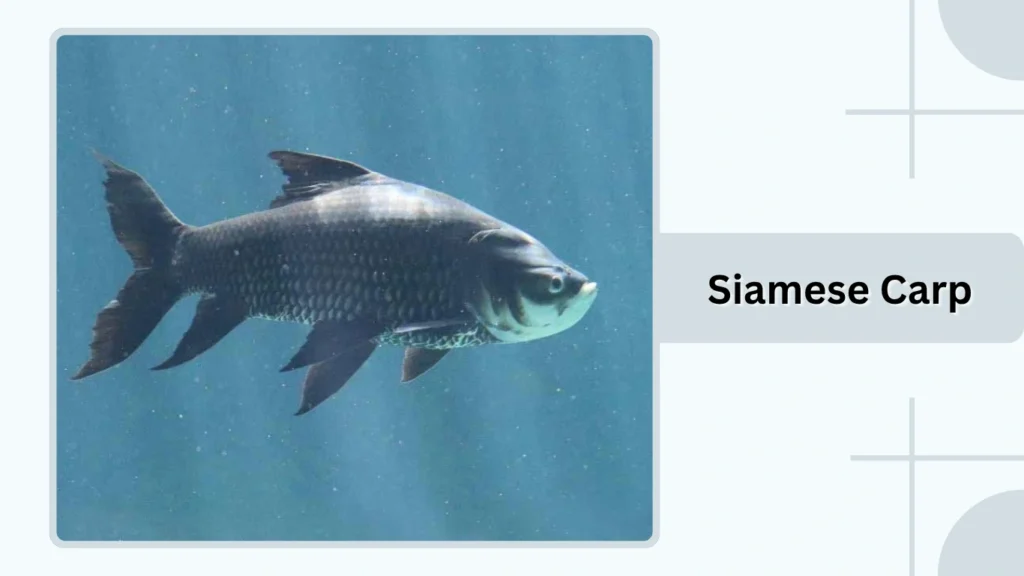
Siamese carp is one of the largest freshwater fish species in the world and is highly valued in Southeast Asia. Native to the Mekong River basin, it plays an important role in local fisheries and ecosystems. Due to overfishing and habitat loss, it is now considered a rare species in the wild.
Identification
- Very large, thick-bodied fish
- Dark gray to bronze coloration
- Smooth appearance with relatively small scales
- Large head with a broad mouth
- No barbels around the mouth
Habitat
Siamese carp inhabit large rivers, floodplains, and connected lakes. They prefer deep waters with seasonal flooding, which provides access to feeding and breeding grounds. During the rainy season, they migrate into flooded forests and wetlands.
Behavior
This species is primarily herbivorous, feeding on aquatic plants, fruits, and vegetation. It is known to migrate long distances in search of food and suitable spawning areas. Siamese carp are generally slow-moving but powerful swimmers.
Size
Siamese carp can grow to exceptional sizes, often exceeding 5 feet in length. Some individuals have been recorded weighing over 200 pounds, making them one of the heaviest freshwater fish species.
Distribution
Native to Southeast Asia, especially the Mekong River system in countries like Thailand, Laos, Cambodia, and Vietnam. Due to declining populations, they are now protected in many areas and are rarely found outside their native range.
18. Mud Carp
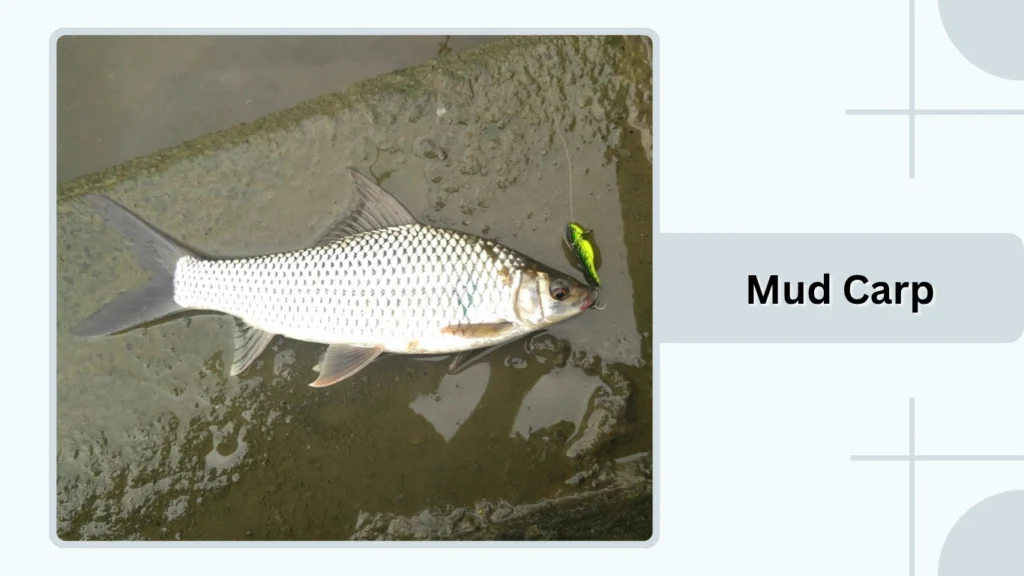
Mud carp are small to medium-sized freshwater fish commonly found in Asia. They are an important species in traditional aquaculture and are well known for their ability to thrive in muddy, low-oxygen environments. Mud carp are widely consumed and valued for their steady growth and adaptability.
Identification
- Slender, elongated body
- Gray to brownish coloration
- Small, smooth scales
- Slightly downturned mouth
- No barbels around the mouth
Habitat
Mud carp prefer shallow, slow-moving waters such as ponds, canals, rice fields, and small rivers. They are highly tolerant of poor water conditions, including muddy environments and low oxygen levels, which makes them suitable for rural aquaculture systems.
Behavior
These carp are bottom and mid-water feeders, consuming organic matter, algae, and small aquatic organisms. They are generally calm and can survive in crowded conditions, making them ideal for traditional fish farming practices.
Size
Mud carp are relatively small compared to other carp species. They typically grow to about 12 to 24 inches in length and weigh between 2 to 6 pounds, depending on environmental conditions.
Distribution
Mud carp are native to East and Southeast Asia, including China and Vietnam. They have been introduced to other regions for aquaculture and are commonly found in managed freshwater systems rather than wild habitats.
19. Olive Barb
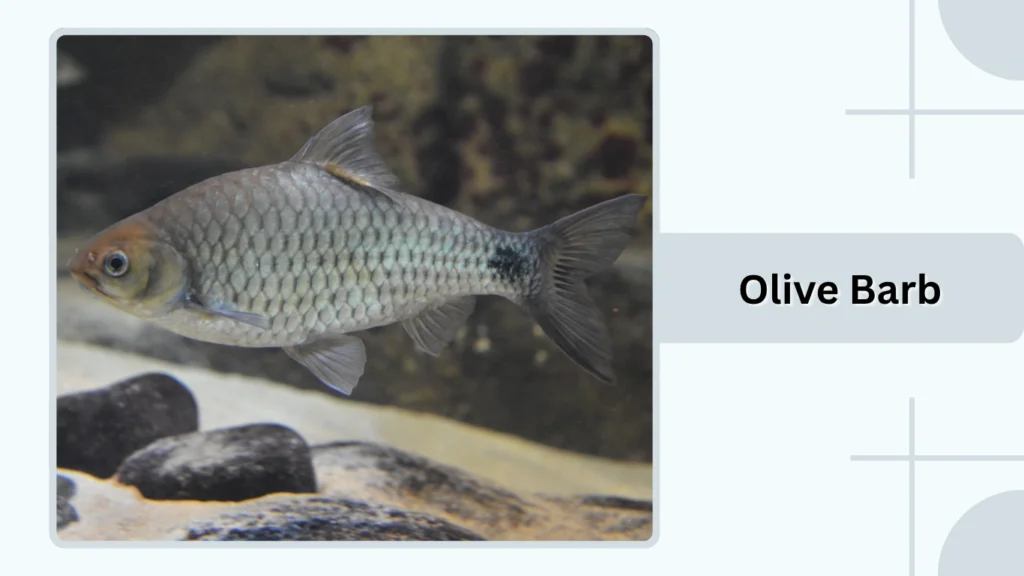
Olive barb is a freshwater carp species known for its hardy nature and adaptability. It is commonly found in rivers and ponds across South and Southeast Asia. This species is valued both as a food fish and for its role in small-scale aquaculture.
Identification
- Elongated body with a slightly compressed shape
- Olive-green to brownish coloration
- Faint vertical markings along the body
- Medium-sized scales
- Small mouth with short barbels
Habitat
Olive barb inhabits rivers, streams, ponds, and floodplains. It prefers slow to moderately flowing waters with vegetation and soft substrates. It can tolerate a range of environmental conditions, including seasonal changes in water levels.
Behavior
This species is omnivorous, feeding on algae, plant matter, insects, and small aquatic organisms. It is active and often found in small groups, especially in natural water bodies.
Size
Olive barb is a medium-sized fish, typically growing to about 10 to 18 inches in length. Under favorable conditions, it may reach slightly larger sizes.
Distribution
Olive barb is native to countries such as India, Bangladesh, Myanmar, and Thailand. It is widely distributed in South and Southeast Asia and is commonly found in both wild and farmed environments.
20. Java Barb
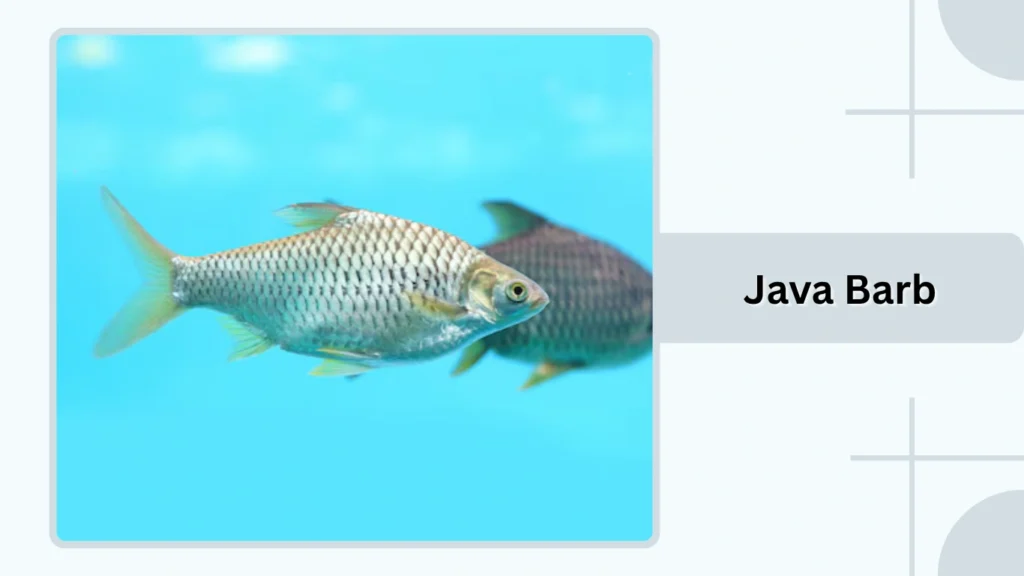
Java barb is a popular freshwater carp species widely found in Southeast Asia. It is known for its adaptability, fast growth, and importance in both aquaculture and local fisheries. This species is often raised in ponds and is valued as a food fish.
Identification
- Slender, elongated body
- Silver to golden coloration with a darker back
- Medium-sized, smooth scales
- Slightly forked tail
- Small mouth with short barbels
Habitat
Java barb thrives in rivers, lakes, ponds, and floodplains. It prefers warm freshwater environments with slow to moderate water flow. This species is commonly found in both natural waters and fish farming systems.
Behavior
Java barb is an active and social fish, often moving in groups. It feeds on a variety of food sources, including algae, plant matter, insects, and small aquatic organisms. Its adaptability makes it suitable for different environmental conditions.
Size
Java barb typically grows to about 12 to 24 inches in length. Under good conditions, it may weigh between 3 to 8 pounds, though sizes can vary depending on habitat and feeding.
Distribution
Native to Southeast Asia, Java barb is commonly found in Indonesia, Thailand, and neighboring countries. It has also been introduced to other regions for aquaculture and is widely farmed due to its economic value.
21. Tinfoil Barb
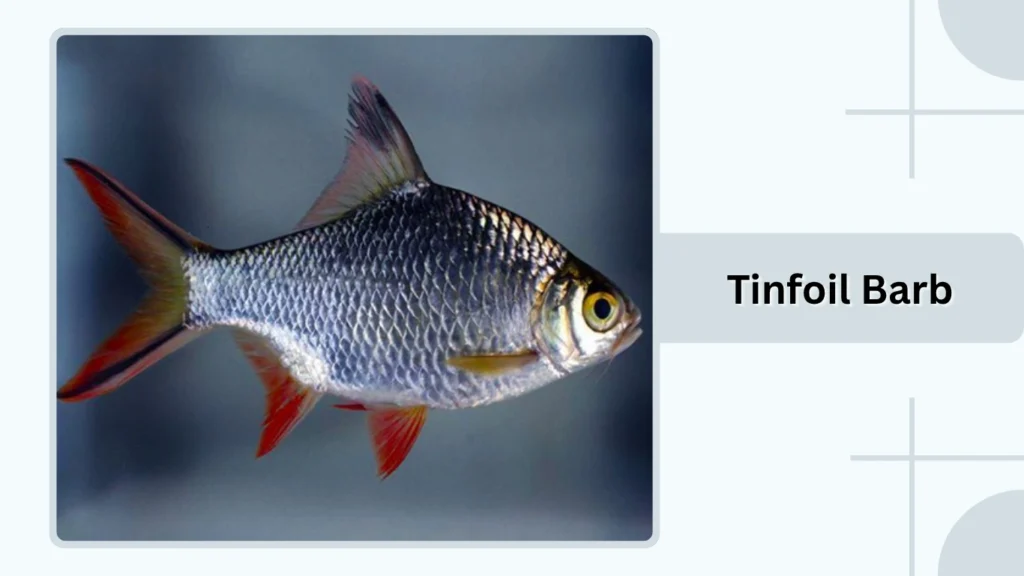
Tinfoil barb is a large, active freshwater carp species known for its shiny, metallic appearance. It is popular both in aquaculture and the aquarium trade due to its attractive look and fast growth. Despite its beauty, it grows quite large and is best suited for spacious environments.
Identification
- Bright silver, reflective body resembling tin foil
- Reddish or orange fins, especially on the tail and dorsal fin
- Streamlined, elongated body shape
- Large, visible scales
- Small mouth without prominent barbels
Habitat
Tinfoil barb is commonly found in rivers, lakes, and floodplains with moderate to fast water flow. It prefers clean, well-oxygenated water and is often seen in open areas rather than dense vegetation.
Behavior
This species is highly active and social, often swimming in schools. It feeds on plant matter, algae, and small invertebrates. Due to its energetic nature, it requires plenty of space, especially in captivity.
Size
Tinfoil barb can grow quite large, typically reaching lengths of 18 to 28 inches. In ideal conditions, it may weigh several pounds, making it one of the larger barb species.
Distribution
Native to Southeast Asia, including Thailand, Malaysia, and Indonesia, tinfoil barb has been introduced to other regions. It is commonly found in both wild habitats and aquaculture systems, as well as in large home aquariums.
22. Silver Barb
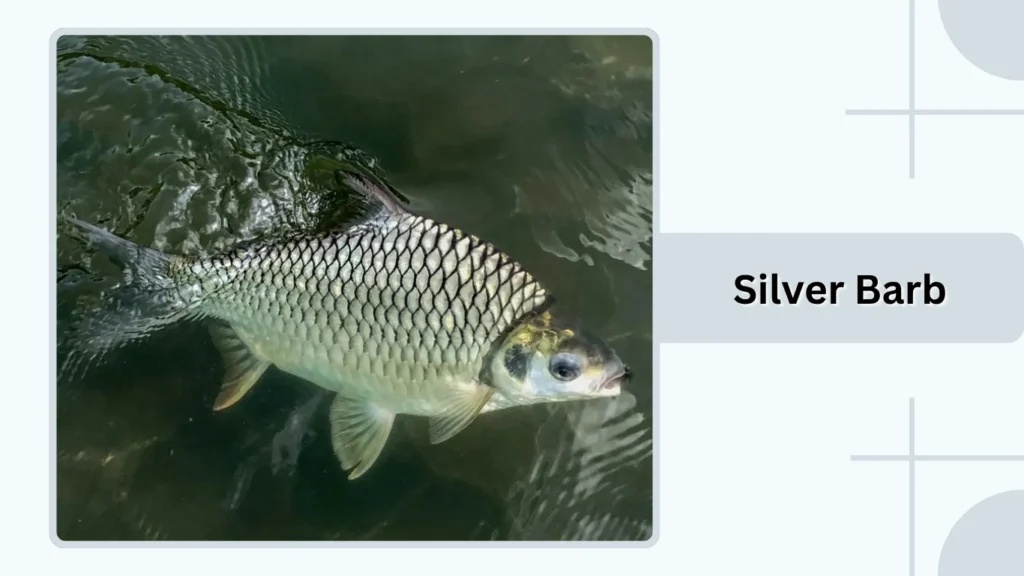
Silver barb is a widely farmed freshwater carp species known for its fast growth and economic importance. It is commonly raised in aquaculture across Asia and is valued as a food fish due to its adaptability and high productivity.
Identification
- Silver, shiny body with a slightly compressed shape
- Medium-sized scales
- Forked tail fin
- Small head with a slightly downturned mouth
- Short barbels present near the mouth
Habitat
Silver barb thrives in ponds, lakes, canals, and slow-moving rivers. It prefers warm freshwater environments and is commonly found in both natural habitats and fish farming systems.
Behavior
This species is omnivorous, feeding on algae, plant material, and small aquatic organisms. It is active and often swims in groups, especially in open water areas.
Size
Silver barb typically grows to about 12 to 20 inches in length. In aquaculture conditions, it can reach market size quickly, usually weighing between 2 to 6 pounds.
Distribution
Silver barb is native to Southeast Asia, including Thailand, Cambodia, and Vietnam. It has been introduced to many other regions for aquaculture due to its fast growth and high demand as a food fish.
23. Goldfish
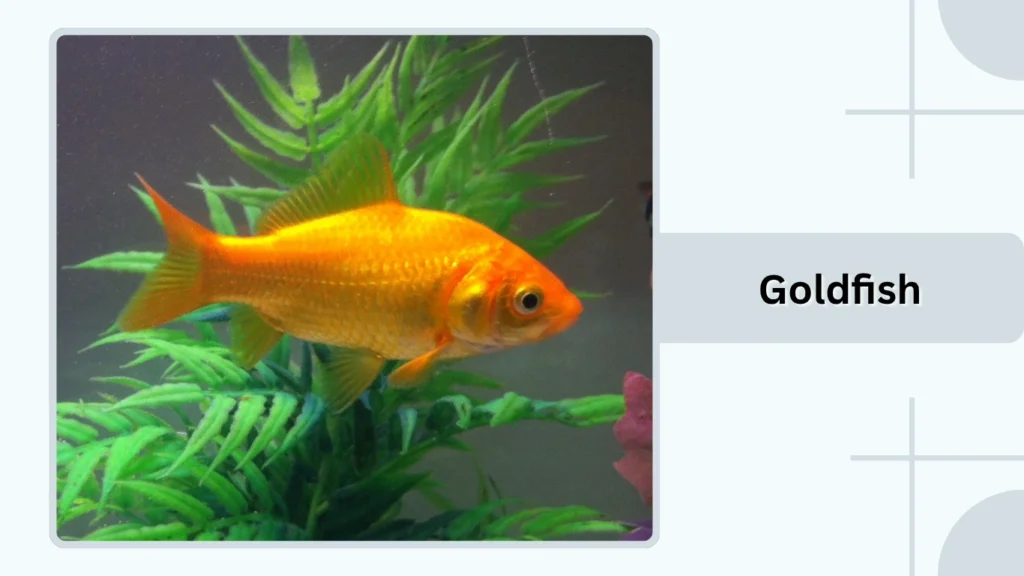
Goldfish are one of the most well-known ornamental carp species, originally developed from the Prussian carp. They are popular worldwide for aquariums and ponds due to their bright colors, variety of shapes, and ease of care.
Identification
- Bright orange, gold, white, or mixed coloration
- Rounded or elongated body depending on variety
- Flowing fins in ornamental types
- Small scales with smooth texture
- No barbels around the mouth
Habitat
Goldfish are commonly kept in aquariums, garden ponds, and controlled freshwater environments. In the wild, they can survive in slow-moving waters such as ponds, lakes, and canals.
Behavior
Goldfish are active and social fish that adapt well to different conditions. They are omnivorous, feeding on plant matter, insects, and commercial fish food. They can also become quite interactive in captivity.
Size
Goldfish size varies widely depending on the variety. While many remain small in aquariums, they can grow up to 12 to 16 inches or more in large ponds or natural environments.
Distribution
Originally bred in China, goldfish are now found worldwide. They are common in ornamental settings but have also established wild populations in some regions where they are considered invasive.
24. Prussian Carp
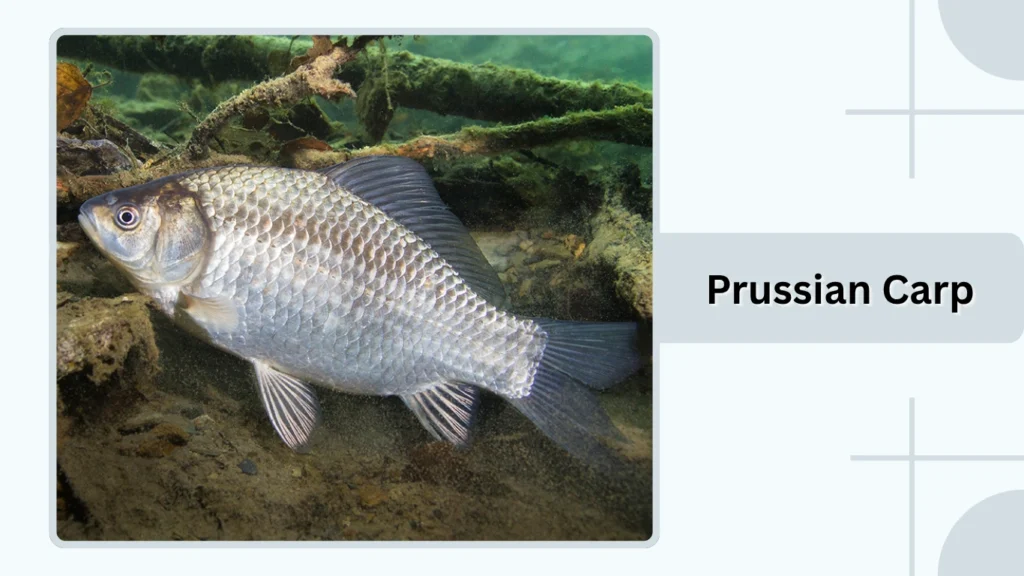
Prussian carp are a hardy freshwater species closely related to goldfish and crucian carp. They are known for their ability to reproduce rapidly and survive in difficult environmental conditions. Because of this, they are often considered invasive in many regions.
Identification
- Deep, rounded body shape
- Gray to greenish-bronze coloration
- Small, closely packed scales
- No barbels around the mouth
- Slightly forked tail fin
Habitat
Prussian carp thrive in a wide range of freshwater habitats, including ponds, lakes, rivers, and wetlands. They can survive in low-oxygen waters and tolerate pollution better than many other fish species.
Behavior
This species is omnivorous and feeds on plant material, insects, and small aquatic organisms. Prussian carp are known for their unique reproductive ability, often reproducing without males in some populations, which helps them spread quickly.
Size
Prussian carp are generally medium-sized fish, typically growing between 8 to 16 inches in length. In favorable conditions, they may grow larger, reaching weights of several pounds.
Distribution
Originally native to Europe and Asia, Prussian carp have spread widely across North America and other regions. Due to their rapid reproduction and adaptability, they are considered invasive in many ecosystems.
25. Thai Carp
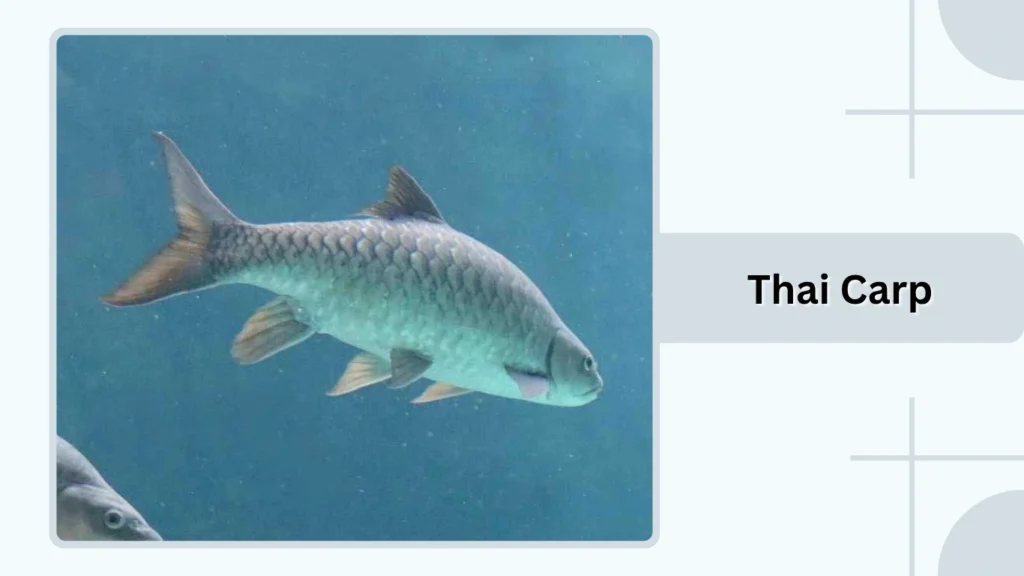
Thai carp is a commonly used name for several carp species found in Thailand, often referring to fast-growing, farmed varieties used in aquaculture. These fish are valued for their adaptability, good taste, and importance in local fisheries.
Identification
- Medium to large, elongated body
- Silver to gray coloration with darker back
- Smooth, medium-sized scales
- Slightly forked tail
- Small mouth with short barbels
Habitat
Thai carp are typically found in rivers, ponds, canals, and floodplains. They thrive in warm freshwater environments and are commonly raised in fish farms due to their adaptability to different water conditions.
Behavior
These carp are omnivorous and feed on a mix of plant material, algae, and small aquatic organisms. They are active swimmers and often move in groups, especially in open water areas.
Size
Thai carp can grow to moderate sizes, usually reaching 12 to 24 inches in length. In aquaculture systems, they may reach market size quickly depending on feeding and environmental conditions.
Distribution
Thai carp are mainly found in Thailand and surrounding Southeast Asian countries. They are widely used in aquaculture and have been introduced to other regions for fish farming purposes.
26. Indian Carp
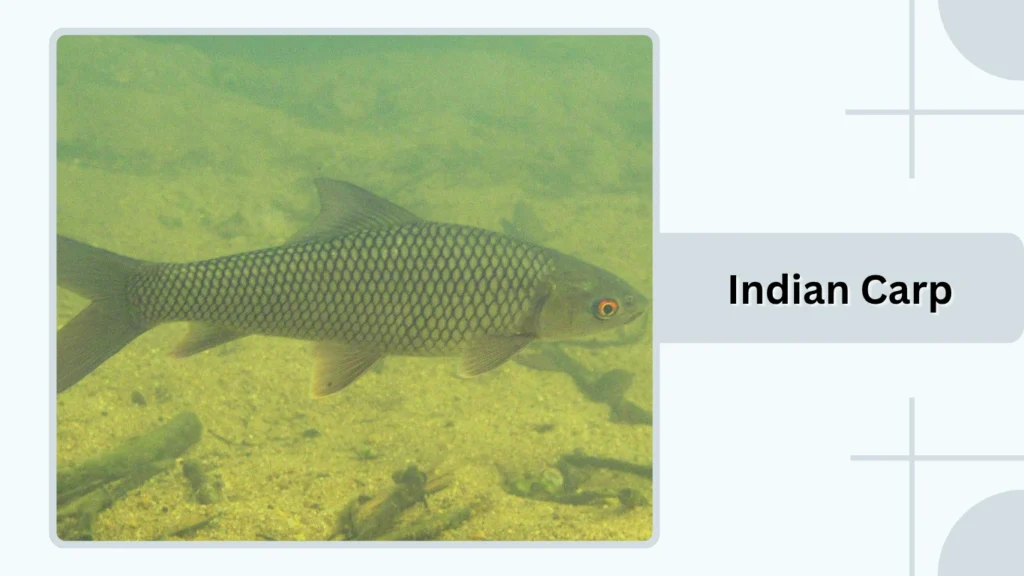
Indian carp is a general term used for major carp species native to the Indian subcontinent, including rohu, catla, and mrigal. These fish are widely farmed and play a crucial role in freshwater aquaculture due to their fast growth and high demand as food fish.
Identification
- Medium to large body size depending on species
- Silver to gray coloration with darker upper side
- Smooth, visible scales
- Body shape varies from elongated to deep-bodied
- Usually no prominent barbels (varies by species)
Habitat
Indian carp are commonly found in rivers, reservoirs, ponds, and floodplains. They prefer warm freshwater environments and are widely raised in managed aquaculture systems across South Asia.
Behavior
These carp species have different feeding habits, including surface, column, and bottom feeding. This makes them ideal for polyculture farming, where multiple species are raised together without competing heavily for food.
Size
Indian carp can grow quite large depending on the species. Many reach lengths of 2 to 4 feet and can weigh between 10 to 40 pounds under optimal conditions.
Distribution
Indian carp are native to countries like India, Bangladesh, Nepal, and Pakistan. Due to their economic importance, they have been introduced to other parts of Asia and beyond for aquaculture.
27. Chinese Carp
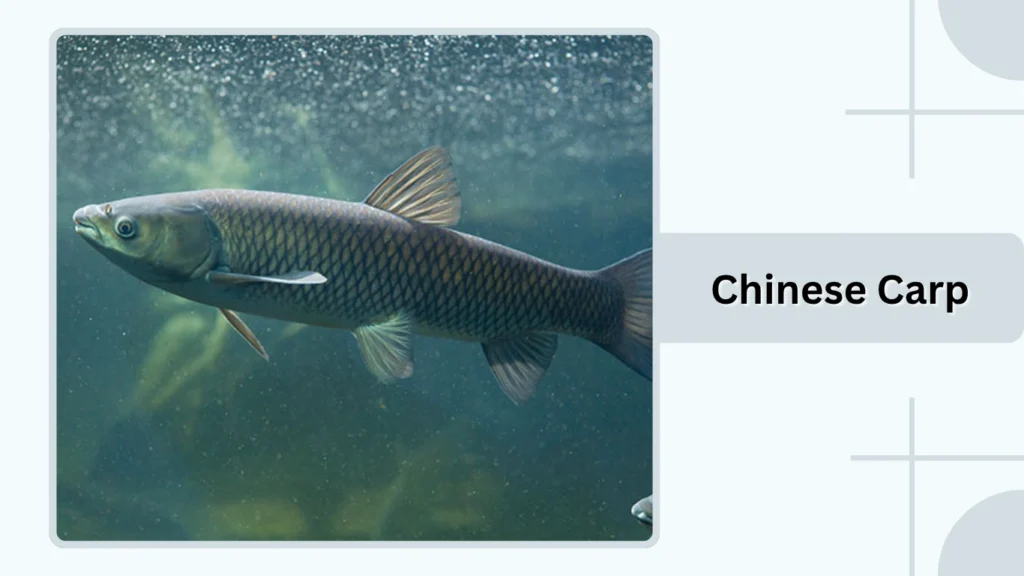
Chinese carp is a general term used for several carp species native to China, including grass carp, silver carp, bighead carp, and black carp. These species are widely used in aquaculture and are important for both food production and water management.
Identification
- Medium to large body size depending on species
- Silver, gray, or dark coloration
- Smooth, streamlined body shape
- Scales vary by species
- Usually no prominent barbels (varies by species)
Habitat
Chinese carp are found in rivers, lakes, reservoirs, and aquaculture ponds. They prefer warm freshwater environments and are often introduced into controlled systems for farming and ecological purposes.
Behavior
These carp species have diverse feeding habits. Some are herbivores (grass carp), while others are filter feeders (silver and bighead carp) or mollusk feeders (black carp). Their varied diets make them useful in balanced aquaculture systems.
Size
Chinese carp species can grow quite large. Many reach lengths of 2 to 4 feet and can weigh between 20 to 80 pounds, depending on the species and environment.
Distribution
Native to China and East Asia, these carp have been introduced worldwide for aquaculture and environmental management. In some regions, they are considered invasive due to their rapid growth and impact on native ecosystems.
28. European Carp
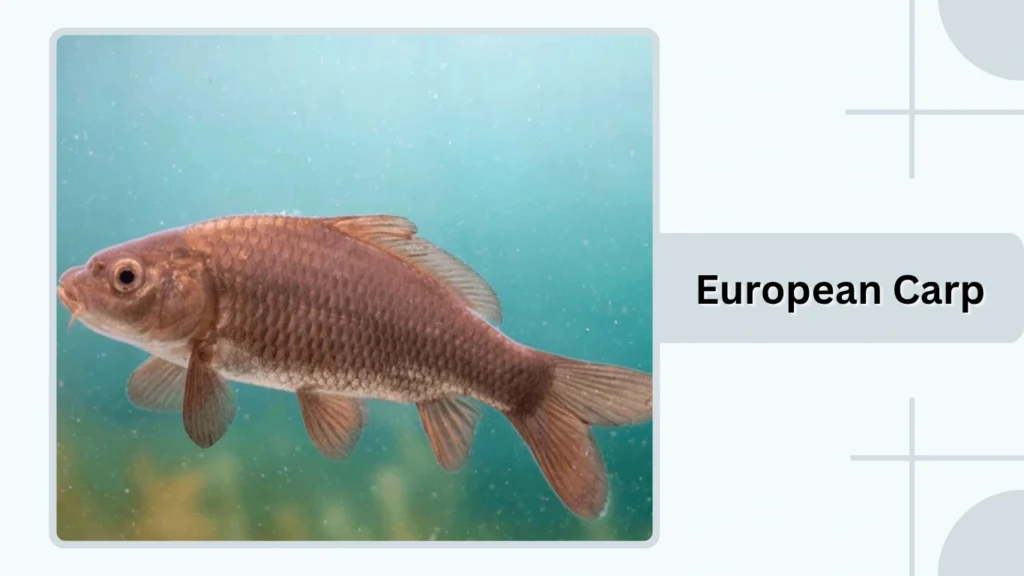
European carp generally refers to the common carp populations native to Europe. These fish have been historically important for food and aquaculture and are among the earliest domesticated fish species. They are hardy, adaptable, and widely distributed across freshwater systems.
Identification
- Deep, robust body shape
- Bronze to golden-brown coloration
- Large, regular scales covering the body
- Two pairs of barbels near the mouth
- Long dorsal fin with a strong leading ray
Habitat
European carp inhabit lakes, rivers, canals, and reservoirs. They prefer slow-moving or still waters with soft, muddy bottoms where they can easily find food.
Behavior
These carp are bottom feeders, searching through sediment for plant matter, insects, and small aquatic organisms. They are highly adaptable and can tolerate a wide range of environmental conditions.
Size
European carp can grow quite large, often reaching 2 to 4 feet in length. Many weigh between 20 to 50 pounds, with larger specimens found in well-managed waters.
Distribution
Native to Europe, this carp has been widely introduced across the world. It is now found on multiple continents and is considered invasive in some regions due to its impact on local ecosystems.
29. Asian Carp
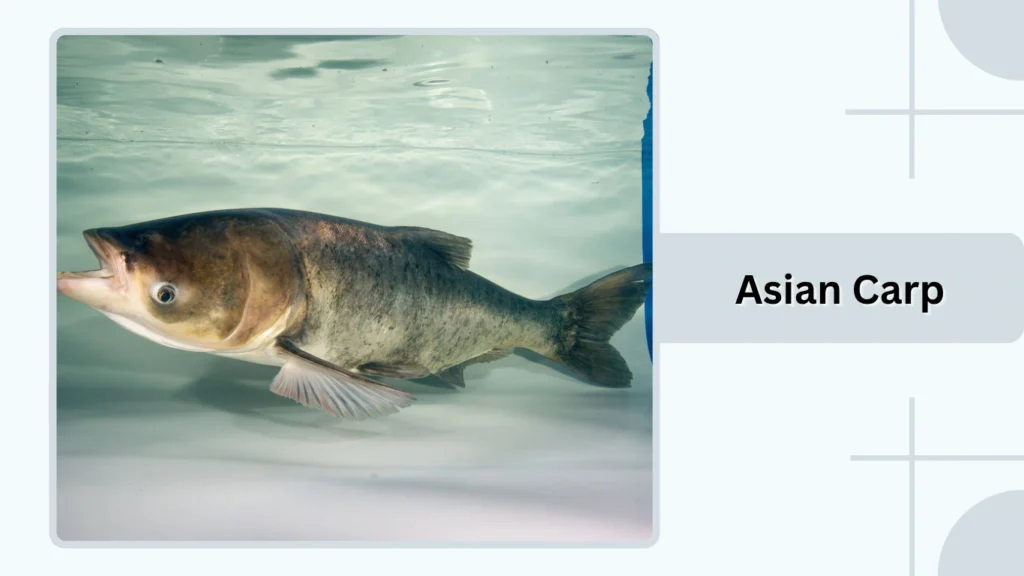
Asian carp is a collective term used for several carp species originating from Asia, including silver carp, bighead carp, grass carp, and black carp. These fish are widely known for their rapid growth and ecological impact, especially in regions where they have been introduced.
Identification
- Medium to very large body depending on species
- Silver, gray, or dark coloration
- Streamlined or deep-bodied shape (varies by species)
- Small scales with smooth appearance
- Typically no barbels (except some species)
Habitat
Asian carp are commonly found in large rivers, lakes, and reservoirs. They prefer warm freshwater systems with abundant food sources and can thrive in both slow-moving and moderately flowing waters.
Behavior
Different species under this group have varied feeding habits. Some are filter feeders consuming plankton, while others feed on plants or mollusks. They are fast-growing and can dominate ecosystems if not controlled.
Size
Asian carp species can grow quite large. Many reach lengths of 2 to 4 feet, with some species exceeding 80 pounds under ideal conditions.
Distribution
Originally native to East Asia, Asian carp have been introduced to many parts of the world, including North America and Europe. In several regions, they are considered invasive due to their rapid reproduction and competition with native species.
30. Asian Carp Hybrid
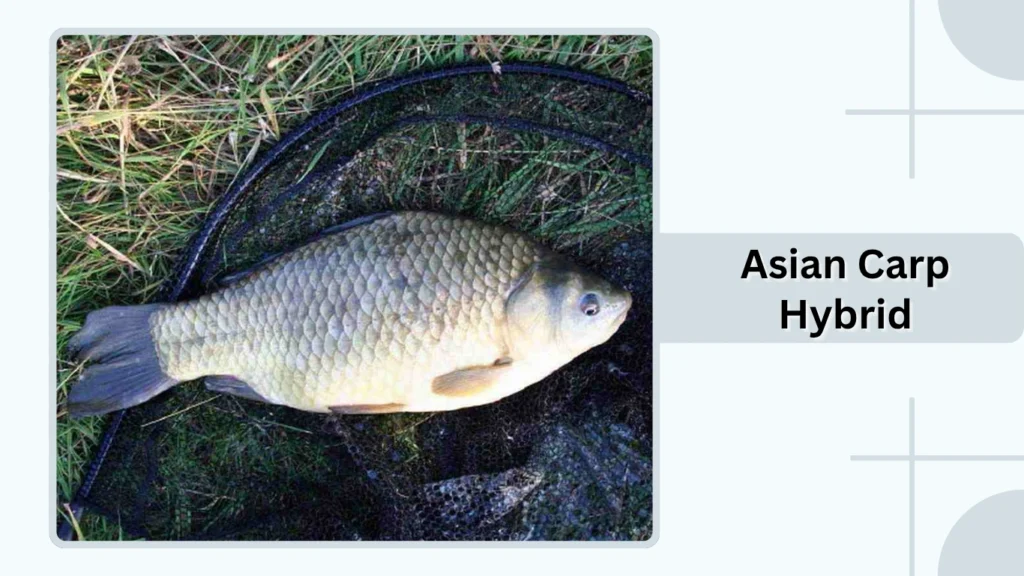
Asian carp hybrids are crossbred varieties resulting from the mixing of different Asian carp species, such as silver carp and bighead carp. These hybrids occur naturally in some regions and are also found in managed environments. They often combine traits from parent species, making them adaptable and fast-growing.
Identification
- Body shape varies depending on parent species
- Mixed coloration, usually silver to gray
- Intermediate head size compared to parent species
- Smooth scales with a streamlined body
- No barbels around the mouth
Habitat
Asian carp hybrids are found in large rivers, lakes, and reservoirs where parent species coexist. They thrive in nutrient-rich waters and can adapt to a wide range of environmental conditions.
Behavior
These hybrids typically inherit filter-feeding habits, consuming plankton and organic matter. They are active swimmers and can compete strongly for food resources, similar to their parent species.
Size
Asian carp hybrids can grow large, often reaching sizes comparable to silver or bighead carp. Many individuals grow between 2 to 4 feet in length and can weigh over 50 pounds.
Distribution
Asian carp hybrids are found in regions where multiple Asian carp species have been introduced, especially in North America and parts of Europe. Their presence can complicate management efforts due to their adaptability and rapid growth.
FAQs
What is the most common type of carp fish?
The most common carp fish is the common carp. It is widely distributed across the world and easily recognized for its large size, barbels near the mouth, and adaptability to different freshwater environments.
Which carp species grows the largest?
Siamese carp is considered one of the largest carp species. It can grow over 200 pounds in ideal conditions, making it one of the biggest freshwater fish in the world.
Are all carp fish the same?
No, carp fish vary widely in size, shape, color, and behavior. Some are bottom feeders, while others are filter feeders or herbivores. There are also ornamental types like koi and goldfish.
Are carp fish good for eating?
Yes, many carp species such as rohu, catla, and common carp are popular food fish. They are widely consumed in Asia and Europe, though taste can vary depending on habitat and preparation.
Are carp fish invasive?
Some carp species, especially Asian carp, are considered invasive in certain regions. They can grow quickly and compete with native fish, causing ecological imbalance in freshwater systems.