
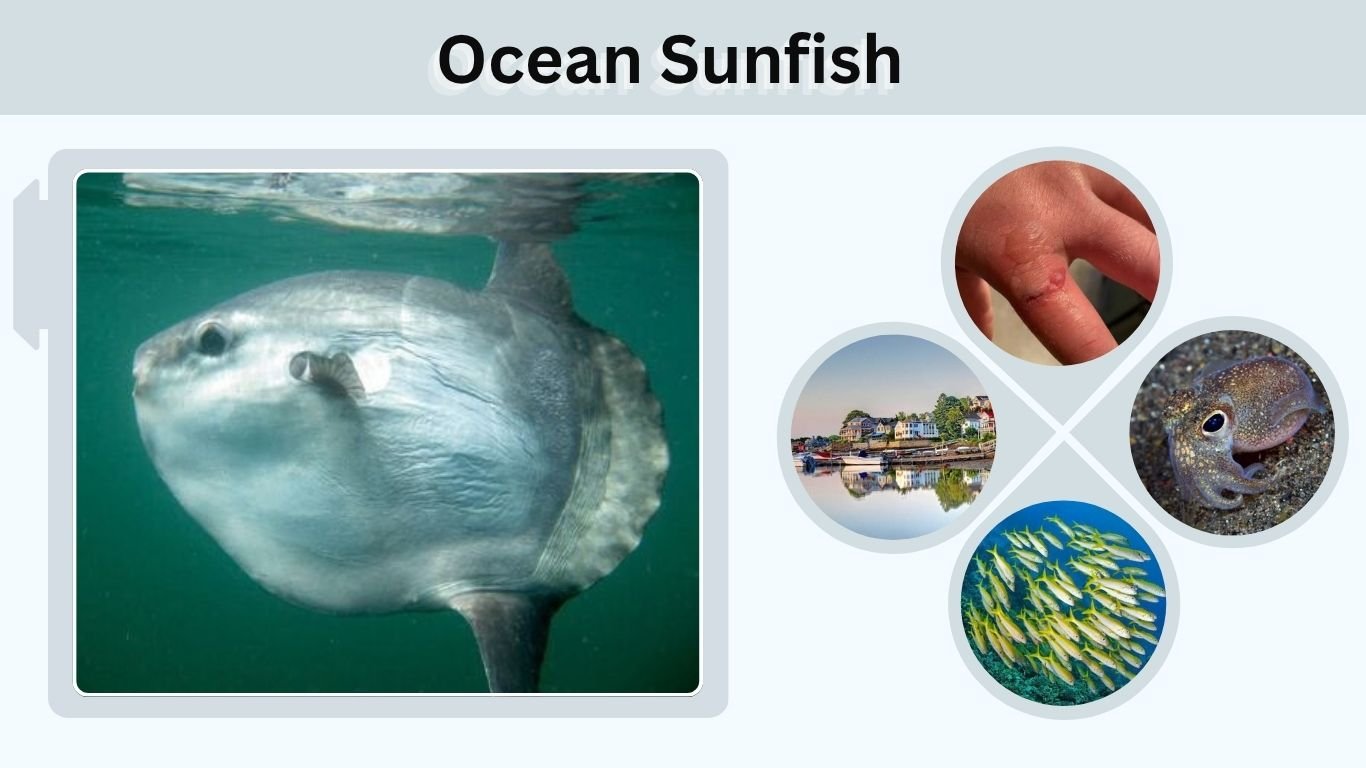
The ocean sunfish, scientifically known as Mola mola, is one of the strangest and largest bony fishes in the world. Its enormous flattened body, tiny mouth, towering fins, and shortened tail give it an appearance unlike almost any other fish. Ocean sunfish live throughout tropical and temperate seas, where they dive for jellyfish and other prey before sometimes returning toward the surface. Despite their awkward appearance, these marine giants are active swimmers with remarkable adaptations, unusual anatomy, and an extraordinary life cycle.
What Is an Ocean Sunfish?
The ocean sunfish belongs to the family Molidae, a group related to pufferfishes and triggerfishes. The common ocean sunfish is Mola mola, although several related mola species also inhabit the world’s oceans. Its round, flattened profile and abruptly shortened rear end make it immediately recognizable. Adults look dramatically different from the tiny, spiny larvae from which they develop.
Ocean Sunfish Scientific Name
The scientific name of the common ocean sunfish is Mola mola.
The word mola comes from Latin for “millstone,” referring to the fish’s large, rounded body. It belongs to the family Molidae, which contains five recognized living species of ocean sunfishes.
What Does an Ocean Sunfish Look Like?
An adult has an extremely deep, laterally compressed body. It lacks the conventional tail fin found on most fishes.
Instead, the rear edge forms a structure called the clavus, which helps with steering. A tall dorsal fin rises from the back, while an equally prominent anal fin extends downward.
Its skin is thick and grayish, and the mouth is surprisingly small for such an enormous animal.
Ocean Sunfish Size
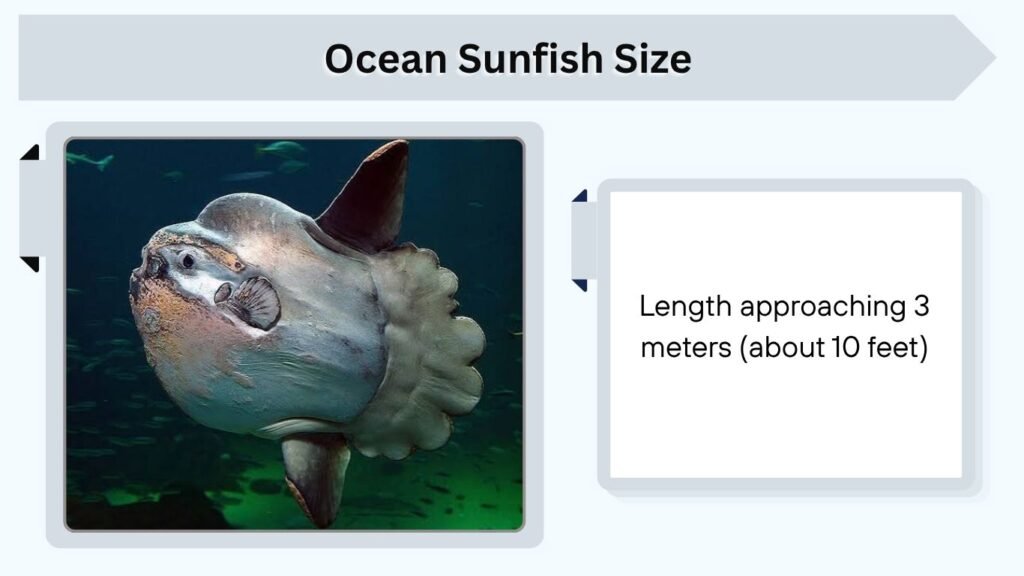
Size is one of the most impressive features of an ocean sunfish. Adults can become taller from fin tip to fin tip than many people are tall. However, “ocean sunfish” is sometimes used loosely for several mola species, so records for Mola mola should not be confused with those of the even larger giant sunfish, Mola alexandrini.
How Big Do Ocean Sunfish Get?
Notable size characteristics include:
- Length approaching 3 meters (about 10 feet) in very large individuals
- Weight exceeding 2,000 kg (4,400 pounds) in exceptionally large molas
- Fin-to-fin height that can exceed body length
- Adults weighing millions of times more than newly hatched young
The exact maximum varies between species and individual records.
What Is the Biggest Ocean Sunfish?
The title of heaviest known bony fish is associated with the giant sunfish, Mola alexandrini rather than the common Mola mola.
Monterey Bay Aquarium reports that giant sunfish can reach approximately 2,700 kg (6,000 pounds) or more. This distinction matters because images and reports of “giant ocean sunfish” sometimes incorrectly identify every record-breaking mola as Mola mola.
Ocean Sunfish Habitat
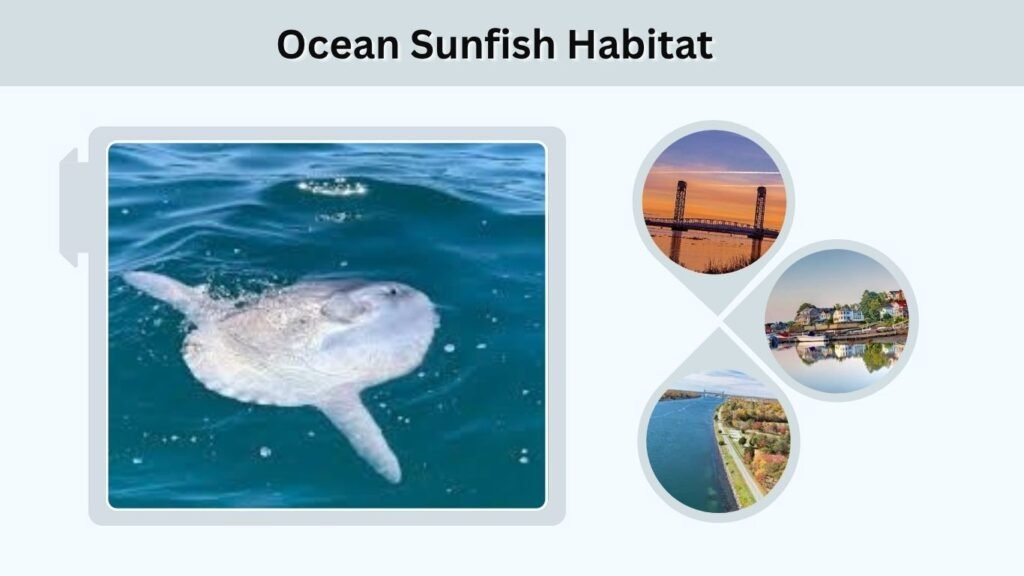
Ocean sunfish have a remarkably broad distribution. They occur in tropical and temperate oceans around the world, including Atlantic, Pacific, and Indian Ocean waters. They are pelagic animals, meaning much of their lives are spent in open water rather than living permanently near reefs or the seafloor. Tracking studies show they also make substantial vertical movements.
Where Do Ocean Sunfish Live?
Mola mola inhabits open ocean environments around the globe.
They may appear near coastlines when currents, prey, or seasonal conditions bring them closer to shore, which explains sightings around California, Cape Cod, Europe, and many other regions.
However, they are capable of extensive offshore movements and should not be considered primarily coastal fish.
How Deep Can Ocean Sunfish Dive?
Ocean sunfish do much more than float near the surface.
Research summarized by the Smithsonian indicates that they can dive to approximately 500 meters (1,600 feet) before returning toward warmer surface water. Other molid research has documented even deeper diving behavior.
Surface basking may help them regain body heat after spending time in colder deep water.
What Do Ocean Sunfish Eat?
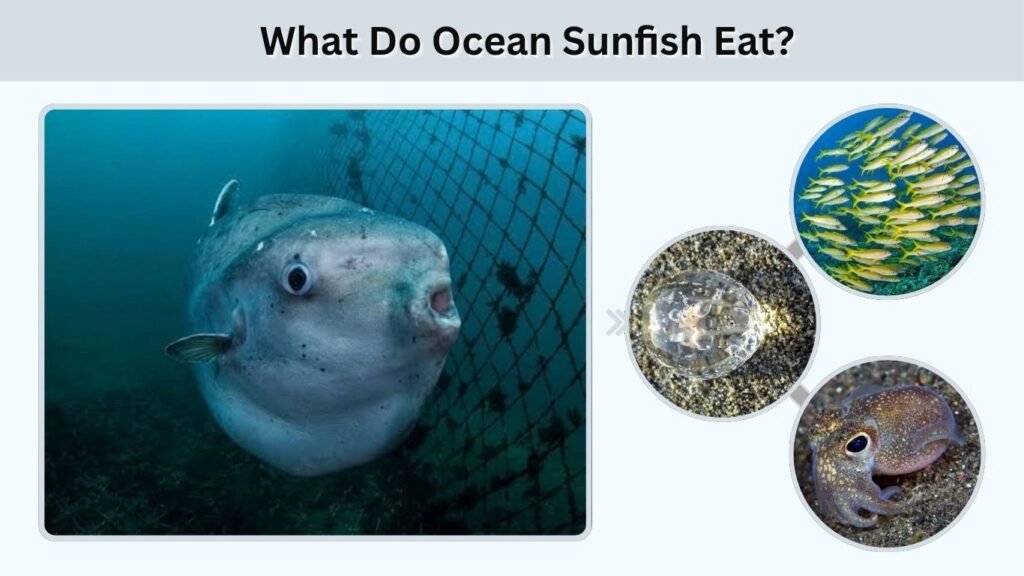
Ocean sunfish were once commonly described as animals that survive almost exclusively on jellyfish. Research now shows that their diet is more varied. Large individuals consume substantial amounts of gelatinous prey, but smaller molas can feed on crustaceans, fish, squid, algae, and other organisms found throughout the water column.
Ocean Sunfish Diet
Their food can include:
- Jellyfish
- Salps
- Comb jellies
- Siphonophores
- Squid
- Small fish
- Crustaceans
- Other marine invertebrates
- Some algae
Larger ocean sunfish appear to shift strongly toward gelatinous prey as they grow.
How Does an Ocean Sunfish Eat?
The sunfish has a relatively small mouth with fused tooth plates that form a beak-like structure.
Rather than chewing food conventionally, it can suck prey inward and manipulate it into manageable pieces. The Smithsonian also notes that a mucus-like lining in the digestive system may help protect the fish while consuming stinging gelatinous animals such as jellyfish.
Ocean Sunfish Anatomy and Adaptations
The anatomy of a sunfish may initially look poorly suited to swimming, yet it is highly specialized. Its large dorsal and anal fins provide propulsion, while the clavus helps with direction. Sunfish also lack the typical tail-powered swimming style used by tuna and many sharks, making their movement distinctly different from most large open-ocean fishes.
How Ocean Sunfish Swim
Ocean sunfish propel themselves largely by moving the dorsal and anal fins in coordinated strokes.
The clavus acts more like a rudder than a propulsive tail. Tracking has demonstrated that they are not helpless drifters; individuals can travel significant distances and actively move against or across currents.
Monterey Bay Aquarium reports tracked individuals covering around 26 kilometers in a day.
Ocean Sunfish Skeleton
Like other bony fishes, the ocean sunfish has an internal skeleton, but its body has undergone dramatic evolutionary modification.
Its vertebral column is shortened, contributing to the truncated appearance. The normal tail structure has been replaced during development by the clavus.
The result is a fish that can look as though the back half of its body has disappeared.
Thick Skin and Temperature Control
Ocean sunfish possess thick skin and spend time moving between very different water temperatures.
After descending into cold deep water, they may return to warmer surface layers. Research suggests these surface periods help restore body temperature and support continued swimming and feeding activity.
Ocean Sunfish Parasites and Predators
Despite their enormous size, ocean sunfish are not free from predators or other organisms that exploit them. Their bodies can host an unusually diverse community of external and internal parasites. They may also visit areas where cleaner fish or seabirds remove parasites from their skin.
Ocean Sunfish Parasites
Nearly 40 kinds of parasites have been documented living in or on ocean sunfish.
These can include organisms inhabiting:
- Skin
- Gills
- Internal organs
- Mouth and throat
- Other external surfaces
Some parasites found on sunfish can even carry parasites of their own.
What Eats Ocean Sunfish?
Large predators include sharks, killer whales, and sea lions.
Size provides adult molas with some protection, but it does not make them immune to predation. Humans can also affect them through fishing, intentional harvest in some regions, accidental bycatch, and marine pollution.
Ocean Sunfish Reproduction and Life Cycle
Much about ocean sunfish reproduction in the wild remains poorly understood because these animals spend so much of their lives in the open sea. What researchers do know reveals an extraordinary transformation. They begin life tiny and spiny, resembling their pufferfish relatives much more closely than their enormous adult forms.
Ocean Sunfish Eggs and Babies
Female molas can produce enormous numbers of tiny eggs.
After hatching, the larvae are extremely small and have spines, giving them a completely different appearance from adults.
As they grow, the body becomes deeper, the spines disappear, and their distinctive adult shape gradually develops.
The Smithsonian notes that an ocean sunfish’s mass may increase by more than 60 million times from hatchling to adult.
How Long Do Ocean Sunfish Live?
The natural lifespan of Mola mola is not known with the same confidence as its size and distribution.
Researchers continue studying growth, age, migration, and reproduction. Because relatively few individuals can be followed throughout their lives in the open ocean, precise claims about a typical maximum lifespan should be treated cautiously.
Are Ocean Sunfish Dangerous?
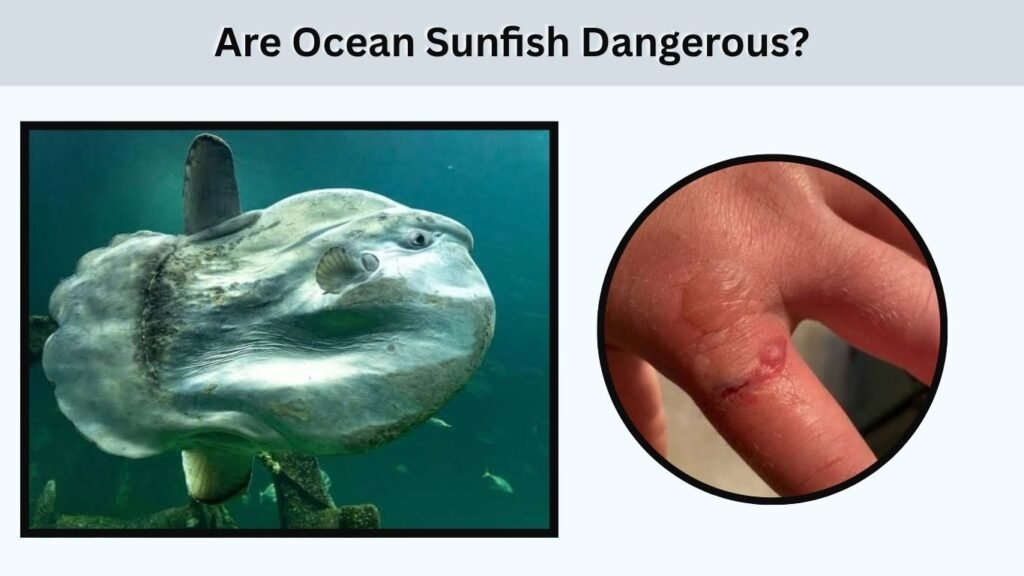
Their enormous size and unusual appearance can make ocean sunfish intimidating, but they are not considered aggressive predators of humans. Their diet consists of marine organisms rather than large mammals, and encounters with divers are generally peaceful.
Do Ocean Sunfish Bite Humans?
Ocean sunfish have small mouths relative to their size and are not adapted for attacking people.
Their beak-like teeth are primarily used for processing prey. As with any large wild animal, divers should avoid touching, chasing, feeding, or interfering with them.
Are Ocean Sunfish Endangered?
The common ocean sunfish faces several human-related pressures despite its enormous range. The IUCN status reported by major aquarium and Smithsonian sources is Vulnerable. Accidental capture in fisheries is an important threat, while marine debris can also pose serious problems when plastic resembles gelatinous prey.
Major Threats to Ocean Sunfish
Important threats include:
- Accidental capture in fishing gear
- Drift-gillnet bycatch
- Injury from fishing equipment
- Plastic pollution
- Ingestion of floating debris
- Fishing and harvest in some regions
Plastic bags are particularly concerning because they can resemble jellyfish and may block a sunfish’s digestive system if swallowed.
Interesting Ocean Sunfish Facts
Ocean sunfish challenge many assumptions about large fish. Despite looking almost tail-less, they can actively travel through the open ocean, perform deep dives, and regulate their temperature behaviorally. Newly hatched molas are tiny and spiny, yet adults can eventually weigh as much as a vehicle. Their bodies may support dozens of parasite species, making each fish almost a miniature ecosystem of its own.
Why Ocean Sunfish Are So Unusual
Perhaps their most remarkable feature is the combination of extreme size and unconventional anatomy.
Few fish undergo such a dramatic transformation from tiny, puffer-like young to enormous disc-shaped adults. Their strange body plan is not evidence that they are poorly adapted; their worldwide distribution shows that the design works remarkably well in open-ocean environments.
FAQs
1. How big does an ocean sunfish get?
Very large ocean sunfish can approach 3 meters in length and weigh well over 1,000 kilograms. Related giant sunfish can exceed 2,700 kilograms.
2. What do ocean sunfish eat?
They eat jellyfish and other gelatinous animals along with squid, fish, crustaceans, and various marine invertebrates.
3. Where do ocean sunfish live?
Ocean sunfish occur in tropical and temperate oceans worldwide, including the Atlantic, Pacific, and Indian oceans.
4. Why do ocean sunfish lie at the surface?
Surface basking appears to help them warm their bodies after diving into colder deep water, although they may also visit the surface for other reasons.
5. Are ocean sunfish dangerous to humans?
Ocean sunfish are not considered aggressive toward humans. They mainly feed on gelatinous animals, small fish, squid, and other marine prey rather than large animals.