
The swordtail guppy is a beautiful freshwater aquarium fish recognized for its colorful body and distinctive sword-shaped tail fins. These ornamental guppies are popular among fishkeepers because of their attractive appearance, peaceful behavior, and relatively easy care requirements. They come in several varieties, including double swordtail, top swordtail, bottom swordtail, and Japanese blue swordtail guppies. Although they resemble swordtail fish, they are actually different aquarium varieties of guppies. This guide covers swordtail guppy identification, types, size, lifespan, tank requirements, feeding, breeding, and compatibility with other freshwater fish.
What Is a Swordtail Guppy?
A swordtail guppy is an ornamental form of the common guppy (Poecilia reticulata), belonging to the Poeciliidae family. Unlike true swordtail fish (Xiphophorus hellerii), these guppies have been selectively bred to develop elongated extensions on their tail fins. They originate from domesticated guppy breeding lines rather than being a separate freshwater fish species.
Swordtail Guppy Appearance
Swordtail guppies have slender bodies, colorful scales, and distinctive tail shapes. Their appearance varies according to the strain.
- Body color: Blue, red, green, yellow, silver, or multicolored.
- Tail: One or two elongated sword-shaped extensions.
- Fins: Often brightly colored, with different patterns.
- Body shape: Small and streamlined.
- Male coloration: Usually brighter and more elaborate than females.
Swordtail Guppy Size and Lifespan
Male swordtail guppies typically grow around 1–1.5 inches in body length, while females commonly reach approximately 1.5–2.5 inches. Decorative tail extensions can increase their overall length.
Their average lifespan is approximately 2–3 years. Genetics, nutrition, aquarium conditions, and temperature influence how long individual fish live.
Popular Types of Swordtail Guppies
Swordtail guppies are available in several attractive varieties distinguished by their fin shapes and body coloration. Aquarium breeders have developed these ornamental strains through selective breeding. Although their appearance varies significantly, most varieties share the same basic care requirements. Some strain names describe tail shapes, while others refer to particular colors or breeding lines.
Common Swordtail Guppy Varieties
- Double Swordtail Guppy: Features two elongated tail extensions, one on the upper edge and another on the lower edge.
- Top Swordtail Guppy: Has a prominent extension growing from the upper part of its tail fin.
- Bottom Swordtail Guppy: Displays a sword-shaped extension along the lower edge of the tail.
- Japanese Blue Swordtail Guppy: Known for its metallic blue coloration and attractive sword-shaped fins.
- Red Swordtail Guppy: Displays reddish coloring combined with one or more elongated tail extensions.
- Yellow Swordtail Guppy: Features yellow or golden body markings and distinctive tail extensions.
Blue Japanese Swordtail Guppy
The Japanese blue swordtail guppy is particularly attractive because of its metallic blue or turquoise coloration.
Some breeding lines develop red, orange, or yellow markings on their fins. Japanese blue double swordtail guppies have elongated extensions on both sides of the tail.
Their coloration and fin development depend on the individual breeding strain.
Swordtail Guppy Care and Tank Requirements

Swordtail guppies are relatively easy to maintain, but they require stable aquarium conditions to remain healthy. Their delicate ornamental fins can become damaged by aggressive tank mates or strong water currents. A planted aquarium with adequate swimming space, reliable filtration, and suitable water chemistry provides a comfortable environment for these colorful fish.
Ideal Tank Conditions
- Tank size: At least 10 gallons for a small group, with 20 gallons providing more space.
- Temperature: Approximately 74–80°F (23–27°C).
- Water pH: Around 7.0–8.0.
- Water hardness: Approximately 8–25 dGH.
- Filtration: Gentle to moderate water movement.
- Lighting: Moderate lighting.
- Plants: Java moss, hornwort, and floating plants.
Aquarium Setup and Maintenance
Swordtail guppies thrive in planted aquariums containing open swimming areas and sheltered spaces.
Use gentle filtration to protect their extended fins. Floating plants provide shade, while dense vegetation offers hiding places for females and fry.
Change approximately 20–30% of the water weekly, adjusting according to aquarium conditions. Maintain zero ammonia and nitrite, and avoid sudden changes in temperature or pH.
What Do Swordtail Guppies Eat?

Swordtail guppies are omnivorous fish that accept a wide variety of aquarium foods. Their natural feeding behavior includes consuming small invertebrates, insect larvae, algae, and organic material. Providing balanced nutrition supports healthy development, strong coloration, and successful reproduction. A varied diet is more beneficial than relying on a single food every day.
Best Foods for Swordtail Guppies
- Tropical flakes: Provide balanced daily nutrition.
- Micro-pellets: Suitable for their small mouths.
- Spirulina flakes: Supply plant-based nutrients.
- Brine shrimp: Offer extra protein.
- Daphnia: Useful as an occasional live or frozen food.
- Bloodworms: Can be offered occasionally in appropriately sized portions.
Feeding Frequency
Feed adult swordtail guppies once or twice daily.
Provide small portions that they can finish in approximately one minute. Remove uneaten food to prevent water pollution.
Young guppies require smaller food particles and more frequent feeding during their early development.
Can Swordtails and Guppies Live Together?
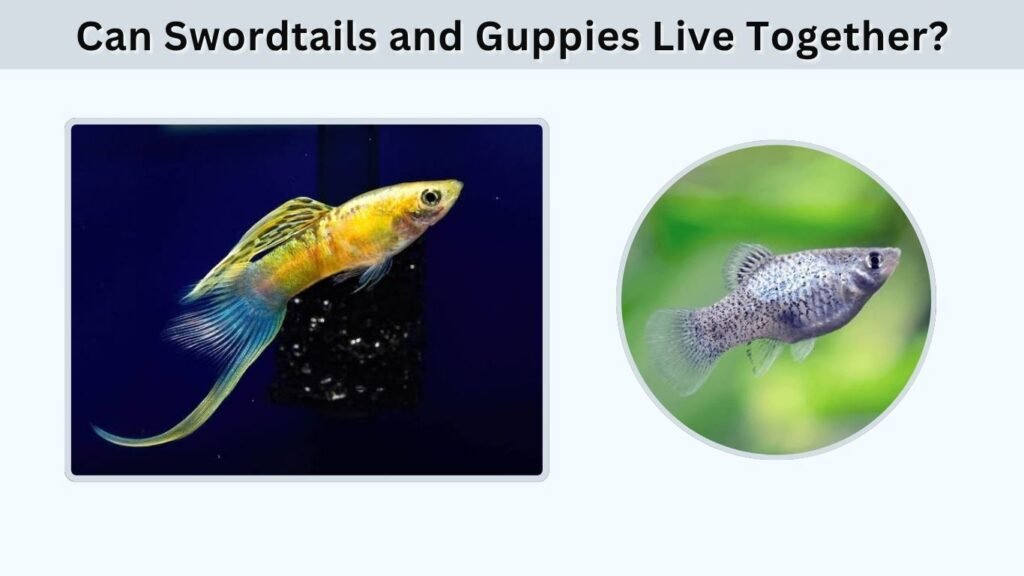
Swordtail fish and guppies are different species, but they can often live together in a properly maintained community aquarium. Both are livebearers that prefer broadly similar freshwater conditions. However, swordtails are significantly larger and more active than guppies, so compatibility depends on available aquarium space and individual fish behavior.
Requirements for Keeping Them Together
- Aquarium size: Use a spacious tank of at least 30 gallons, preferably with ample horizontal swimming room.
- Water temperature: Maintain approximately 74–80°F (23–27°C).
- Water conditions: Keep neutral to slightly alkaline, moderately hard water.
- Hiding places: Provide plants and sheltered areas.
- Feeding: Ensure smaller guppies receive enough food.
- Behavior: Monitor male swordtails for chasing or fin-nipping.
Will Swordtails Eat Guppies?
Adult swordtails do not normally treat healthy adult guppies as prey. However, larger or aggressive individuals may chase smaller fish and damage their delicate fins.
Swordtails may also eat newborn guppy fry.
Providing dense plants and separating vulnerable fry can improve their survival.
Swordtail Guppy Breeding and Reproduction
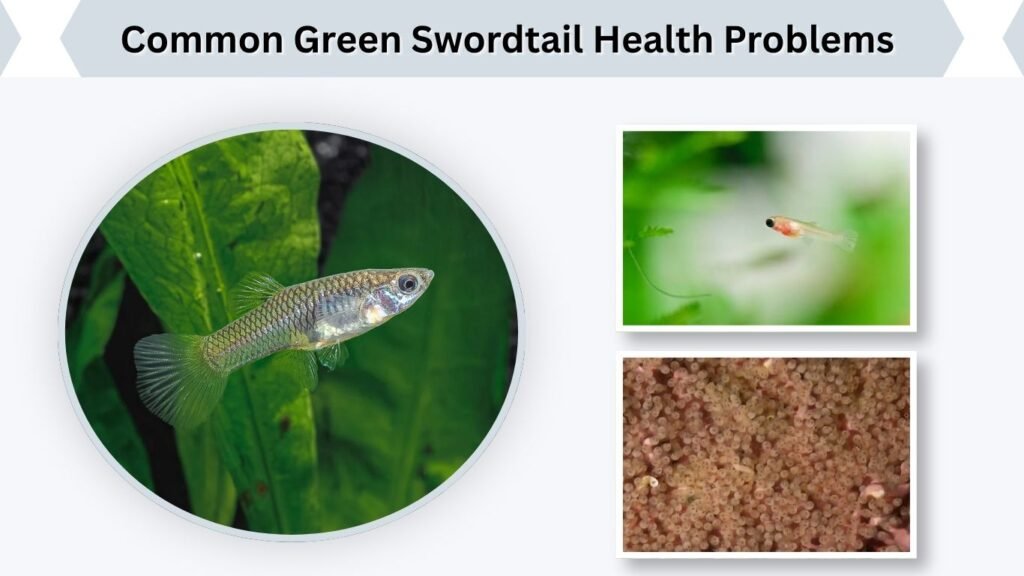
Swordtail guppies reproduce in the same way as other common guppies. They are livebearers, meaning females give birth to live, free-swimming young rather than laying eggs. Breeding is generally straightforward, although maintaining specific swordtail fin shapes and colors across generations requires selective breeding and careful management of breeding groups.
Male vs. Female Swordtail Guppy
Male swordtail guppies usually have brighter coloration and more noticeable tail extensions.
They possess a modified anal fin called a gonopodium, which is used for reproduction.
Females are generally larger, have fuller bodies, and possess fan-shaped anal fins. They usually display less elaborate tail extensions.
Swordtail Guppy Pregnancy
Female guppies commonly remain pregnant for approximately four to six weeks, depending on environmental conditions.
Pregnant females develop enlarged abdomens and may display a darker gravid spot near the anal fin.
Females can store sperm and produce additional broods without mating again.
Caring for Swordtail Guppy Fry
Swordtail guppy fry can swim independently shortly after birth.
Adult guppies may eat newborn fry, so dense plants or a separate nursery aquarium are helpful.
Feed finely crushed flakes, powdered fry food, or newly hatched brine shrimp. Keep the water clean and stable to support healthy growth.
Can Guppies and Swordtails Crossbreed?
Guppies and true swordtail fish belong to different genera and cannot produce viable hybrids through ordinary aquarium breeding. Guppies belong to the genus Poecilia, while swordtails belong to Xiphophorus. Their similar reproductive methods do not make them genetically compatible.
Can a Swordtail Guppy Breed With a Regular Guppy?
Yes. A swordtail guppy is simply a guppy with a particular ornamental tail shape.
It can reproduce with other compatible guppies of the same species. However, not all offspring will necessarily inherit the desired swordtail fin shape or parental coloration.
Can a Male Swordtail Fish Breed With a Female Guppy?
A male swordtail fish cannot successfully produce hybrid offspring with a female guppy under normal aquarium conditions.
Although mating attempts between different livebearer species may occasionally occur, this does not mean successful fertilization is possible.
Swordtails can hybridize with certain platy species, but guppies are not suitable hybrid partners.
FAQs
1. Are Swordtail Guppies Easy to Care For?
Yes, swordtail guppies are relatively easy to care for and suitable for beginners. They accept various aquarium foods and adapt well to stable freshwater conditions. However, their ornamental fins require protection from aggressive fish, strong currents, and poor water quality.
2. How Big Do Double Swordtail Guppies Get?
Male double swordtail guppies typically reach around 1–1.5 inches in body length, while females may grow to approximately 2–2.5 inches. Their elongated tail extensions can make males appear longer. Genetics, feeding, and aquarium conditions influence their final size.
3. Can Swordtail Guppies Live With Regular Guppies?
Yes, swordtail guppies can live with ordinary guppies because they belong to the same species. They share similar feeding habits, water requirements, and social behavior. Males and females can also reproduce together, although the offspring may display different colors and tail shapes.
4. Can Guppies and Swordtails Breed Together?
No, common guppies and true swordtail fish cannot normally produce viable hybrid offspring. They belong to different genera, Poecilia and Xiphophorus. However, ornamental swordtail guppies can breed with ordinary guppies because both are varieties of the same species.
5. What Is the Best Tank Size for Swordtail Guppies?
A 10-gallon aquarium can accommodate a small group of swordtail guppies, although 20 gallons provides more space and better flexibility. If keeping them with true swordtail fish, choose a much larger aquarium, preferably at least 30 gallons with sufficient swimming room.