
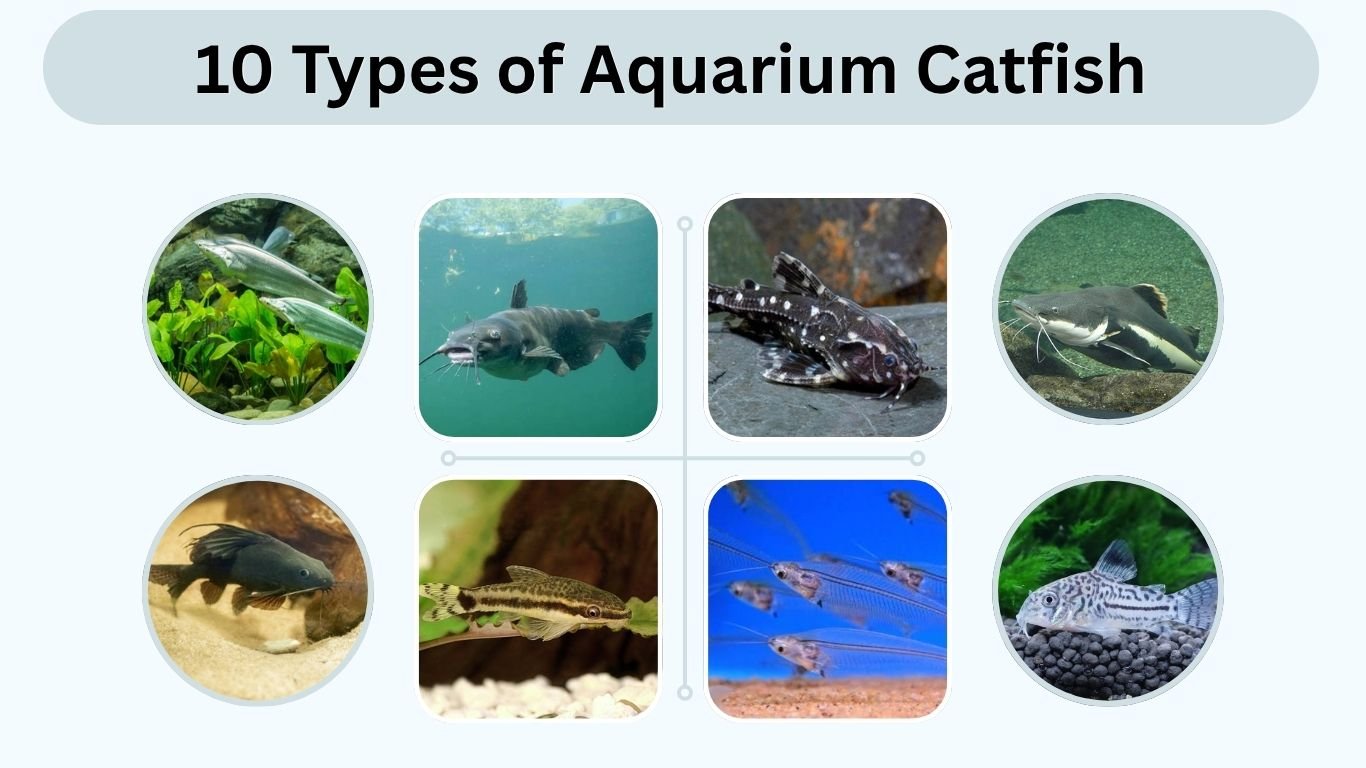
Aquarium catfish are popular freshwater fish known for their whisker-like barbels, unusual appearances, and bottom-dwelling habits. Some species, such as Cory and Otocinclus catfish, remain small and suit peaceful community tanks. Others, including Redtail and Tiger Shovelnose catfish, grow extremely large and require custom aquariums or indoor ponds. This guide explores 10 types of aquarium catfish, covering their identification, tank requirements, feeding habits, temperament, and suitable tank mates to help you choose the right species for your aquarium.
1. Cory Catfish
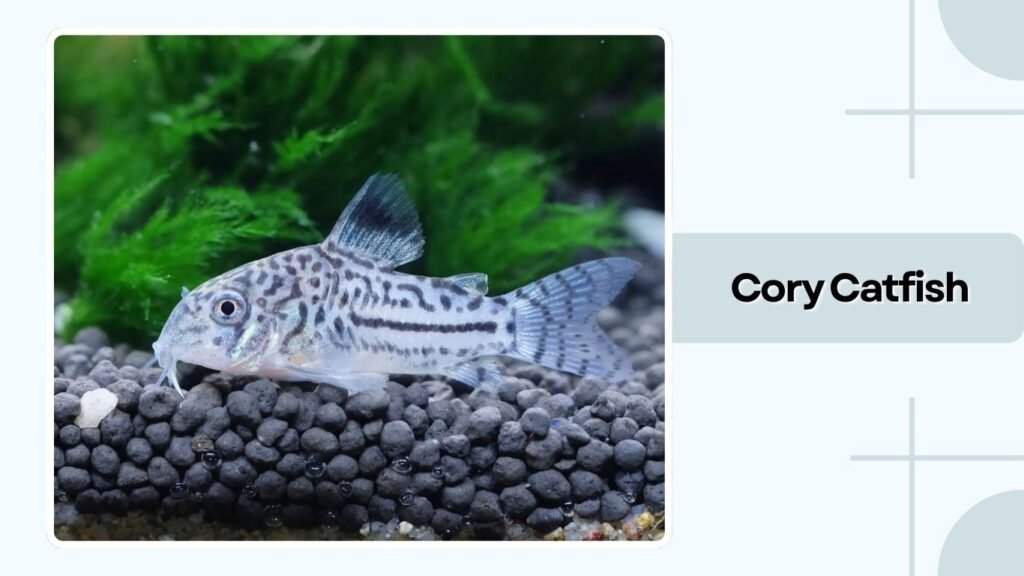
Cory catfish are small, peaceful freshwater fish commonly kept in community aquariums. They spend much of their time exploring the bottom for food with their sensitive whisker-like barbels. Available in bronze, albino, panda, peppered, pygmy, and other varieties, these social catfish are best kept in groups rather than alone.
Identification
- Small body measuring approximately 1–3 inches, depending on the species
- Broad head with a downward-facing mouth
- Several sensitive barbels around the mouth
- Two rows of protective bony plates along the body
- Short triangular dorsal fin
- Colors ranging from silver and bronze to black, white, and spotted
- Frequently rests or searches for food along the aquarium floor
The peppered cory, one of the larger commonly kept varieties, may grow to approximately 7 cm.
Aquarium Size and Setup
Most Corydoras varieties are best housed in a 20-gallon aquarium or larger, although some dwarf species may live in a properly maintained 10-gallon tank. Keep at least six individuals of the same species so they feel secure and display natural social behavior. Use smooth sand or fine, rounded gravel because sharp substrate may irritate their delicate barbels. Plants, driftwood, caves, and shaded resting areas make the aquarium more comfortable. Water requirements vary by species, but many popular varieties thrive between 72°F and 82°F.
Diet and Feeding
Cory catfish are omnivorous scavengers, but they cannot survive only on leftovers from other fish. Feed them sinking catfish pellets, wafers, frozen bloodworms, brine shrimp, insect larvae, and other appropriately sized foods. They are not primarily algae eaters and should receive direct feeding every day. Place food in several areas of the aquarium so faster tank mates cannot consume everything before it reaches the bottom.
Temperament and Tank Mates
Cory catfish are gentle, active, and well suited to peaceful community aquariums. Suitable companions include small tetras, rasboras, danios, peaceful gouramis, livebearers, and similarly calm bottom dwellers. Avoid housing them with large predatory fish or aggressive species that may attack, swallow, or prevent them from feeding. A healthy group will forage together, rest beside one another, and occasionally swim quickly to the surface for air.
2. Pictus Catfish
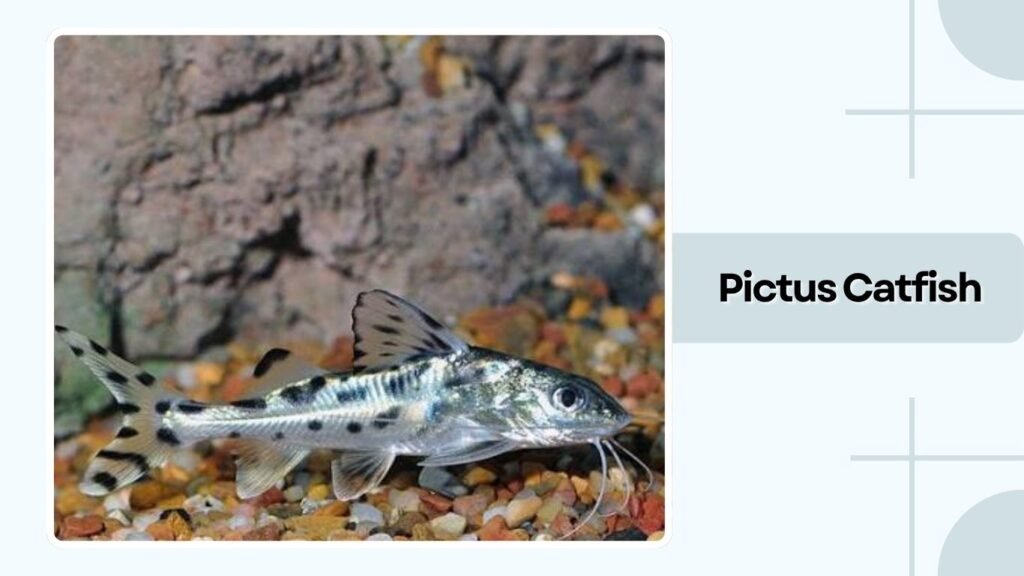
The Pictus catfish, Pimelodus pictus, is an active South American species recognized by its spotted silver body and extremely long barbels. It naturally occurs in the Amazon and Orinoco river basins and grows to approximately 11 cm, although its energetic swimming behavior requires considerably more space than its body length might suggest.
Identification
- Metallic silver or pale gray body
- Numerous round black spots across the body and fins
- Extremely long white barbels around the mouth
- Tall triangular dorsal fin
- Deeply forked tail
- Streamlined body built for fast swimming
- Adult length of around 4–5 inches
Aquarium Size and Setup
A long aquarium with plenty of swimming room is more suitable than a small, tall tank. FishBase recommends an aquarium at least 120 cm long. Use smooth sand or rounded gravel because the fish’s barbels continually sweep across the substrate. Add caves, driftwood, and shaded areas while keeping a large central space open. Strong filtration, moderate current, and stable tropical water conditions are important because Pictus catfish are active feeders that can produce considerable waste.
Diet and Feeding
Pictus catfish are opportunistic omnivores with a strong preference for protein-rich food. Offer sinking carnivore pellets, insect-based foods, bloodworms, brine shrimp, chopped earthworms, and other suitably sized frozen foods. Feed after the lights dim because they often become more active in lower light. Food should reach the bottom quickly, but overfeeding must be avoided because uneaten protein can reduce water quality.
Temperament and Tank Mates
This catfish is energetic rather than deliberately aggressive. It may live with peaceful or moderately active fish that are too large to fit inside its mouth. Small tetras, tiny rasboras, shrimp, and fish fry may be treated as food. Suitable companions include medium-sized barbs, larger tetras, rainbowfish, peaceful cichlids, and similarly sized catfish. Avoid slow, delicate fish that may be stressed by its fast nighttime activity.
3. Glass Catfish
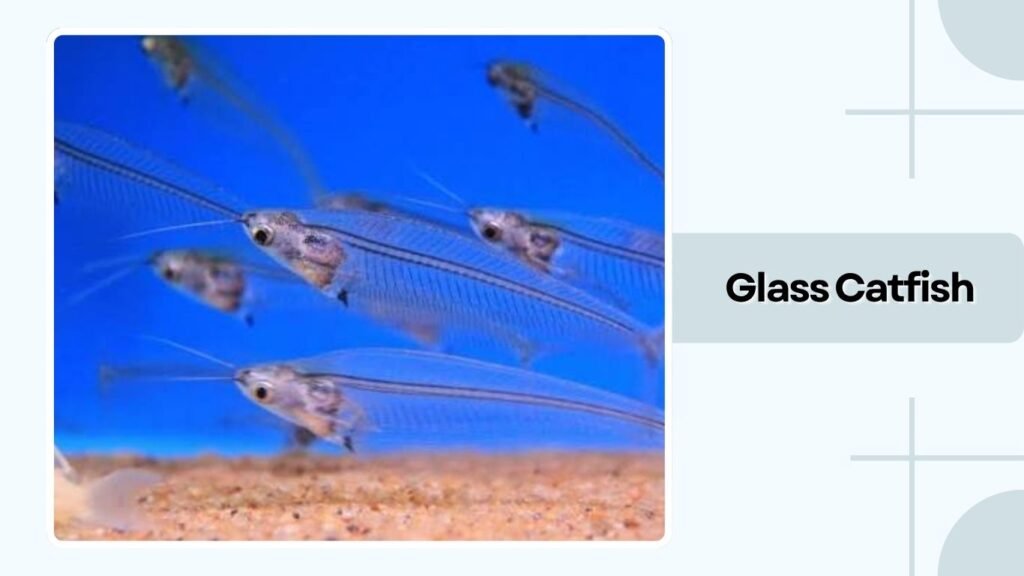
The Glass catfish, Kryptopterus vitreolus, is a transparent freshwater fish whose spine and internal structures can be seen through its body. Unlike most catfish, it does not spend all its time on the bottom. It forms groups in the middle level of a peaceful aquarium and depends on companionship and plant cover to feel secure.
Identification
- Nearly transparent, scaleless body
- Visible spine extending toward the tail
- Small silvery area containing the internal organs
- Two long barbels extending from the mouth
- Narrow, laterally compressed body
- Clear fins with little visible coloration
- Adult length of approximately 2½–3 inches
Aquarium Size and Setup
Keep Glass catfish in a group of at least six, preferably more, because solitary specimens often become shy and stressed. A 20- to 30-gallon aquarium provides room for the group to swim together. Use live plants, driftwood, floating vegetation, and a dark background to create shaded areas, but retain open midwater swimming space. Gentle to moderate current, subdued lighting, and stable water conditions suit their sensitive nature.
Diet and Feeding
Glass catfish have relatively small mouths and should receive appropriately sized food that remains suspended in the water long enough for them to notice it. Quality flakes, nano pellets, daphnia, mosquito larvae, baby brine shrimp, and finely chopped frozen foods are suitable choices. They may hesitate during feeding when housed with fast or aggressive fish, so observe the group and make sure every individual receives food.
Temperament and Tank Mates
These are peaceful, timid schooling fish that perform best with calm community species. Suitable companions include small tetras, rasboras, danios, Corydoras, kuhli loaches, and peaceful gouramis. Avoid large predators, territorial cichlids, and persistent fin nippers. A comfortable group usually swims openly together, while frightened fish may hide among plants or remain unusually still.
4. Otocinclus Catfish
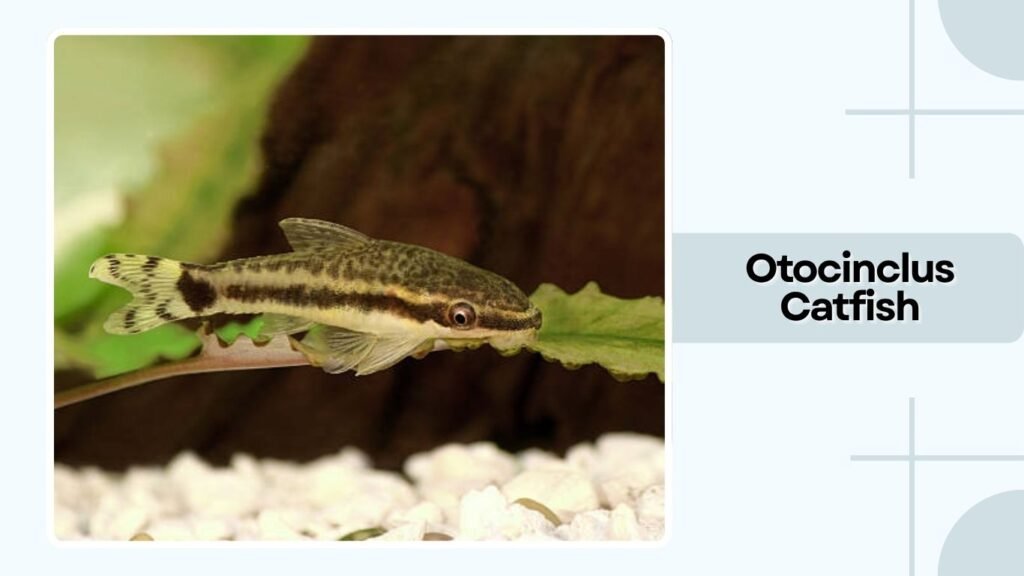
Otocinclus catfish, commonly called otos, are tiny South American suckermouth catfish often added to planted aquariums for algae control. They usually grow to around 1½–2 inches and graze across leaves, glass, driftwood, and decorations. Despite their reputation as cleaner fish, they are sensitive animals that require an established aquarium and a dependable food supply.
Identification
- Small, slender body
- Sucker-shaped mouth beneath the head
- Dark horizontal stripe along each side
- Gray-brown or olive-colored back
- Pale or white underside
- Transparent or lightly marked fins
- Adult size of approximately 1½–2 inches
- Frequently attached to leaves, glass, or wood
Aquarium Size and Setup
Otocinclus should be introduced only after an aquarium has matured enough to develop natural algae and biofilm. Keep them in a social group of at least three to six, although a larger group is better when space permits. A planted 15- to 20-gallon aquarium with driftwood, smooth stones, broad leaves, gentle flow, and high oxygen levels creates useful grazing surfaces. Stable, clean water is especially important because newly imported or underfed specimens may already be weakened.
Diet and Feeding
Otos eat soft green algae, brown diatoms, and the biofilm that develops on plants, wood, and other submerged surfaces. They do not reliably consume black beard algae, hair algae, or every hard algae type. Natural growth should be supplemented with algae wafers, gel food designed for grazing fish, softened zucchini, and canned green beans. A healthy individual should have a gently rounded belly rather than a hollow or sunken abdomen.
Temperament and Tank Mates
Otocinclus catfish are exceptionally peaceful and rarely disturb fish, plants, or adult shrimp. They work well with small tetras, rasboras, Corydoras, dwarf gouramis, peaceful livebearers, and nonaggressive shrimp. Avoid large predatory fish and highly competitive bottom feeders that may prevent them from eating. Their small size and gentle behavior make them excellent planted-tank residents, provided that algae is not treated as their only food source.
5. Upside-Down Catfish
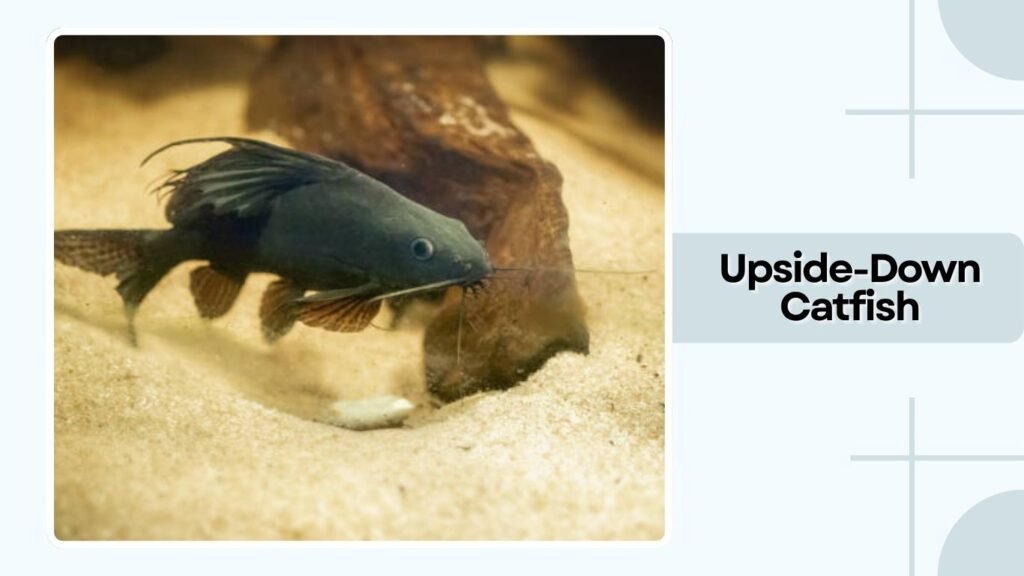
The Upside-Down catfish, Synodontis nigriventris, gets its name from its habit of swimming with its belly facing upward. This position allows it to graze beneath leaves, branches, and other overhead surfaces. It is a peaceful African catfish that usually reaches approximately 3–4 inches and becomes more visible when maintained with others of its kind.
Identification
- Brown or gray body covered with dark spots and blotches
- Pale or darker belly adapted for upside-down camouflage
- Broad head with three pairs of barbels
- Large eyes positioned for upward viewing
- Tall triangular dorsal fin
- Forked tail with dark markings
- Adult length of approximately 3–4 inches
- Frequently rests or swims beneath wood and leaves
Aquarium Size and Setup
A 20- to 30-gallon aquarium is appropriate for a small group, with larger tanks providing better swimming space and more territories. Create numerous shaded retreats using driftwood arches, caves, broad-leaved plants, and rock overhangs. These structures allow the fish to display its characteristic inverted swimming behavior. Use efficient filtration and maintain stable tropical conditions with moderate flow and plenty of oxygen.
Diet and Feeding
Upside-Down catfish are omnivorous scavengers that graze on surfaces and accept a broad range of aquarium foods. Offer sinking wafers, quality pellets, insect-based foods, bloodworms, brine shrimp, and occasional vegetable matter. Some food should become trapped beneath wood or leaves where the fish naturally searches. Feeding shortly before or after the aquarium lights go out can help shy individuals obtain enough food.
Temperament and Tank Mates
This species is generally peaceful and works well in a calm community aquarium. Suitable companions include African tetras, Congo tetras, peaceful barbs, rainbowfish, Corydoras, and similarly sized nonaggressive fish. Very small fry or shrimp may be eaten opportunistically, while aggressive cichlids may intimidate the catfish. Keeping several Upside-Down catfish together can encourage more confident, visible behavior.
6. Redtail Catfish
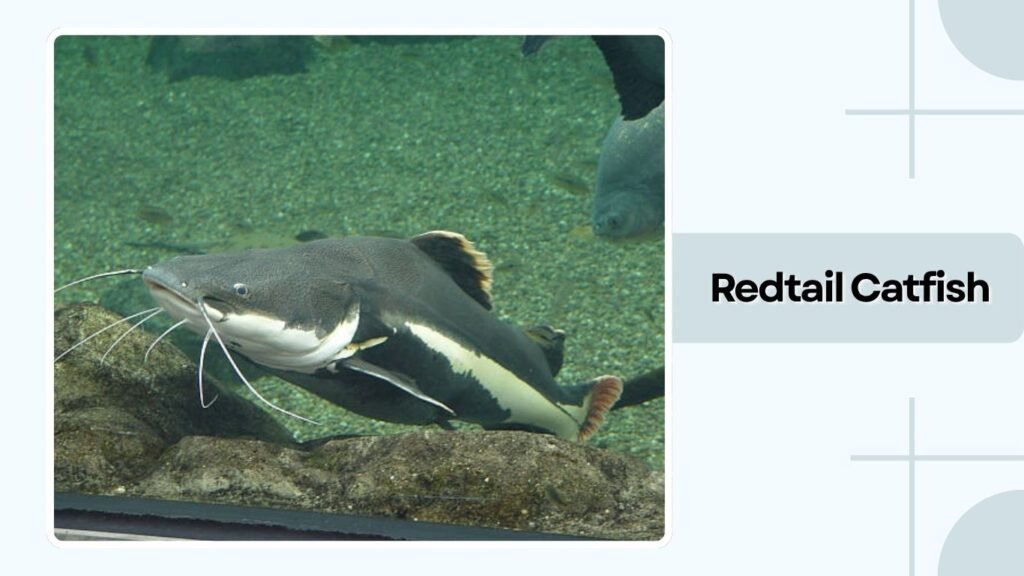
The Redtail catfish, Phractocephalus hemioliopterus, is a massive South American predator recognized by its broad head, white side stripe, and bright reddish-orange tail. Although juveniles are commonly sold as aquarium fish, adults can reach approximately 4 feet long and are generally appropriate only for custom indoor ponds or public aquariums.
Identification
- Broad, flattened head with a very wide mouth
- Dark gray or black upper body
- Wide white stripe running along each side
- White or cream-colored underside
- Bright red or orange tail fin
- Three pairs of long sensory barbels
- Thick, muscular body
- Potential adult length exceeding 3 feet
Aquarium Size and Setup
A normal household aquarium cannot accommodate a fully grown Redtail catfish. Adults require a custom enclosure measured in hundreds or thousands of gallons, powerful sump filtration, excellent oxygenation, and a large unobstructed floor area. Decorations must be heavy and securely positioned because this powerful fish can overturn rocks and wood. Owners must plan for its adult size before purchasing a small juvenile.
Diet and Feeding
Redtail catfish are opportunistic predators that consume fish, crustaceans, insects, and other animal matter. Captive individuals can be fed quality carnivore pellets, prawns, mussels, earthworms, and pieces of appropriate seafood. Mammal or poultry meat should not form the regular diet. Adults require fewer meals than rapidly growing juveniles, and overfeeding can cause obesity and severe water-quality problems.
Temperament and Tank Mates
This species is usually calm toward animals it cannot swallow, but its enormous mouth makes almost every smaller fish potential prey. Tank mates must be similarly large, robust, and compatible with the same conditions. Even then, predation and competition remain possible. Redtail catfish are best kept alone unless the enclosure is exceptionally large and managed by an experienced aquarist.
7. Spotted Raphael Catfish
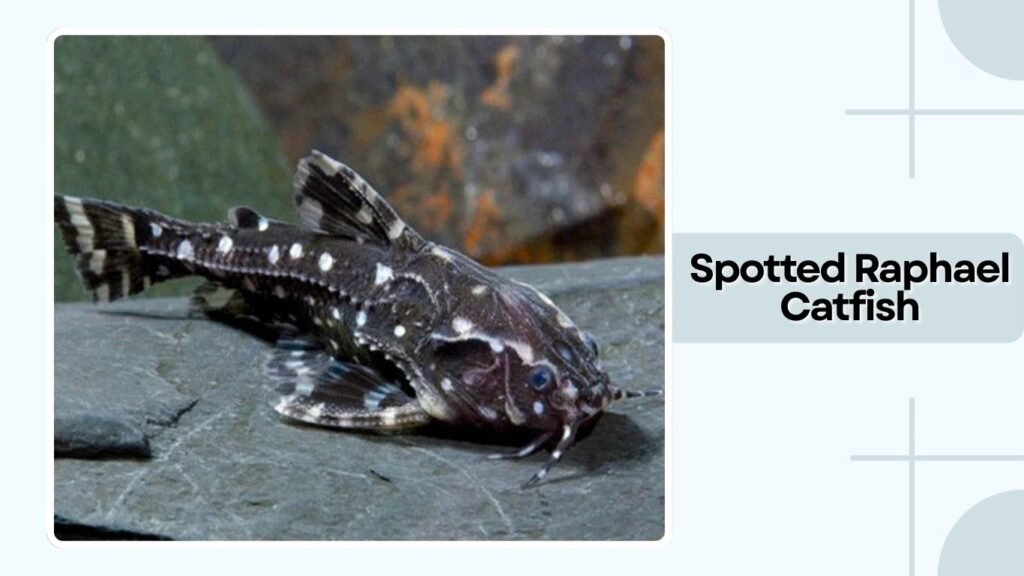
The Spotted Raphael catfish, Agamyxis pectinifrons, is a heavily armored nocturnal species covered with pale spots. It is also called the spotted talking catfish because it can produce audible sounds by moving its pectoral spines. Unlike giant predatory catfish, it usually remains around 6 inches long and can live in a suitably sized community aquarium.
Identification
- Dark brown or nearly black body
- Numerous cream or white spots
- Broad, flattened head
- Three pairs of barbels
- Rows of hard protective plates
- Strong serrated pectoral spines
- Rounded belly and tapered tail
- Adult length of approximately 5–6 inches
Aquarium Size and Setup
A tank of approximately 40 gallons or larger provides useful bottom space for an adult. Supply smooth sand, driftwood, caves, rock shelters, and shaded areas where it can hide during daylight. Secure decorations carefully and protect filter intakes. Exercise caution when netting this fish because its strong pectoral spines can become tangled in mesh; a rigid container is usually safer.
Diet and Feeding
Spotted Raphael catfish are omnivorous scavengers that accept sinking pellets, wafers, bloodworms, insect larvae, chopped earthworms, prawns, and occasional plant-based foods. Feed near evening because the fish becomes more active after the lights dim. It should receive its own food rather than depending entirely on leftovers produced by upper-level fish.
Temperament and Tank Mates
This catfish is generally peaceful but may eat very small fish, shrimp, or fry that it encounters at night. It can live with medium-sized tetras, peaceful cichlids, barbs, gouramis, and other catfish that cannot fit inside its mouth. Avoid aggressive species that may continually harass it or compete for every piece of sinking food.
8. Asian Stone Catfish
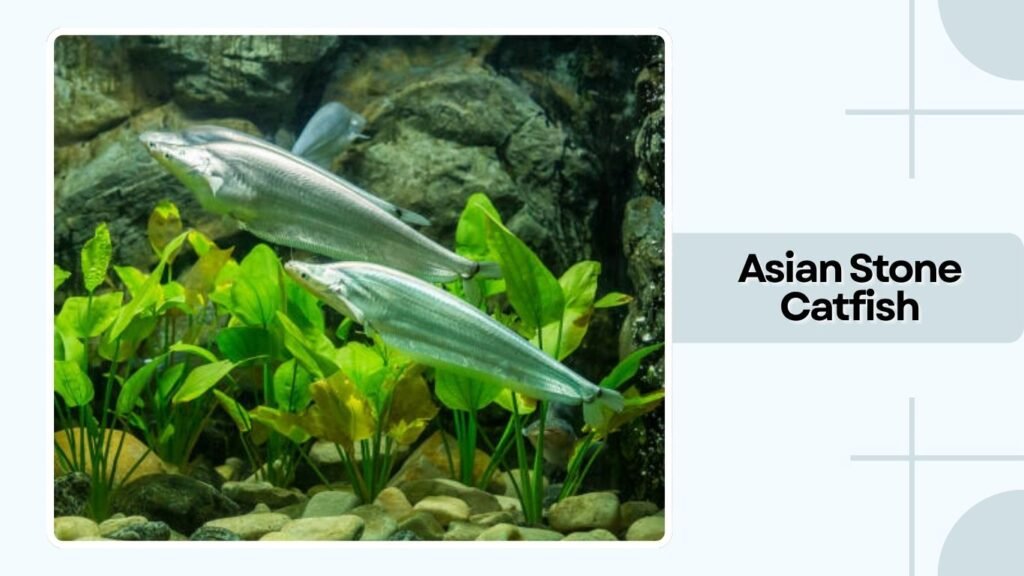
The Asian Stone catfish, Hara jerdoni, is a tiny camouflage specialist native to parts of India and Bangladesh. Also called the dwarf anchor catfish, it usually remains around 1–1½ inches long and spends much of the day resting motionless among stones, wood, and leaf litter.
Identification
- Very small, flattened body
- Brown or gray mottled coloration
- Broad pectoral fins resembling anchors
- Rough, textured body surface
- Short barbels around the mouth
- Small eyes positioned high on the head
- Irregular outline that resembles a dead leaf
- Maximum length of approximately 1½ inches
Aquarium Size and Setup
A mature 10-gallon aquarium can house a small group, although a larger tank makes stable water conditions easier to maintain. Use fine sand, smooth stones, driftwood, dried leaves, moss, and dense shaded cover. Lighting should remain subdued, and the current should be gentle while maintaining good oxygen levels. These fish prefer cooler conditions than many tropical community species.
Diet and Feeding
Asian Stone catfish are shy micropredators that prefer tiny live or frozen foods. Suitable options include daphnia, cyclops, baby brine shrimp, mosquito larvae, and finely chopped bloodworms. Some individuals learn to eat small sinking granules, but dry food should not be assumed acceptable immediately. Feeding after the lights are lowered gives these timid catfish a better opportunity to eat.
Temperament and Tank Mates
This species is peaceful but easily outcompeted by fast or aggressive fish. Appropriate companions include tiny rasboras, small peaceful barbs, dwarf shrimp, and other calm nano species that tolerate similar temperatures. Avoid large fish, energetic bottom feeders, and fin nippers. Keeping several Asian Stone catfish can encourage more natural behavior, although they may still remain hidden for long periods.
9. Tiger Shovelnose Catfish
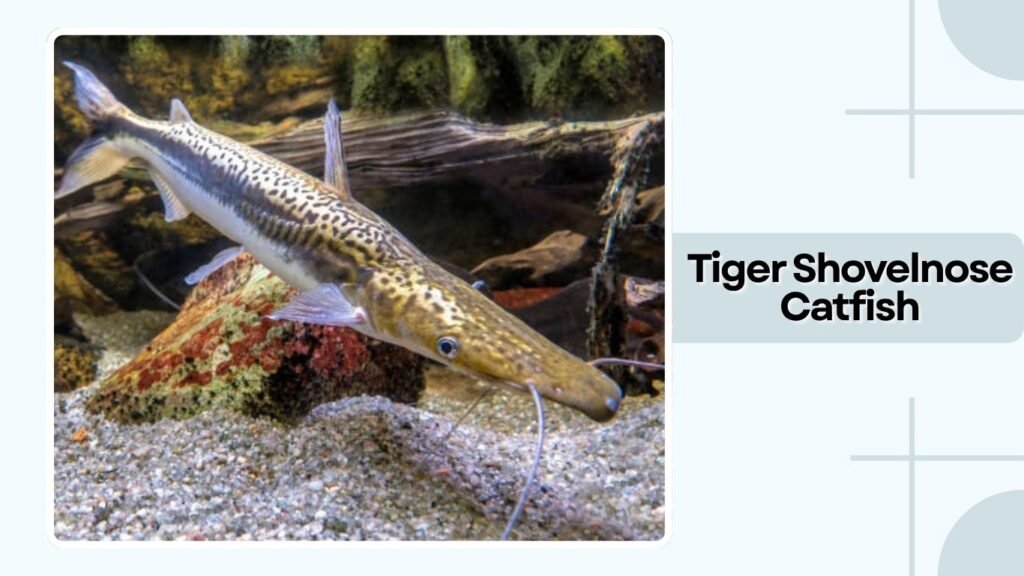
The Tiger Shovelnose catfish is a large South American predator from the genus Pseudoplatystoma. It has a long, flattened snout, dark vertical markings, and exceptionally long barbels. Aquarium specimens may grow to approximately 2½–3 feet, making this species unsuitable for an ordinary home aquarium.
Identification
- Long, broad, shovel-shaped snout
- Silver-gray or tan body
- Dark vertical stripes and scattered spots
- Very long white barbels
- Streamlined, muscular body
- Forked tail marked with dark spots
- Large mouth designed for swallowing prey
- Adult aquarium length commonly exceeding 2 feet
Aquarium Size and Setup
Juveniles quickly outgrow standard aquariums. A mature specimen requires a custom-built tank or indoor pond with several hundred gallons of water, a wide turning area, strong filtration, and a tightly secured lid. Keep decorations minimal and firmly anchored because adults need open swimming space and may collide with sharp objects when startled.
Diet and Feeding
Tiger Shovelnose catfish are carnivores that accept sinking predator pellets, prawns, mussels, earthworms, and other suitable animal-based foods. Feeder fish are unnecessary and may introduce parasites or nutritional problems. Juveniles need controlled, regular meals, whereas adults can be fed less frequently. Excessive feeding leads to rapid waste accumulation and unhealthy weight gain.
Temperament and Tank Mates
The species is not constantly aggressive, but it will swallow smaller fish. Suitable companions must be large enough to avoid predation and strong enough to tolerate its energetic behavior. Even large tank mates require an enormous enclosure. Territorial or highly aggressive fish should be avoided because the Shovelnose’s long barbels and unprotected body can be damaged during conflicts.
10. Channel Catfish
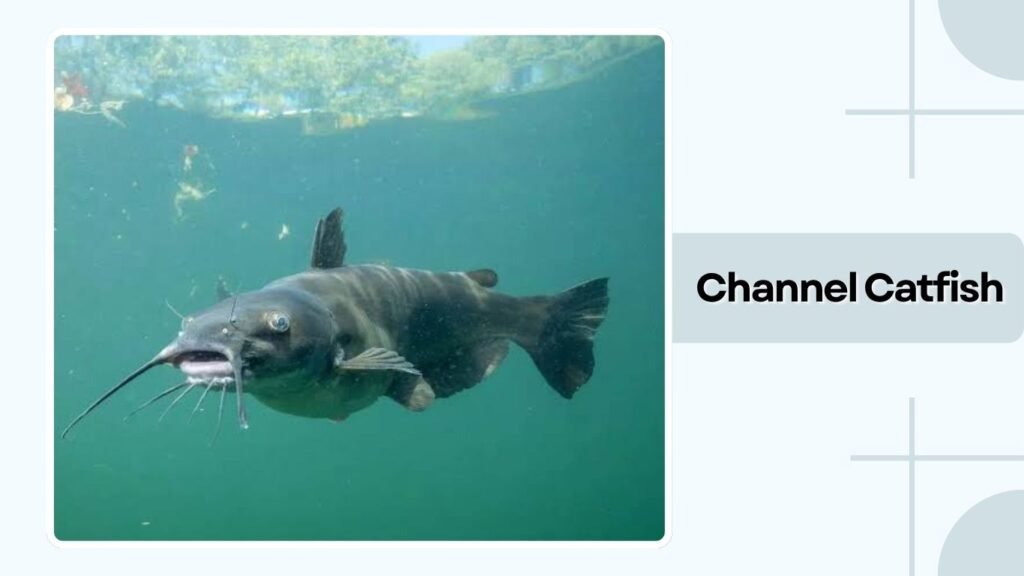
The Channel catfish, Ictalurus punctatus, is a large North American species commonly raised for food and stocked for recreational fishing. Albino forms sometimes enter the aquarium trade, but their eventual size, heavy waste production, and preference for spacious environments make them better suited to ponds than typical indoor aquariums.
Identification
- Long body with a deeply forked tail
- Gray-blue, olive, or dark upper coloration
- Pale belly
- Small dark spots, especially on younger fish
- Four pairs of barbels around the mouth
- Smooth, scaleless skin
- Strong dorsal and pectoral spines
- Albino varieties with pale bodies and reddish eyes
Aquarium Size and Setup
Young Channel catfish may temporarily fit in a large aquarium, but adults require a custom enclosure or outdoor pond. They need substantial swimming space, powerful mechanical and biological filtration, and highly oxygenated water. Use a smooth substrate and leave wide open areas. Their sharp fin spines can damage nets and injure handlers, so movement should be performed with a large rigid container rather than bare hands.
Diet and Feeding
Channel catfish are adaptable omnivores. They consume insects, crustaceans, mollusks, plant material, fish, and other available foods. In captivity, a nutritionally complete sinking catfish pellet should form the main diet, supplemented occasionally with earthworms, prawns, and other suitable foods. Their strong appetite and rapid waste production make portion control and regular water changes essential.
Temperament and Tank Mates
Juveniles may coexist with similarly sized fish, but adults become powerful opportunistic feeders capable of swallowing smaller companions. Suitable tank mates are limited to robust fish too large to consume and require a very spacious enclosure. Channel catfish should not be combined with delicate ornamental species, tiny community fish, or territorial animals likely to attack their barbels.
FAQs
What is the best aquarium catfish for beginners?
Cory catfish are among the best choices for beginners because they are peaceful, social, and relatively easy to care for. Keep them in groups of at least six, provide smooth substrate, and feed sinking foods rather than expecting them to survive only on leftovers.
Which aquarium catfish stay small?
Otocinclus, Asian stone catfish, pygmy Corydoras, and some other small Cory species remain suitable for compact aquariums. Their exact tank requirements differ, but all need stable water, proper food, and compatible tank mates. Small size does not mean they can live without regular maintenance.
Are catfish good for cleaning an aquarium?
Some aquarium catfish eat algae, leftover food, or biofilm, but they cannot replace cleaning and water changes. Otocinclus graze on soft algae, while Cory catfish search for sinking food. Every species still needs a complete diet, and uneaten waste must be removed by the aquarist.
Can different aquarium catfish live together?
Many peaceful catfish can share an aquarium when their size, temperature needs, behavior, and diet are compatible. Corydoras, Otocinclus, and some small species may coexist successfully. Large predatory catfish should not be mixed with small fish because anything fitting inside their mouths may be eaten.
How long do aquarium catfish live?
Lifespan varies greatly by species and care. Smaller aquarium catfish may live around five to ten years, while some larger species can survive much longer. Clean water, correct feeding, adequate tank size, stable temperature, and suitable companions all influence how long an individual fish lives.