

The Royal Pleco is a fascinating freshwater catfish known for its beautiful striped body, impressive adult size, and unusual wood-rasping behavior. Native to South American river systems, this fish has become popular among aquarium enthusiasts who appreciate distinctive bottom-dwelling species. Royal Plecos come in several varieties, including the L190, L191, L027, and Watermelon Royal Pleco. However, their large size and specialized feeding habits require careful planning. Understanding Royal Pleco size, diet, tank requirements, growth rate, lifespan, and behavior will help you provide a healthier aquarium environment.
What Is a Royal Pleco?
The Royal Pleco (Panaque nigrolineatus) is a large freshwater catfish belonging to the family Loricariidae. It is recognized for its armored body, dark horizontal stripes, broad head, and specialized mouth designed for scraping submerged wood.
The name Royal Pleco is also used for several closely related Panaque species and regional forms.
Royal Pleco Identification
- Common Name: Royal Pleco, Royal Panaque
- Scientific Name: Panaque nigrolineatus (L190)
- Family: Loricariidae
- Origin: South America
- Adult Size: Approximately 14–17 inches for L190
- Lifespan: Commonly estimated at 10–20 years
- Diet: Wood-associated material, algae, detritus, and plant foods
- Temperament: Generally peaceful but territorial
- Care Level: Intermediate to advanced
- Swimming Level: Bottom
Physical Appearance
Royal Plecos have broad, flattened bodies covered with protective bony plates. Their striking patterns commonly include dark lines running across a gray, brown, or olive-colored body.
Many individuals have orange or reddish eyes, broad pectoral fins, and powerful sucker-like mouths.
Their colors and stripe patterns vary among species, populations, and individual fish.
Royal Pleco Size and Growth Rate

Royal Plecos are among the larger catfish commonly available in the aquarium trade. Although juveniles may appear small, adults require significantly more swimming space and stronger filtration.
How Big Does a Royal Pleco Get?
A full-grown L190 Royal Pleco commonly reaches approximately 14–17 inches, although exact adult measurements vary.
Scientific records report Panaque nigrolineatus reaching about 43 centimeters in standard length, which excludes the tail fin.
Some related Royal Pleco species grow even larger, making correct identification important before purchasing one.
How Fast Does a Royal Pleco Grow?
Royal Plecos generally grow slowly compared with many other large aquarium catfish.
Their growth rate depends on:
- Diet quality and feeding frequency
- Aquarium size and available space
- Water temperature and cleanliness
- Genetics and species
- Stress levels and overall health
Juveniles may show noticeable growth during their early years, but reaching maximum adult size can take several years.
There is no dependable universal annual growth rate for all Royal Pleco varieties.
Different Types of Royal Plecos
Several Royal Pleco varieties appear in the aquarium trade under different L-numbers. These designations help distinguish fish by appearance and collection locality, but they do not always represent separate scientifically recognized species.
L190 Royal Pleco
The L190 Royal Pleco (Panaque nigrolineatus) is one of the best-known varieties. It features dark horizontal stripes, a broad head, and reddish eyes. Its striking appearance makes it highly desirable among experienced catfish enthusiasts.
L191 Dull-Eyed Royal Pleco
The L191 Royal Pleco is commonly called the Dull-Eyed or Broken-Line Royal Pleco. Juveniles often display a pale band on their tails, while adults develop distinctive dark markings. This Colombian form is generally identified as an undescribed Panaque species.
L027 Goldline Royal Pleco
The L027 designation covers several related regional forms. The Goldline or Tapajós Royal Pleco is associated with Panaque armbrusteri. It is known for its attractive golden or cream-colored stripes against a darker body.
L330 Watermelon Royal Pleco
The Watermelon Royal Pleco (L330) is known for its unusual spotted or broken-line markings. It is generally treated as a form close to Panaque nigrolineatus rather than an entirely unrelated fish.
Blue-Eyed Royal Pleco
Blue-eyed Panaque species, including Panaque cochliodon and Panaque suttonorum, are especially distinctive. Their bluish eyes and darker body coloration help distinguish them from typical red-eyed Royal Plecos.
L203 Titanic Royal Pleco
The Titanic Royal Pleco (Panaque schaeferi) is one of the largest members of the genus. Scientific specimens have reached approximately 24 inches in standard length. Its exceptional size makes it suitable only for extremely spacious aquariums.
Royal Pleco Tank Size and Setup
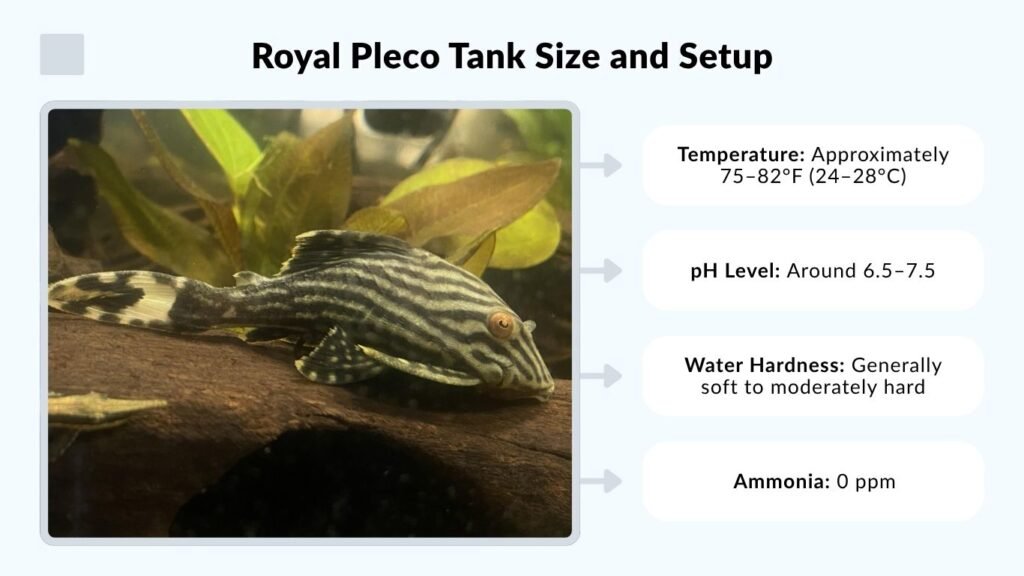
Royal Plecos require spacious aquariums with excellent filtration, stable water conditions, and substantial driftwood. Their heavy bodies and wood-rasping behavior make small aquariums unsuitable for permanent housing.
Recommended Tank Size
For an adult L190 Royal Pleco, an aquarium of approximately 150 gallons or larger, preferably at least 6 feet long with generous front-to-back space, is a sensible long-term starting point.
Larger varieties may require considerably more room.
Aquarium dimensions matter as much as water volume because these fish need space to turn around and establish territories.
Water Parameters
- Temperature: Approximately 75–82°F (24–28°C)
- pH Level: Around 6.5–7.5
- Water Hardness: Generally soft to moderately hard
- Ammonia: 0 ppm
- Nitrite: 0 ppm
- Water Flow: Moderate to strong, with sheltered resting areas
- Filtration: Powerful biological and mechanical filtration
Stable conditions and well-oxygenated water are especially important.
Substrate and Decorations
Royal Plecos can live over smooth gravel or sand, provided the substrate has no sharp edges.
Large pieces of aquarium-safe driftwood should form the main decoration. They provide shelter, grazing surfaces, and natural hiding spaces.
Caves and shaded areas help the fish feel secure. Any heavy decorations must be stable enough to prevent accidents.
What Do Royal Plecos Eat?
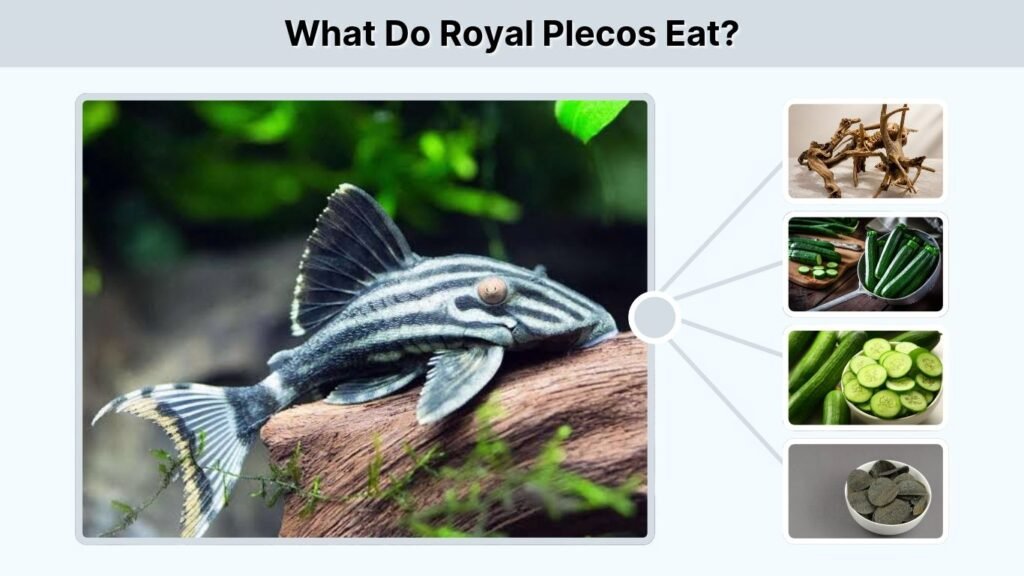
Royal Plecos are famous for scraping and swallowing wood. However, they should not survive on wood alone. Research indicates that these fish extract limited energy from wood cellulose and also depend on associated detritus and other foods.
Best Foods for Royal Plecos
A suitable aquarium diet may include:
- Driftwood: Provides natural grazing material and shelter.
- Zucchini: A commonly accepted vegetable food.
- Cucumber: Provides dietary variety and moisture.
- Squash: Offers additional plant-based nutrition.
- Algae Wafers: Convenient supplemental aquarium food.
- Vegetable-Based Sinking Pellets: Help provide balanced nutrients.
- Sweet Potato: Can be offered occasionally in suitable portions.
- Natural Biofilm: Develops on submerged aquarium surfaces.
Remove uneaten vegetables before they deteriorate and affect water quality.
Do Royal Plecos Eat Algae?
Royal Plecos may consume some algae while grazing, but they are not dependable aquarium algae cleaners.
Their feeding behavior focuses heavily on wood surfaces, associated organic material, and supplementary foods.
Aquarium owners should never rely on Royal Plecos to control significant algae growth.
Royal Pleco Behavior and Tank Mates
Royal Plecos are usually calm toward unrelated fish but may become territorial around other large bottom dwellers.
They frequently rest beneath driftwood or inside caves during daylight and become more active when lighting is reduced.
Suitable Tank Mates
Potential companions in sufficiently large aquariums include:
- Silver Dollar Fish
- Peaceful Geophagus Cichlids
- Larger Tetras
- Congo Tetras
- Boesemani Rainbowfish
- Other peaceful, appropriately sized midwater fish
Compatibility depends on temperament, water requirements, and available space.
Avoid keeping multiple large territorial plecos together in cramped aquariums. Aggressive cichlids and persistent fin-nipping species may also cause problems.
Royal Pleco Lifespan and Breeding

Royal Plecos are long-lived freshwater fish. With appropriate care, they may survive for 10–20 years, although reliable lifespan records are limited.
Their longevity makes them a substantial commitment for aquarium owners.
Can Royal Plecos Breed in Captivity?
Royal Pleco breeding is extremely uncommon in home aquariums.
Breeding conditions remain poorly documented, and distinguishing males from females can be challenging.
Mature males may develop more prominent odontodes, or bristle-like structures, around parts of their heads and fins.
Their large size, territorial behavior, and specialized habitat requirements make successful reproduction difficult.
Common Royal Pleco Health Problems
Poor water quality, inadequate nutrition, overcrowding, and prolonged stress can contribute to health problems.
Warning signs include persistent loss of appetite, unusual breathing, visible injuries, severe weight loss, or abnormal swimming.
Maintaining stable water conditions and providing appropriate food are essential preventive measures.
Royal Pleco Price and Buying Considerations
Royal Pleco prices vary depending on size, species, rarity, location, and availability. Common juvenile L190 specimens are generally easier to find than rare varieties such as certain blue-eyed or platinum-labeled Royal Plecos.
Choosing a Healthy Royal Pleco
Before buying, examine the fish carefully.
Look for clear eyes, intact fins, healthy body condition, and normal breathing. A severely sunken abdomen may indicate poor nutrition or illness.
Ask the seller about the fish’s scientific identification, L-number, feeding habits, and approximate adult size.
Trade names such as platinum, gold, green, and thunder are not always standardized. Confirm the actual fish rather than relying entirely on its label.
FAQs
1. What Is the Maximum Size of a Royal Pleco?
An adult L190 Royal Pleco can reach approximately 17 inches in standard length. Some related species grow larger. The Titanic Royal Pleco, for example, has a reported scientific maximum of approximately 24 inches excluding its tail fin.
2. Is a Royal Pleco Good for Beginners?
Royal Plecos are generally better suited to experienced aquarium keepers. Their large adult size, specialized feeding behavior, heavy waste production, and substantial space requirements can make long-term care challenging for beginners with smaller aquariums.
3. What Is the Difference Between Watermelon Pleco and Royal Pleco?
The Watermelon Pleco, commonly identified as L330, is a type of Royal Pleco with distinctive spotted or broken-line patterns. The standard L190 Royal Pleco usually displays more continuous horizontal stripes. Both belong to the closely related Panaque group.
4. Can Royal Plecos Live Together?
Royal Plecos may become territorial toward their own kind, especially around driftwood and shelters. Keeping multiple adults requires an exceptionally large aquarium with separate hiding places and feeding areas. Keeping one is generally easier and safer.
5. Do Royal Plecos Need Driftwood?
Yes, aquarium-safe driftwood is an important part of Royal Pleco care. These fish naturally scrape and ingest wood while grazing. Driftwood also provides hiding places and supports natural behavior, although additional nutritious foods remain necessary.