

The Sailfin Pleco is a popular freshwater catfish recognized for its enormous dorsal fin, beautiful spotted patterns, and impressive adult size. Native to South American river systems, this armored fish is commonly kept in large tropical aquariums. Several varieties, including Leopard, Spotted, Albino, Marble, and Gold-Spotted Sailfin Plecos, attract aquarium enthusiasts worldwide. Although these fish are relatively hardy, their rapid growth, substantial waste production, and large space requirements make proper care essential. Understanding Sailfin Pleco size, diet, lifespan, behavior, and tank conditions can help you maintain a healthy aquarium.
What Is a Sailfin Pleco?
The Sailfin Pleco (Pterygoplichthys gibbiceps) is a large freshwater catfish belonging to the Loricariidae family. It is also called the Leopard Sailfin Pleco, Gibbiceps Pleco, or Gibby.
This species naturally inhabits the Amazon and Orinoco river basins of South America. Its most recognizable feature is a tall dorsal fin resembling a sail.
Sailfin Pleco Identification
- Common Name: Sailfin Pleco, Leopard Sailfin Pleco
- Scientific Name: Pterygoplichthys gibbiceps
- Family: Loricariidae
- L-Numbers: L083, L165
- Origin: South America
- Adult Size: Approximately 15–20 inches
- Lifespan: Commonly 10–20 years or longer
- Diet: Primarily herbivorous omnivore
- Temperament: Generally peaceful but territorial
- Care Level: Intermediate
- Water Temperature: 73–81°F (23–27°C)
Physical Appearance
Sailfin Plecos have broad, flattened heads, armored bodies, and sucker-shaped mouths. Their bodies display attractive brown, black, cream, or golden markings.
Their enormous dorsal fins contain numerous rays and create an impressive sail-like appearance when fully extended.
Their patterns often change as they mature, with older individuals displaying more complex markings.
Sailfin Pleco Size and Growth Rate

Sailfin Plecos are among the larger plecos commonly available in aquarium stores. Although juveniles may measure only a few inches, they eventually require very spacious aquariums.
How Big Does a Sailfin Pleco Get?
A full-grown Sailfin Pleco can reach approximately 15–20 inches in total length. The scientifically reported maximum for Pterygoplichthys gibbiceps is about 50 centimeters, or 19.7 inches.
Adult size depends on genetics, nutrition, and environmental conditions.
Albino and Leopard Sailfin Plecos have similar growth potential when they belong to the same species.
How Fast Do Sailfin Plecos Grow?
Sailfin Plecos can grow relatively quickly during their juvenile stages, particularly when provided with adequate food and clean water.
Their growth rate depends on:
- Nutrition: Balanced feeding supports development.
- Tank Space: Adequate space supports healthy movement.
- Water Quality: Poor conditions may restrict growth.
- Temperature: Suitable temperatures support metabolism.
- Genetics: Individual fish grow at different rates.
- Health: Disease and stress can slow development.
There is no fixed monthly growth rate, and growth generally slows as the fish approaches adulthood.
Different Types of Sailfin Plecos
Several fish are sold under the Sailfin Pleco name. Some represent color variations of the same species, while others belong to different species within the genus Pterygoplichthys.
Leopard Sailfin Pleco
The Leopard Sailfin Pleco (Pterygoplichthys gibbiceps) displays dark spots and irregular honeycomb patterns across its body and fins.
It is one of the most recognizable varieties and can grow to approximately 20 inches.
Spotted Sailfin Pleco
The name Spotted Sailfin Pleco is often used for Pterygoplichthys gibbiceps, although some retailers also apply similar names to Pterygoplichthys pardalis.
These fish display numerous dark spots across their bodies. Accurate species identification is important because common names overlap.
Albino Sailfin Pleco
The Albino Sailfin Pleco is a pale-colored form commonly associated with Pterygoplichthys gibbiceps.
It typically has a cream, yellowish, or pinkish body with reddish eyes. Despite its different appearance, it can reach the same large adult size as normally colored individuals.
Marble Sailfin Pleco
The Marble Sailfin Pleco is a trade name used for fish displaying irregular, marble-like patterns.
The name is not a reliable scientific identification, and retailers may use it for different Pterygoplichthys species.
Gold-Spotted Sailfin Pleco
The Gold-Spotted Sailfin Pleco (L001) is generally identified as Pterygoplichthys joselimaianus.
It has beautiful golden spots against a darker body. This species is distinct from the Leopard Sailfin Pleco and can grow to approximately 12–14 inches or more.
Sailfin Pleco Tank Size and Water Requirements
Sailfin Plecos require spacious aquariums because of their large adult size and substantial waste production. Maintaining excellent filtration and stable water conditions is essential for their health.
Recommended Tank Size
A minimum of around 125 gallons is commonly recommended for adult Pterygoplichthys gibbiceps, although 150–180 gallons or larger provides a more comfortable long-term setup.
A tank approximately 6 feet long with generous front-to-back space is preferable.
A 29-gallon aquarium is unsuitable for a fully grown Sailfin Pleco.
Ideal Water Parameters
- Temperature: 73–81°F (23–27°C)
- pH Level: Approximately 6.0–8.0
- Water Hardness: Around 5–19 dGH
- Ammonia: 0 ppm
- Nitrite: 0 ppm
- Nitrate: Preferably below 20–30 ppm
- Water Flow: Moderate
- Filtration: Powerful biological and mechanical filtration
Regular partial water changes help control waste accumulation.
Substrate and Decorations
Smooth gravel or sand provides a suitable substrate for Sailfin Plecos.
Large driftwood pieces, rocks, and spacious caves create natural hiding places. Decorations should be firmly positioned because mature plecos are powerful enough to move lightweight objects.
What Do Sailfin Plecos Eat?

Sailfin Plecos are primarily plant-oriented omnivores that naturally graze on algae, biofilm, and organic material.
Although they are often sold as algae eaters, they require additional nutritious foods for proper growth and long-term health.
Best Foods for Sailfin Plecos
Suitable aquarium foods include:
- Algae Wafers: Provide convenient plant-based nutrition.
- Zucchini: A popular vegetable for plecos.
- Cucumber: Offers dietary variety.
- Spinach: Can be fed occasionally.
- Peas: Provide additional plant nutrients.
- Sinking Pellets: Supply balanced nutrition.
- Spirulina-Based Foods: Support a vegetable-rich diet.
- Occasional Protein: Small portions of suitable frozen or prepared foods.
Remove uneaten vegetables before they spoil.
Do Sailfin Plecos Eat Driftwood?
Sailfin Plecos may rasp and graze on driftwood surfaces, but they are not specialized wood-eating catfish like Royal Plecos.
Driftwood is useful for shelter and natural grazing behavior rather than serving as their main food source.
Sailfin Pleco Behavior and Tank Mates
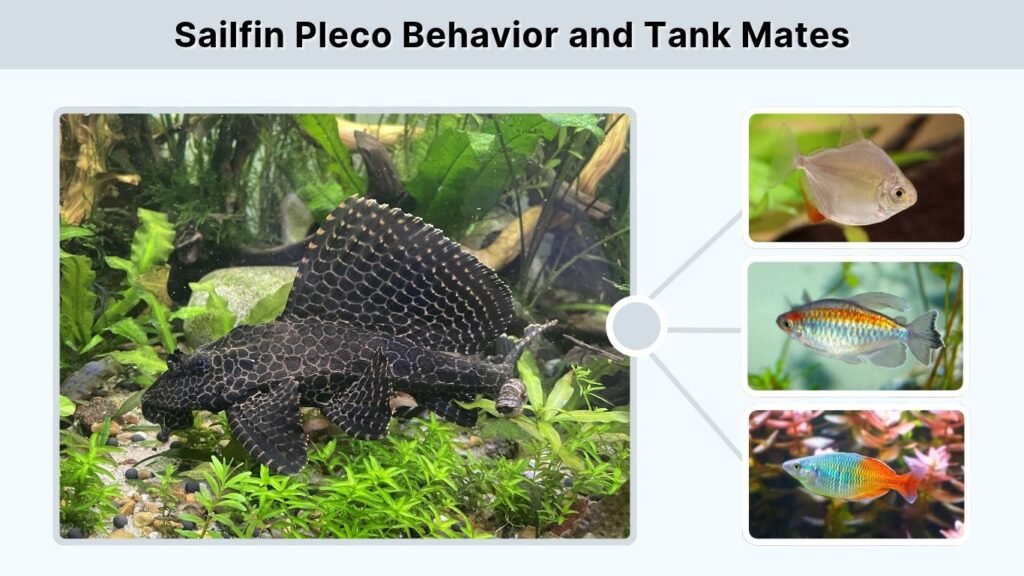
Sailfin Plecos are generally peaceful toward fish that occupy the middle and upper levels of an aquarium. However, they can become territorial toward other large plecos, especially when competing for hiding places.
They are usually most active during evening and nighttime hours.
Suitable Tank Mates
Potential companions include:
- Silver Dollar Fish
- Larger Peaceful Tetras
- Congo Tetras
- Suitable Rainbowfish
- Peaceful Larger Barbs
- Compatible South American Cichlids
Tank mates must tolerate similar water conditions and should not harass the pleco.
Avoid overcrowding or keeping multiple territorial plecos in limited space.
Sailfin Pleco vs. Common Pleco
Sailfin Plecos and Common Plecos are frequently confused because both have armored bodies, sucker mouths, and similar feeding habits.
However, their body patterns and dorsal fins can help distinguish them.
| Feature | Sailfin Pleco | Common Pleco |
| Scientific Name | P. gibbiceps | Often P. pardalis or related species |
| Adult Size | Up to about 20 inches | Often 15–20 inches |
| Dorsal Fin | Very large, sail-like | Large, often less dramatically raised |
| Pattern | Leopard or honeycomb | Usually spots or irregular markings |
| Diet | Plant-oriented omnivore | Omnivore |
| Tank Size | Very large aquarium | Very large aquarium |
Both fish can grow too large for ordinary community tanks, so neither should be purchased solely for cleaning algae.
Sailfin Pleco Lifespan and Breeding
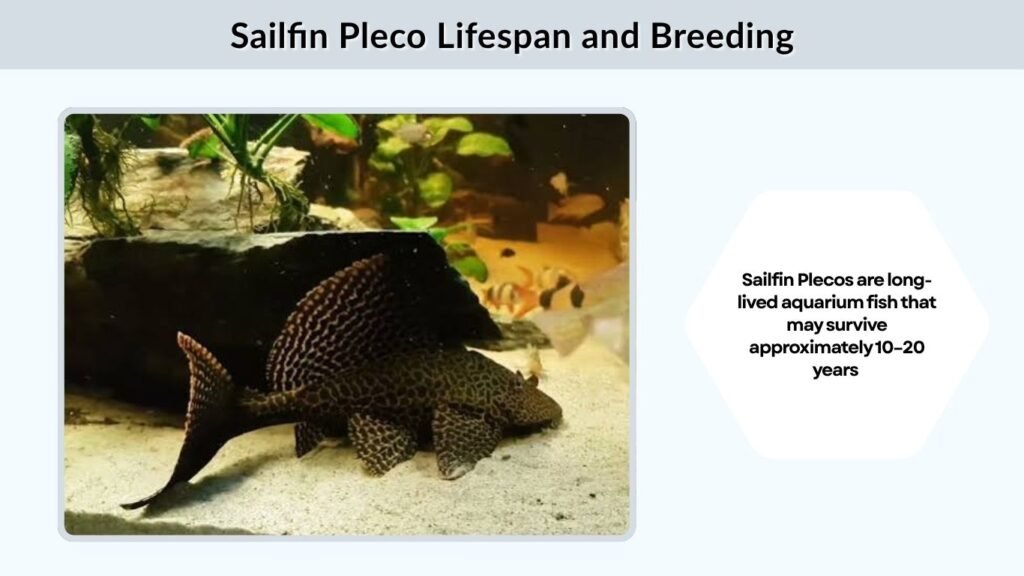
Sailfin Plecos are long-lived aquarium fish that may survive approximately 10–20 years or longer with appropriate care.
Their longevity makes them a significant long-term responsibility.
Male vs. Female Sailfin Pleco
Distinguishing males from females is difficult, especially when fish are immature.
Adult males may have a slightly more prominent genital papilla, while females generally have a flatter or more recessed structure.
Body shape and fin size alone are not reliable methods for identifying sex.
Can Sailfin Plecos Breed in Captivity?
Sailfin Pleco breeding is extremely uncommon in ordinary home aquariums.
In their natural environment, members of the genus Pterygoplichthys reproduce in burrows along riverbanks, with males guarding the eggs.
Reproducing these conditions in a household aquarium is challenging, making commercial or specialized breeding environments more suitable.
Sailfin Pleco Price and Buying Tips
Sailfin Pleco prices vary according to size, coloration, variety, and retailer. Juvenile standard Sailfin Plecos are often relatively inexpensive, while larger specimens and unusual color forms can cost more.
Before purchasing, inspect the fish for healthy body condition, clear eyes, intact fins, and normal breathing.
Avoid specimens with severely sunken bellies, visible wounds, or unusual swimming behavior.
Most importantly, confirm that your aquarium can accommodate the fish’s eventual adult size.
FAQs
1. Are Sailfin Plecos Aggressive?
Sailfin Plecos are generally peaceful toward unrelated community fish. However, mature individuals can become territorial toward other plecos, especially when competing for shelters or food. Providing a spacious aquarium with multiple hiding areas helps reduce aggressive encounters.
2. Can Sailfin Plecos Live in Cold Water?
Sailfin Plecos are tropical fish and should not be maintained in unheated cold-water aquariums. They generally prefer temperatures around 73–81°F (23–27°C). Prolonged exposure to unsuitable cold temperatures can cause stress and increase susceptibility to illness.
3. Do Albino Sailfin Plecos Grow as Big as Regular Sailfin Plecos?
Yes, albino Sailfin Plecos can reach approximately the same adult size as standard Sailfin Plecos of the same species. Their pale coloration results from reduced pigmentation and does not make them smaller or suitable for compact aquariums.
4. Can Two Sailfin Plecos Live Together?
Two Sailfin Plecos may coexist in exceptionally large aquariums with separate territories and hiding places. However, mature individuals can become territorial and aggressive toward each other. Keeping a single Sailfin Pleco is generally easier and safer.
5. Are Sailfin Plecos Good Algae Eaters?
Sailfin Plecos naturally consume algae and biofilm, particularly when young. However, adults require substantial additional food and produce considerable waste. They are not suitable substitutes for routine aquarium maintenance or reliable solutions to serious algae problems.