
The western mosquitofish (Gambusia affinis) is a small freshwater fish known for its ability to consume mosquito larvae and survive in challenging aquatic environments. Native to parts of the central and southern United States and Mexico, this hardy species commonly inhabits ponds, marshes, streams, and shallow wetlands. Western mosquitofish reproduce quickly, tolerate changing water conditions, and play an important role in aquatic food webs. However, they can become invasive outside their natural range. Understanding their size, identification, habitat, diet, lifespan, breeding, and care requirements helps explain the biology of these fascinating fish.
What Is a Western Mosquitofish?
The western mosquitofish is a livebearing freshwater species belonging to the family Poeciliidae. It is closely related to the eastern mosquitofish, guppies, and other small livebearers. Its common name comes from its habit of consuming mosquito larvae, although its diet includes many other aquatic organisms.
Western Mosquitofish Facts
- Scientific name: Gambusia affinis
- Family: Poeciliidae
- Common name: Western mosquitofish
- Size: Approximately 1–3 inches, depending on sex
- Color: Gray, olive, or light brown
- Diet: Omnivorous, primarily small invertebrates
- Lifespan: Usually 1–3 years
- Reproduction: Livebearing
- Habitat: Freshwater and occasionally brackish water
- Native region: Central and southern United States and northeastern Mexico
Western mosquitofish were scientifically described in 1853 and have since been introduced to numerous countries for mosquito control.
Western Mosquitofish Identification and Size
Western mosquitofish have relatively plain coloration compared with ornamental aquarium species. However, their body shape and feeding behavior provide useful identification clues. Their small size, upward-facing mouth, and rounded tail help distinguish them from many other freshwater fish.
Physical Appearance
Western mosquitofish have short, slender bodies, slightly flattened heads, and rounded tail fins. Their scales are generally gray or brown with darker edges, creating a subtle pattern.
Their mouths point upward, allowing them to capture small organisms near the water’s surface. They also have relatively large eyes and transparent fins that may display small dark spots.
Male vs. Female Western Mosquitofish
Adult females are considerably larger than males and have fuller, more rounded abdomens.
Females commonly grow to approximately 2–3 inches, while males usually reach around 1–1.5 inches.
Mature males possess a modified anal fin called a gonopodium, which transfers sperm during reproduction. Females retain a normal fan-shaped anal fin and often develop a dark gravid spot toward the rear of the abdomen.
These differences make mature male and female western mosquitofish relatively easy to distinguish.
Western Mosquitofish Habitat and Native Range

Western mosquitofish naturally occupy freshwater habitats across parts of North America. They thrive in shallow, warm water with abundant vegetation, where small aquatic organisms provide food and plants offer shelter from predators.
Where Do Western Mosquitofish Live?
Their native range includes the Mississippi River basin from central Indiana and Illinois southward toward the Gulf of Mexico.
They also occur naturally in Gulf Coast drainages extending westward into northeastern Mexico.
Western mosquitofish have been introduced to California, Hawaii, and other regions outside their original distribution.
Preferred Habitat
Common habitats include:
- Shallow freshwater ponds
- Marshes and wetlands
- Slow-moving rivers and streams
- Vegetated drainage ditches
- Lakes and quiet backwaters
- Occasionally brackish coastal waters
Western mosquitofish frequently swim near the surface, searching for food among aquatic plants. They can tolerate low dissolved oxygen and fluctuating environmental conditions better than many freshwater fish.
Western Mosquitofish Adaptations
Several adaptations help western mosquitofish survive challenging environments. Their upturned mouths support surface feeding, while their flexible diet allows them to exploit different food sources.
Their rapid reproduction and tolerance of changing water conditions also help populations recover after periods of environmental stress.
What Do Western Mosquitofish Eat?

Western mosquitofish are opportunistic omnivores that consume a wide variety of aquatic organisms. Although mosquito larvae are an important food source in some habitats, these fish do not depend exclusively on mosquitoes for survival.
Western Mosquitofish Diet
Their natural diet includes:
- Mosquito larvae and pupae
- Small aquatic insects
- Zooplankton
- Tiny crustaceans
- Insect eggs and larvae
- Rotifers and small snails
- Occasional plant material and detritus
Western mosquitofish may also eat newly born fish, including their own offspring.
In aquariums, they can accept appropriately sized commercial fish food supplemented with daphnia, brine shrimp, and other small foods.
Western Mosquitofish Care in Aquariums
Western mosquitofish are hardy aquarium fish, but proper care remains important. Their active behavior, rapid breeding, and occasional aggression mean they are generally better suited to experienced fishkeepers or species-focused aquariums.
Tank Size and Water Conditions
A 20-gallon aquarium provides a practical starting point for a small group, although larger populations require additional space.
Provide these basic conditions:
- Filtration: Use effective biological filtration.
- Water quality: Maintain undetectable ammonia and nitrite.
- Temperature: Avoid sudden changes and prolonged extremes.
- Aquatic plants: Include hiding places and vegetated areas.
- Feeding: Offer a varied diet in small portions.
- Maintenance: Perform regular partial water changes.
Although western mosquitofish tolerate difficult environmental conditions in nature, maintaining stable aquarium conditions promotes better long-term health.
Temperament and Tankmates
Western mosquitofish can display aggressive behavior, especially when crowded. They may nip fins or attack smaller fish.
Avoid housing them with delicate, slow-moving, or long-finned aquarium species.
A species-only aquarium is often a suitable option for observing their natural behavior and reproductive activity.
Western Mosquitofish Breeding and Lifespan
Western mosquitofish reproduce through internal fertilization and give birth to live young. Their reproductive efficiency allows populations to increase rapidly when food and environmental conditions are favorable.
How Do Western Mosquitofish Reproduce?
During mating, the male uses his gonopodium to transfer sperm into the female.
Females can store sperm and produce multiple broods following a successful mating.
Developing embryos hatch internally, and females give birth to free-swimming young. Development commonly takes around 21–28 days, depending on environmental conditions.
Brood sizes vary significantly, ranging from a few fry to large numbers in mature females.
Aquatic vegetation provides important protection for newborn fish because adults may consume them.
How Long Do Western Mosquitofish Live?
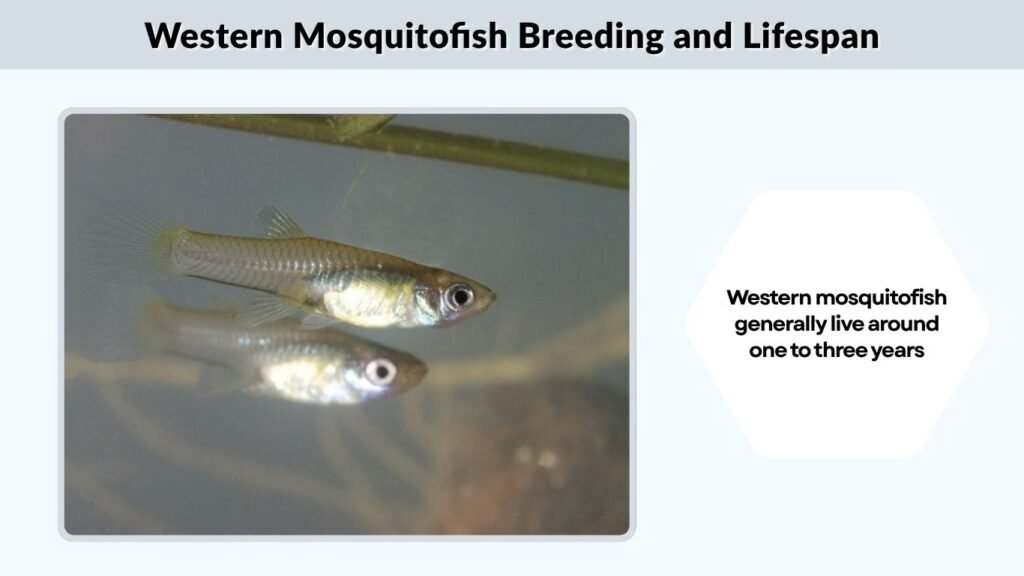
Western mosquitofish generally live around one to three years, although many wild individuals have shorter lifespans.
Temperature, food availability, predation, and water conditions influence survival.
Their rapid growth and reproduction help populations remain abundant even when seasonal mortality is high.
Western Mosquitofish Benefits and Invasive Impacts
Western mosquitofish have historically been introduced into ponds and other water bodies to reduce mosquito larvae. However, their effectiveness and environmental consequences vary considerably between habitats.
Benefits of Western Mosquitofish
These fish consume mosquito larvae and other small aquatic organisms. In suitable, managed water bodies, their feeding activity may help reduce mosquito development.
They also serve as prey for larger fish, birds, and other aquatic predators.
Are Western Mosquitofish Invasive?
Yes. Western mosquitofish can become invasive when introduced outside their native range.
They may compete with native fish, prey on amphibian larvae, and disrupt aquatic food webs.
Research summarized by the USGS indicates that introducing mosquitofish does not consistently improve mosquito control compared with native aquatic predators.
For this reason, western mosquitofish should never be released into natural waterways without appropriate environmental authorization.
Eastern Mosquitofish vs. Western Mosquitofish

Eastern and western mosquitofish are closely related species that share many physical and behavioral characteristics. Although they appear nearly identical, their original geographic ranges and certain fin structures differ.
| Feature | Western mosquitofish | Eastern mosquitofish |
| Scientific name | Gambusia affinis | Gambusia holbrooki |
| Native range | Mississippi basin and western Gulf drainages | Atlantic and eastern Gulf drainages |
| Average appearance | Gray-brown | Gray-olive |
| Dorsal soft rays, typically | 6 | 7 |
| Reproduction | Livebearing | Livebearing |
| Diet | Small aquatic organisms | Small aquatic organisms |
Western mosquitofish generally have fewer dorsal and anal soft rays than eastern mosquitofish. Specialists may also examine the male gonopodium for accurate identification.
Because historical stocking records often confuse the two species, identification based on geographic location alone is not always reliable.
Western Mosquitofish for Sale: Where to Buy
Western mosquitofish may be available through specialty aquarium suppliers, pond-fish sellers, or approved mosquito-control programs.
Before purchasing, verify the scientific name and check local regulations governing possession and outdoor stocking.
Avoid releasing purchased fish into public waterways. In locations where western mosquitofish are invasive, native aquatic species may be more appropriate alternatives for mosquito management.
FAQs
1. Are western mosquitofish native to North Carolina?
Western mosquitofish have been documented in several western North Carolina counties, including Buncombe, Cherokee, Henderson, and Macon. Their native status should be evaluated by individual drainage basin rather than assuming all mosquitofish throughout the state are native.
2. Do western mosquitofish eat mosquitoes?
Yes. Western mosquitofish consume mosquito larvae and pupae, particularly when these organisms are readily available. However, their diet includes many other aquatic invertebrates, and their effectiveness as mosquito-control agents varies between different environments.
3. Can western mosquitofish survive in cold water?
Western mosquitofish tolerate some cold conditions, but prolonged freezing temperatures can cause significant mortality. Populations in northern locations may decline during winter and recover through rapid reproduction when warmer weather returns.
4. What animals eat western mosquitofish?
Western mosquitofish are eaten by larger predatory fish, wading birds, and other aquatic predators. Their small size makes them vulnerable, particularly in open water. Vegetated habitats provide protection and improve their chances of survival.
5. Are western mosquitofish good for ponds?
Western mosquitofish can live in suitable ponds and consume mosquito larvae. However, their aggressive behavior and invasive potential create ecological concerns. Only use them where legally permitted and environmentally appropriate, preferably following local mosquito-control guidance.