
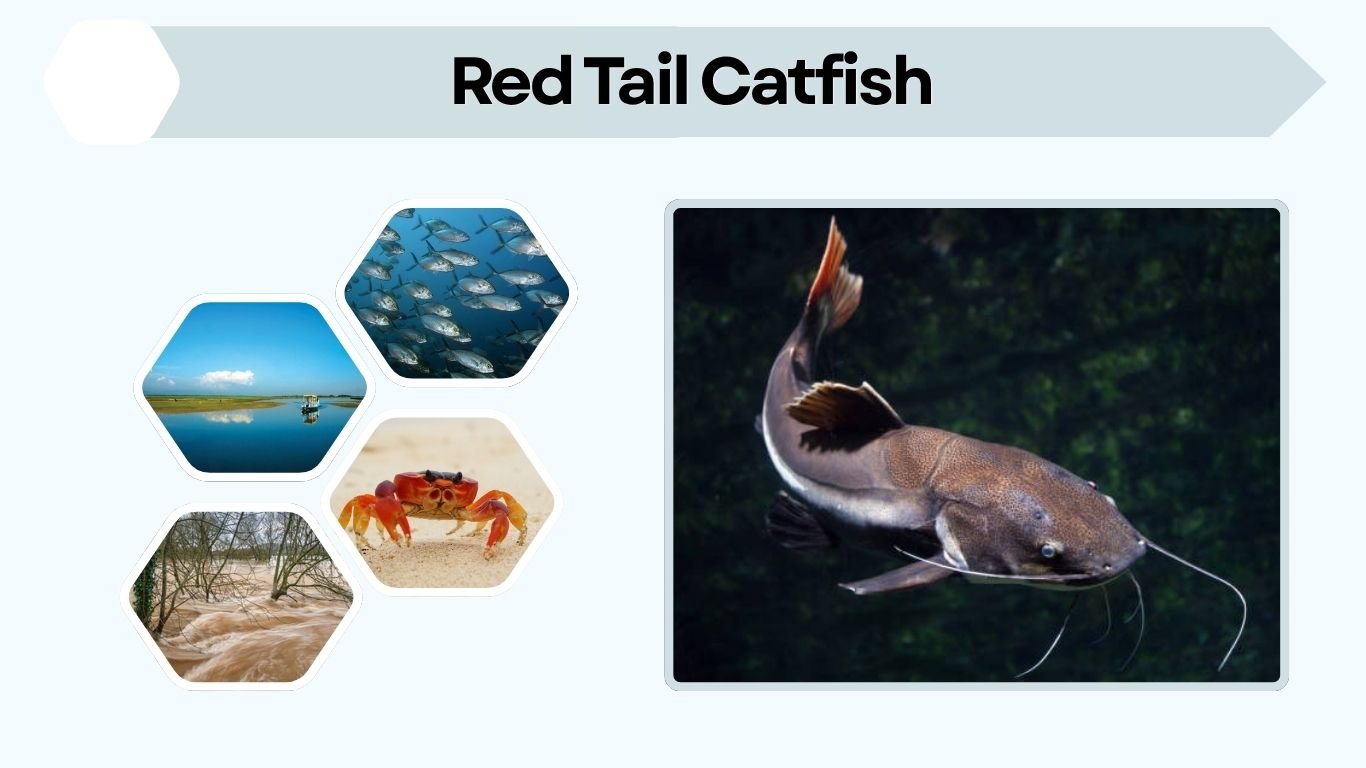
The red tail catfish (Phractocephalus hemioliopterus) is one of the most recognizable giant freshwater catfish in the aquarium world. Its broad head, long whiskers, dark body, white belly, and bright orange-red tail make it easy to identify. Native to the Amazon and Orinoco river basins of South America, this fish can grow well beyond 3 feet long and requires an enormous amount of space. Although young red tail catfish are sometimes sold as aquarium pets, their adult size makes them unsuitable for most home aquariums.
What Is a Red Tail Catfish?
The red tail catfish, also spelled red-tailed catfish or redtail catfish, belongs to the family Pimelodidae, commonly known as long-whiskered catfishes.
Its scientific name is Phractocephalus hemioliopterus. FishBase lists it as a tropical freshwater, bottom-oriented species native to South America’s Amazon and Orinoco river systems.
| Feature | Red Tail Catfish |
|---|---|
| Scientific name | Phractocephalus hemioliopterus |
| Family | Pimelodidae |
| Type | Freshwater catfish |
| Native range | Amazon and Orinoco basins |
| Maximum documented length | About 135 cm (53 in) |
| Maximum published weight | 44.2 kg (97 lb) |
| Diet | Fish, crustaceans, fruit and other foods |
| Aquarium level | Advanced / giant-fish specialist |
Red Tail Catfish Identification
A full-grown red tail catfish has an unmistakable appearance. Its huge head and mouth account for a significant portion of its body, while long barbels extend around the mouth.
Identification Features
Look for:
- Large, broad flattened head
- Very wide mouth
- Long whisker-like barbels
- Dark gray to black upper body
- Pale or white underside
- Bright orange or red caudal fin
- Thick, muscular body
- Large adipose fin
Juveniles have essentially the same basic body pattern but are much smaller and often look more manageable than they eventually become.
Red Tail Catfish Size
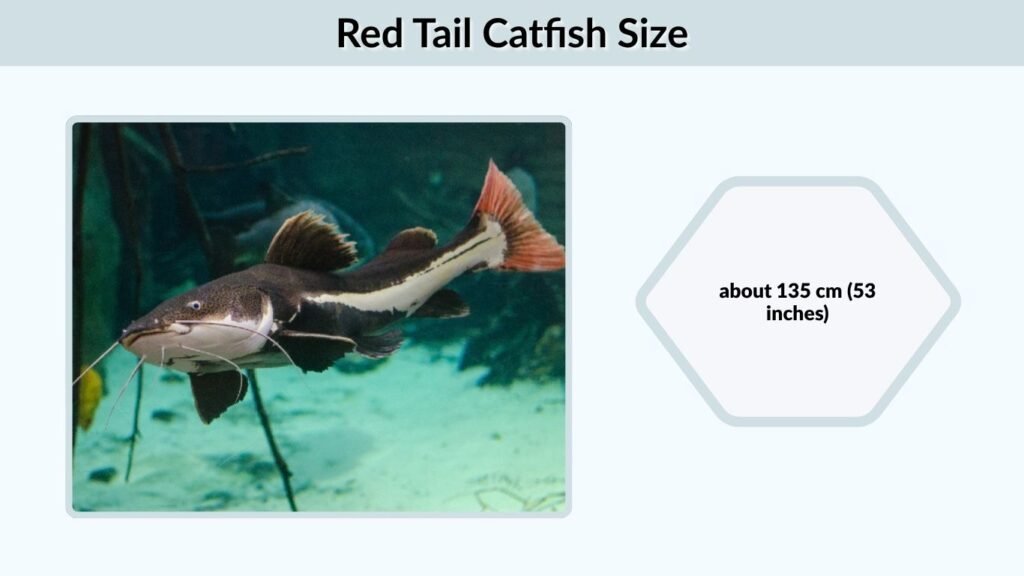
One of the most important facts about this species is its enormous adult size.
FishBase reports a maximum published total length of about 135 cm (53 inches) and a maximum published weight of 44.2 kg (97 pounds). A commonly recorded length is around 60 cm, but individual fish can become substantially larger.
How Big Do Red Tail Catfish Get?
A particularly large adult can reach approximately:
- 4 feet or more in length
- Around 100 pounds based on published scientific records
- Several times the size of the juveniles commonly seen in aquarium stores
This extreme growth potential is why buying a small red tail catfish without planning for its adult size can quickly become a problem.
Full-Grown Red Tail Catfish
A full-grown red tail catfish is an enormous and powerful fish.
Juveniles measuring only several inches may be sold in the aquarium trade, but they should never be purchased on the assumption that a regular home aquarium will permanently restrict their growth.
Keeping a fish in a small enclosure does not provide a healthy or humane way to keep it small. Adult housing must accommodate normal movement and the fish’s massive body.
For a genuinely full-grown individual, specialist fish resources recommend an enclosure measuring roughly 12 × 8 × 4 feet, or around 10,000 liters, illustrating just how unrealistic conventional aquariums are for adults.
Red Tail Catfish Tank Size
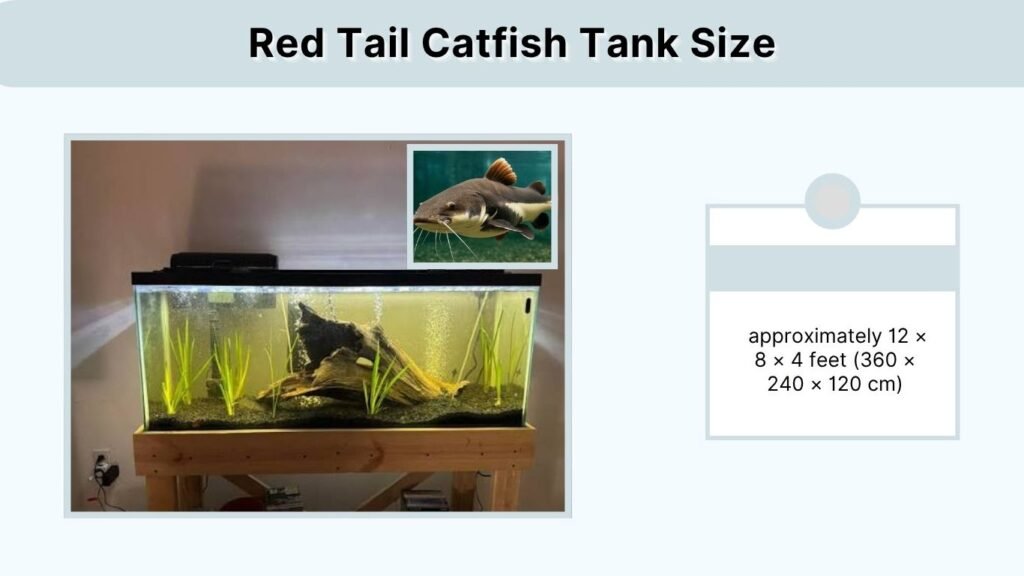
The red tail catfish tank size requirement is far beyond that of ordinary aquarium fish.
Small juveniles can temporarily live in comparatively smaller tanks, but this should only be part of a planned progression toward an enormous permanent enclosure.
Tank Requirements for Adults
A mature red tail catfish needs:
- An extremely large custom aquarium or indoor pond
- Large open swimming areas
- Powerful biological and mechanical filtration
- Excellent oxygenation
- Heavy-duty equipment
- Secure decorations that cannot be knocked over
Seriously Fish estimates that approximately 12 × 8 × 4 feet (360 × 240 × 120 cm) would be needed for a fully grown specimen—more than 10,000 liters of water.
Consequently, this species is much better suited to public aquariums, monster-fish specialists, and professionally designed indoor ponds than typical household tanks.
Do Red Tail Catfish Need a Heater?
Red tail catfish are tropical freshwater fish.
FishBase records a tropical temperature range of approximately 20–26°C (68–79°F) and a pH range around 5.5–6.8 in their natural environment.
Whether a heater is necessary depends on the ambient temperature of the aquarium or pond. In cooler climates, heating is generally necessary to maintain stable tropical conditions.
Because extremely large volumes of water are involved, heating an adult enclosure can require specialized equipment rather than a small conventional aquarium heater.
Where Do Red Tail Catfish Live?
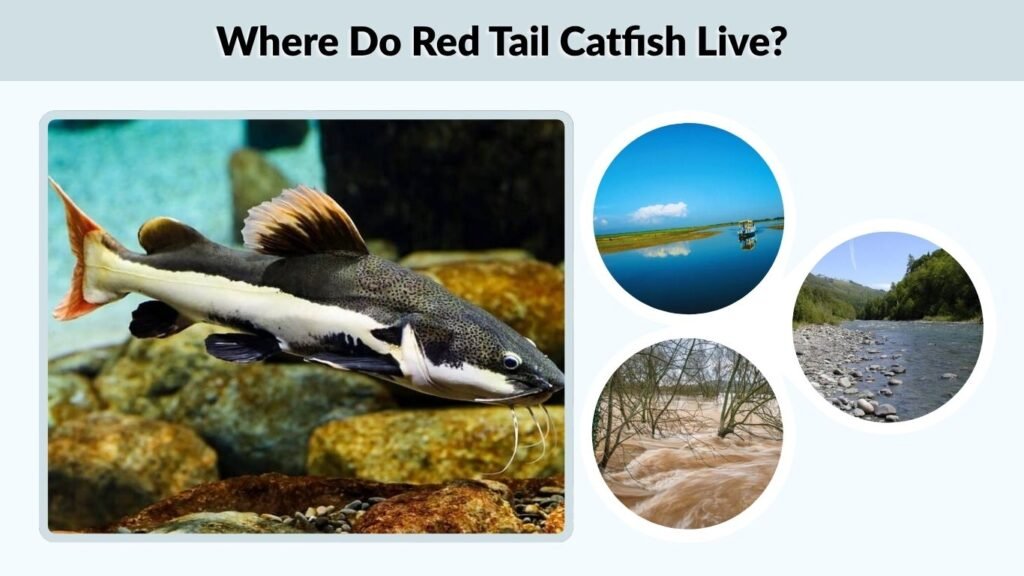
Wild red tail catfish are native to South America, particularly the Amazon and Orinoco river basins.
They are freshwater, bottom-associated fish and inhabit the vast tropical river systems of the continent.
Red Tail Catfish Habitat
Their natural environment includes:
- Major rivers
- River channels
- Flooded habitats
- Deep freshwater areas
- Areas offering access to abundant food
FishBase also records the species as introduced but not established in Florida, meaning occasional records should not be confused with a naturally established Florida population.
What Do Red Tail Catfish Eat?
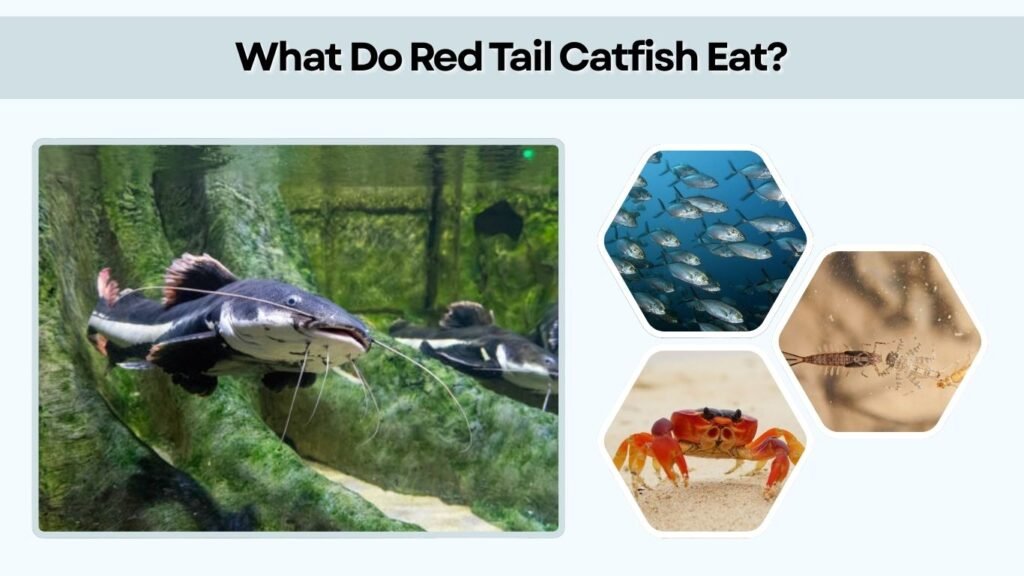
Red tail catfish are opportunistic feeders.
FishBase reports that adults consume fish, crabs, and fruit in their natural habitat.
Their potential diet includes:
- Fish
- Crustaceans
- Crabs
- Shrimp
- Aquatic invertebrates
- Fallen fruit
- Other animal foods
Red Tail Catfish Food in Aquariums
Captive fish should receive a nutritionally varied diet appropriate for large carnivorous or omnivorous catfish rather than relying solely on feeder fish.
Overfeeding should also be avoided. Large predatory fish can readily consume substantial meals, but excessive feeding contributes unnecessary waste and can negatively affect water quality.
Are Red Tail Catfish Aggressive?
Red tail catfish are powerful predators, but they are not necessarily constantly aggressive toward every fish.
The larger issue is predation.
Their enormous mouth allows them to swallow fish that appear surprisingly large. Tank mates small enough to fit into the mouth should be considered potential food.
Even large companions require enormous shared space, making community setups extremely difficult in ordinary home aquariums.
Red Tail Catfish Lifespan
Red tail catfish are long-term commitments rather than short-lived aquarium pets.
Exact lifespan figures vary considerably among aquarium sources, and robust scientific maximum-age data are limited. Their potential longevity, combined with enormous growth, means prospective owners should plan for many years of specialized housing rather than buying one as a temporary display fish.
Their size—not their day-to-day feeding—is usually the biggest challenge of ownership.
Platinum, Albino and Phantom Red Tail Catfish
Several unusual-looking red tail catfish appear in the ornamental fish trade.
Platinum Red Tail Catfish
A platinum red tail catfish has unusually pale coloration compared with the standard dark-backed form. These specimens can command high prices because of their rarity.
Albino Red Tail Catfish
Fish sold as albino red tail catfish have strongly reduced dark pigmentation and a much lighter overall appearance.
Phantom Red Tail Catfish
“Phantom red tail catfish” is primarily an aquarium-trade description for unusually colored individuals rather than a separate recognized wild species.
Regardless of coloration, these fish retain the enormous housing requirements associated with red tail catfish.
Red Tail Catfish Hybrid
One of the better-known aquarium hybrids combines the red tail catfish with a tiger shovelnose catfish (Pseudoplatystoma species).
These fish may be advertised as:
- Red tail tiger shovelnose catfish
- Tiger red tail catfish
- Redtail shovelnose hybrid
- RTC × tiger shovelnose
They can combine physical features from both parents and may become enormous themselves. Hybrid status should therefore never be interpreted as meaning the fish stays small.
Asian Red Tail Catfish vs South American Red Tail Catfish
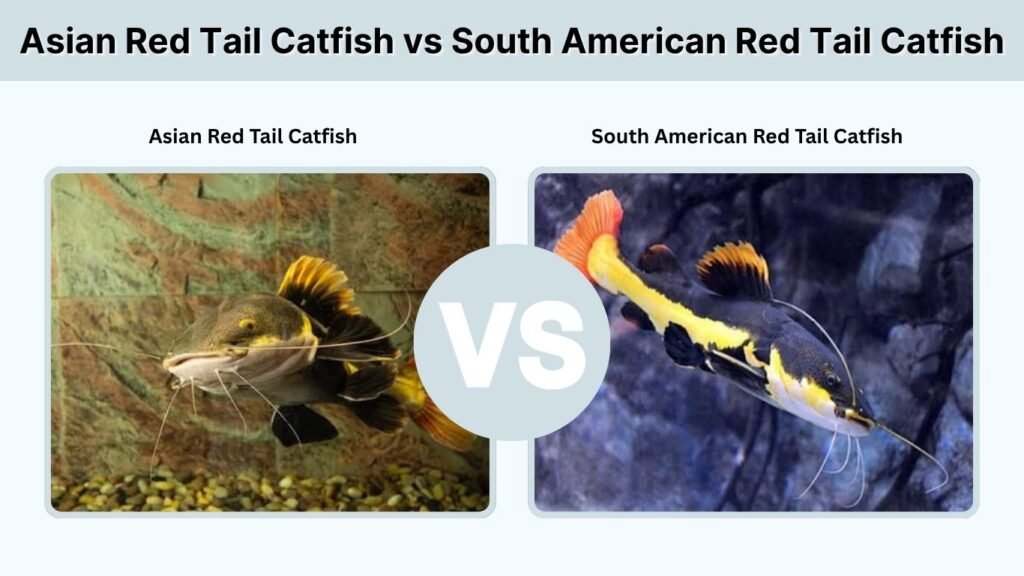
The Asian red tail catfish is a completely different species.
The name commonly refers to Hemibagrus wyckioides, a large Asian catfish found in the Mekong and other Southeast Asian river systems. FishBase reports that it can reach about 130 cm and has a bright red tail in larger individuals.
| Feature | South American Red Tail | Asian Red Tail |
| Scientific name | P. hemioliopterus | H. wyckioides |
| Native region | South America | Southeast Asia |
| Family | Pimelodidae | Bagridae |
| Maximum reported length | ~135 cm | ~130 cm |
| Tail | Orange-red | Bright red in larger fish |
Despite similar common names, they should not be treated as the same species.
Biggest Red Tail Catfish
Claims about the biggest red tail catfish ever caught vary because fishing records are divided into categories such as tackle class, length, and angler division.
For a reliable biological comparison, FishBase documents a maximum published length of approximately 135 cm and maximum published weight of 44.2 kg.
IGFA also maintains multiple official angling-record categories for red tail catfish rather than one simple universal “world record.”
Is a Red Tail Catfish a Good Pet?
Red tail catfish can be impressive captive fish, but they are not suitable pets for most aquarium owners.
The biggest problem is not temperament—it is size.
A juvenile may look perfect in an aquarium store, but a full-grown fish requires something closer to an indoor pond or public-aquarium installation than a conventional fish tank.
Before buying one, an owner should already have a realistic permanent plan for housing an adult.
FAQs
How big does a red tail catfish get?
Red tail catfish can become exceptionally large. FishBase reports a maximum published total length of about 135 cm, or roughly 53 inches, and a maximum published weight of 44.2 kg, or approximately 97 pounds.
Are red tail catfish freshwater fish?
Yes. Red tail catfish are entirely freshwater fish native to the Amazon and Orinoco river basins of South America. They inhabit tropical freshwater environments and should not be maintained in marine or brackish aquariums.
What does a red tail catfish eat?
Wild adults eat fish, crabs, fruit, and other available foods. In captivity, they require an appropriate varied diet suited to a very large predatory catfish while avoiding excessive feeding.
Can red tail catfish live with other fish?
They can sometimes coexist with very large fish, but anything small enough to fit into their enormous mouth may become prey. Housing multiple giant fish also requires substantially more space and filtration.
Are red tail catfish poisonous?
Red tail catfish are not regarded as poisonous to humans. FishBase lists the species’ threat to humans as harmless, although any very large fish should still be handled carefully because of its physical size and strength.