
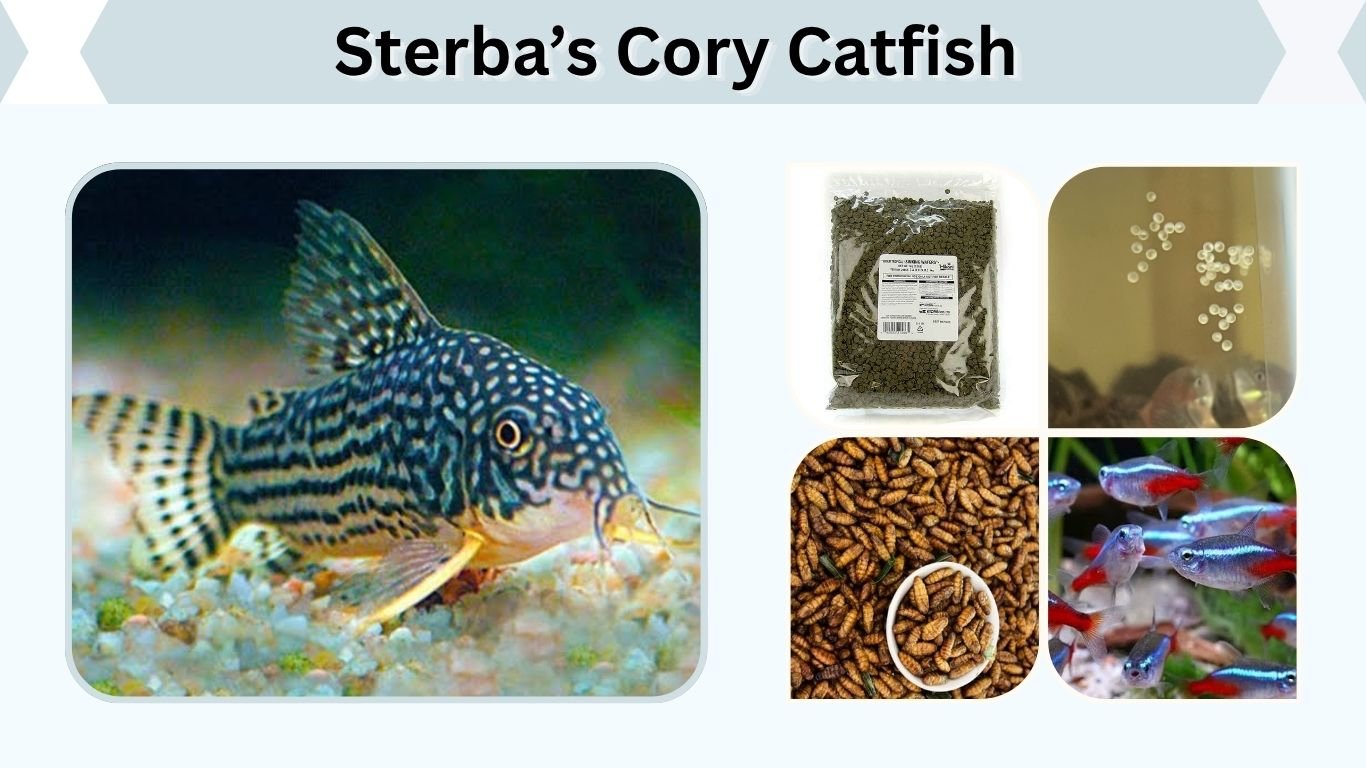
Sterba’s cory catfish is a peaceful bottom-dwelling freshwater fish famous for its spotted body, orange-tinted fins, and social personality. It has traditionally been known in the aquarium hobby as Corydoras sterbai, although FishBase currently lists the species as Hoplisoma sterbai. Native to central Brazil and Bolivia, these small catfish naturally occur in tributaries, flooded forest pools, and other freshwater habitats. They are excellent community fish but should be kept in groups rather than alone.
What Is a Sterba’s Cory Catfish?
Sterba’s cory is a small armored catfish from South America. Its attractive pattern and peaceful nature have made it one of the most popular cory-type catfish in freshwater aquariums.
The fish spends much of its time exploring the bottom for food, although it may occasionally dart toward the surface to gulp atmospheric air. FishBase classifies the species as a facultative air-breather.
| Feature | Sterba’s Cory |
| Common name | Sterba’s cory catfish |
| Traditional scientific name | Corydoras sterbai |
| Current FishBase name | Hoplisoma sterbai |
| Native range | Brazil and Bolivia |
| Maximum reported length | About 6.8 cm |
| Temperament | Peaceful |
| Diet | Omnivorous |
| Social behavior | Best in groups |
| Reproduction | Egg layer |
Sterba’s Cory Catfish Identification
Sterba’s cory has one of the most distinctive patterns among commonly kept cory catfish.
How to Identify Sterba’s Cory
Look for:
- Dark gray or brown base coloration
- Numerous pale spots across the head and body
- Maze-like markings toward the rear
- Orange or yellow coloration on the pectoral fins
- Short barbels around the mouth
- Armored plates covering the body
- Rounded underside adapted to bottom living
The combination of white spotting and orange fins makes this species especially easy to recognize once mature.
Sterba’s Cory Catfish Size
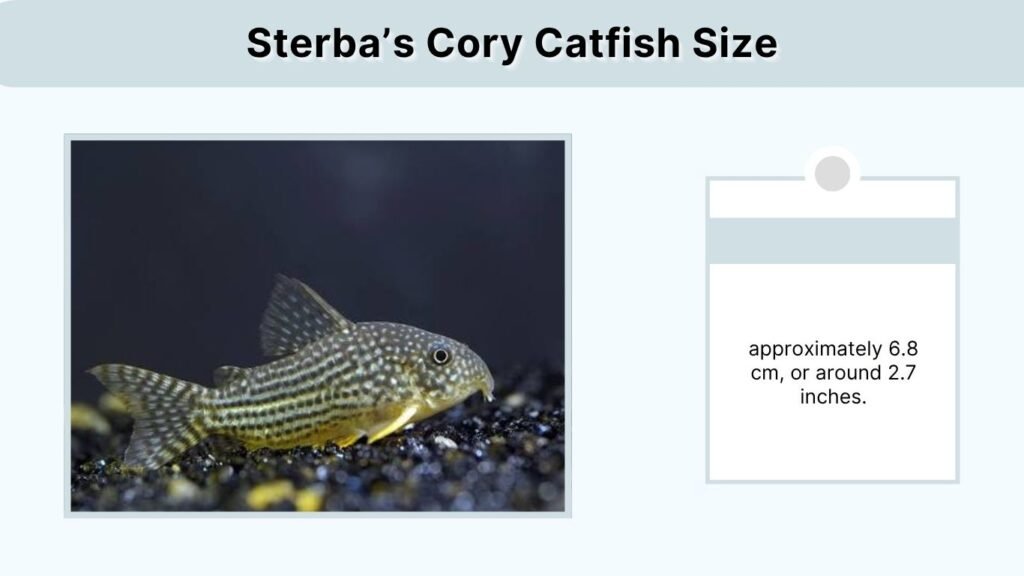
Sterba’s cory remains relatively small compared with most catfish.
FishBase reports a maximum standard length of approximately 6.8 cm, or around 2.7 inches.
Most aquarium specimens therefore remain manageable in moderately sized freshwater tanks.
Females often become somewhat broader through the abdomen than males, particularly when carrying mature eggs.
Sterba’s Cory Tank Size
Sterba’s cory catfish should not be kept alone. Cory-type catfish are highly social and feel more secure when surrounded by others of their own kind.
A 20-gallon or larger aquarium is a practical starting point for a group. Aquarium Co-Op recommends 20 gallons or more for most cory species and strongly suggests keeping approximately six or more together.
Ideal Aquarium Setup
A suitable Sterba’s cory aquarium should include:
- Fine sand or smooth substrate
- Open areas for foraging
- Driftwood
- Plants
- Shaded hiding areas
- Gentle to moderate water movement
- Good filtration
- High water quality
Fine sand is especially useful because these fish spend considerable time searching the substrate with their sensitive barbels.
Water Parameters
Wild Sterba’s cory populations inhabit tropical freshwater environments. FishBase reports natural conditions around 21–25°C (70–77°F) with a pH range of approximately 6.0–8.0.
Aquarium-bred Sterba’s corys are also known among fishkeepers for tolerating somewhat warmer conditions than several other common cory species, which is one reason they are sometimes kept in warmer community aquariums.
Stability and clean water are more important than constantly trying to adjust the aquarium to one exact number.
How Many Sterba’s Corys Should Be Kept Together?
Sterba’s cory catfish are social fish and should ideally be maintained in a group of at least six.
Seriously Fish also recommends keeping this species in groups of six or more.
A larger group often displays more natural behavior, including:
- Exploring together
- Resting near one another
- Group feeding
- Following one another across the bottom
- Increased activity during feeding
A single cory may survive, but keeping one alone does not provide the social environment characteristic of the species.
What Do Sterba’s Cory Catfish Eat?
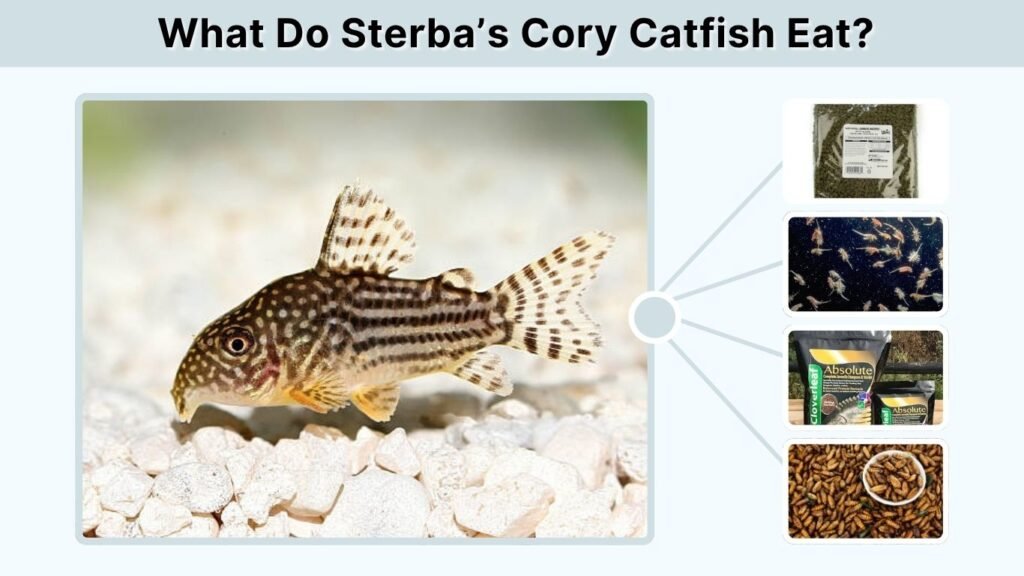
Sterba’s corys are omnivorous bottom feeders. They will search the substrate for food, but they should not be expected to survive only on leftovers from other aquarium fish.
Suitable foods include:
- Quality sinking catfish pellets
- Sinking wafers
- Frozen bloodworms
- Blackworms
- Brine shrimp
- Small insect-based foods
- Other appropriately sized frozen foods
Aquarium Co-Op recommends sinking foods along with worms and other small, soft foods for cory catfish.
Make sure enough food actually reaches the bottom, particularly when keeping Sterba’s corys with fast-feeding tetras, barbs, or other community fish.
Sterba’s Cory Catfish Tank Mates
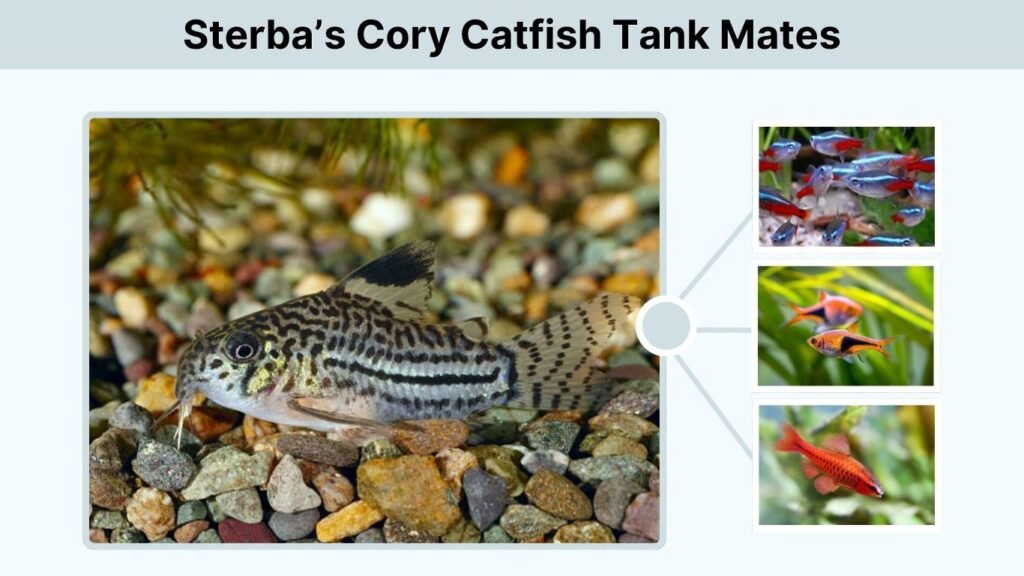
Sterba’s cory catfish are peaceful and generally work well in community aquariums.
Potential tank mates include:
- Tetras
- Rasboras
- Peaceful barbs
- Small rainbowfish
- Gouramis
- Peaceful dwarf cichlids
- Other compatible cory species
Avoid large predatory fish that could swallow or repeatedly attack them.
Their peaceful temperament makes Sterba’s cory particularly useful for aquariums where an active but nonaggressive bottom-dwelling species is wanted.
Sterba’s Cory Catfish Breeding
Sterba’s cory catfish are egg layers.
Their reproductive behavior follows the general cory pattern, although FishBase notes that detailed reproduction information for this particular species is largely inferred from related cory species.
Well-conditioned adults may begin spawning when provided with abundant nutritious food and appropriate water conditions.
Breeders frequently use a partial water change with slightly cooler water as a spawning stimulus because it can imitate environmental changes associated with rainfall.
Sterba’s Cory Catfish Gravid Female
Aquarists sometimes describe a female as gravid when her abdomen becomes noticeably fuller with developing eggs.
Technically, Sterba’s corys do not become pregnant because they are egg-laying fish. A mature female instead develops eggs internally before spawning them.
Signs of a Female Carrying Eggs
A female ready to spawn may appear:
- Broader than males
- Noticeably rounded through the abdomen
- Especially wide when viewed from above
- More active around males
- Interested in suitable egg-laying surfaces
Mature females are usually larger and heavier-bodied than males.
A round belly alone, however, does not prove that a fish is carrying eggs.
Sterba’s Cory Catfish With Eggs
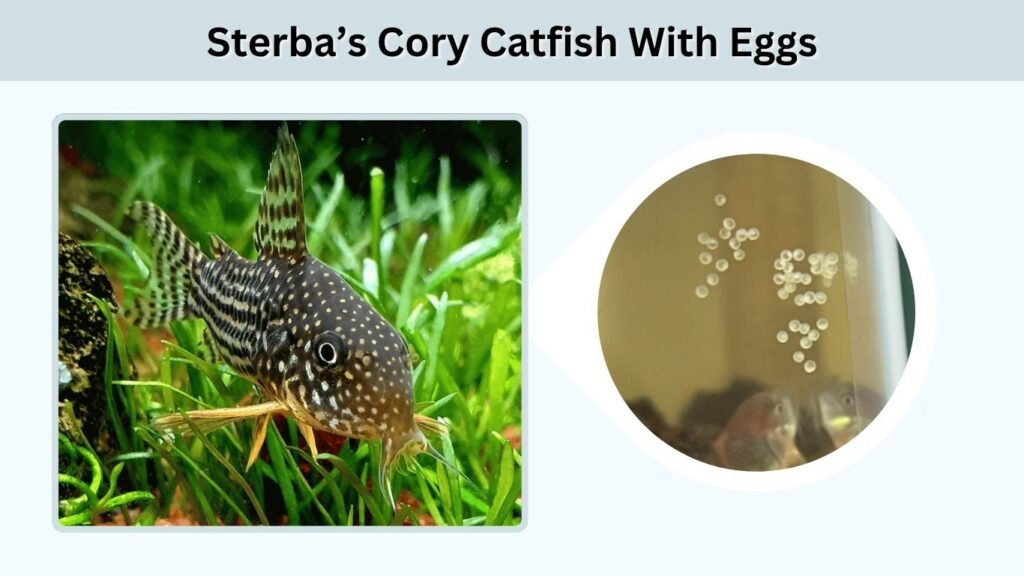
During spawning, eggs may be attached individually or in small groups to aquarium surfaces.
Common locations include:
- Aquarium glass
- Plant leaves
- Filter surfaces
- Decorations
- Other smooth surfaces
Adult fish and other tank inhabitants may sometimes eat eggs, so aquarists specifically attempting to raise fry often move the eggs or breeding adults to a separate setup.
Healthy eggs should be monitored carefully because unfertilized or damaged eggs can develop fungal growth.
Once fry hatch and consume their yolk reserves, they require extremely small foods before gradually moving onto larger foods as they grow.
Why Does My Sterba’s Cory Have a Distended Belly?
A distended belly in a Sterba’s cory can have several possible explanations.
A mature female carrying eggs is one possibility, particularly when she otherwise behaves normally and has gradually become broader.
Other possible causes include:
- Recent heavy feeding
- Internal parasites
- Internal infection or disease
- Fluid accumulation
- Digestive problems
The fish’s overall condition provides important clues.
A normally active female with an evenly rounded abdomen may simply be developing eggs. A fish that is lethargic, losing weight elsewhere, refusing food, breathing abnormally, or developing a dramatically swollen abdomen should not automatically be assumed to be gravid.
Sterba’s Cory Catfish and Camallanus Worms
“Calamus worm” and “Callamanus worm” are common misspellings of Camallanus, a group of parasitic nematodes that can infect aquarium fish.
Camallanus worms live in the intestinal tract. One of the most characteristic signs of advanced infection is the appearance of thin, blood-red worms protruding from the fish’s anus.
Possible Signs of Internal Worms
Watch for:
- Red thread-like worms protruding from the vent
- Weight loss
- Poor body condition
- Abnormal abdominal appearance
- Reduced appetite
- Weakness
- Abnormal feces
A swollen abdomen by itself cannot confirm Camallanus infection.
The Merck Veterinary Manual notes that direct visualization or microscopic examination is used for diagnosis and lists medications such as levamisole and fenbendazole for certain nematode infections.
Because dosing depends on the medication, fish species, formulation, and aquarium conditions, treatment should follow veterinary or manufacturer guidance rather than guessing a dose.
Sterba’s Cory Lifespan
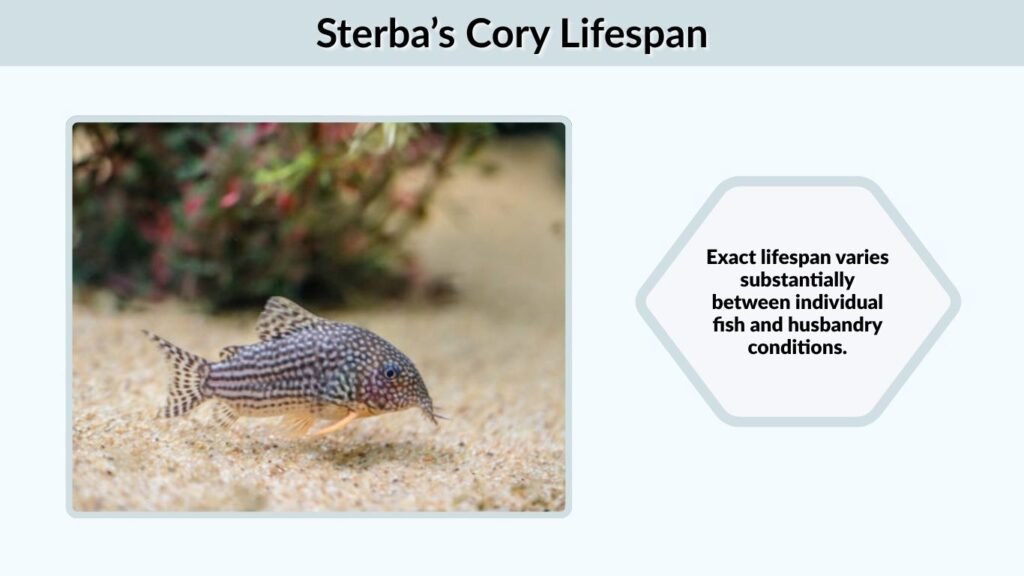
Sterba’s cory catfish can be a long-term aquarium resident when provided with stable water quality, proper nutrition, appropriate companions, and sufficient space.
Exact lifespan varies substantially between individual fish and husbandry conditions. Good care is particularly important because chronic exposure to ammonia, nitrite, poor substrate hygiene, or inadequate nutrition can shorten a fish’s life.
Is Sterba’s Cory a Good Aquarium Fish?
For most peaceful freshwater community aquariums, yes.
Sterba’s cory offers several desirable qualities:
- Peaceful temperament
- Attractive spotted pattern
- Manageable adult size
- Interesting social behavior
- Compatibility with many community fish
- Ability to tolerate relatively warm aquarium conditions
The main requirement is that owners treat them as social animals rather than buying a single specimen simply to “clean” the tank.
FAQs
How big do Sterba’s cory catfish get?
Sterba’s cory remains relatively small. FishBase reports a maximum standard length of approximately 6.8 cm, or about 2.7 inches.
How many Sterba’s corys should I keep?
A group of at least six is recommended. Cory catfish are social, and keeping several individuals encourages more natural and confident behavior.
How can I tell if my Sterba’s cory is gravid?
A female carrying mature eggs often develops a noticeably broad, rounded abdomen and appears wider when viewed from above. However, abdominal swelling alone does not prove that she has eggs, especially if the fish also appears sick.
What do Sterba’s cory eggs look like?
Cory eggs are small and adhesive and may be deposited on aquarium glass, leaves, decorations, or other surfaces. If breeding is the goal, separating or protecting the eggs can improve their chances of surviving.
Can Sterba’s cory catfish get Camallanus worms?
Like other freshwater aquarium fish, corys can potentially be affected by internal nematode parasites. A classic warning sign of Camallanus is the appearance of thin red worms protruding from the anus. A distended belly alone is not enough to diagnose the infection.