
Golden tench are beautiful ornamental freshwater fish known for their bright yellow-orange bodies, peaceful behavior, and bottom-feeding habits. These colorful fish are a selectively bred variety of the common tench (Tinca tinca) and are popular in outdoor garden ponds. Unlike ordinary tench, which usually have olive-green coloration, golden tench display attractive golden scales, sometimes decorated with dark spots. They are relatively hardy, long-lived fish that require spacious ponds and suitable water conditions. Understanding golden tench size, lifespan, diet, pond care, and breeding helps fishkeepers maintain healthy ornamental fish.
What Is a Golden Tench Fish?
The golden tench is an ornamental color variety of the common tench, a freshwater species native to much of Europe and parts of western Asia. It belongs to the family Tincidae and is sometimes associated with the traditional nickname “doctor fish.”
Golden tench are generally peaceful and prefer spending time near the bottom of ponds. Their bright coloration makes them easier to observe than ordinary dark-colored tench, although they often remain hidden among aquatic plants.
| Characteristics | Details |
| Scientific Name | Tinca tinca |
| Common Name | Golden Tench |
| Fish Type | Freshwater pond fish |
| Adult Size | Commonly 30–40 cm |
| Lifespan | Often 10–20 years |
| Color | Golden yellow to orange-red |
| Diet | Omnivorous |
| Temperament | Peaceful and shy |
| Preferred Habitat | Large outdoor ponds |
| Care Level | Moderate |
Golden Tench Appearance and Colors
Golden tench have sturdy, slightly elongated bodies covered with extremely small scales and a protective mucus layer. They possess rounded fins, fleshy lips, and small barbels near the corners of their mouths.
How to Identify a Golden Tench
Several physical features distinguish golden tench from other ornamental pond fish.
- Golden Body: Bright yellow, orange, or reddish-gold coloration.
- Dark Spots: Some individuals develop black markings across their bodies and fins.
- Rounded Fins: Broad, rounded fins that support gentle swimming.
- Small Scales: Tiny scales beneath a slippery protective coating.
- Short Barbels: Small sensory projections near the mouth that help locate food.
The intensity of their coloration varies with genetics, age, and environmental conditions. Some golden tench become more richly colored as they mature.
Golden Tench Size and Lifespan
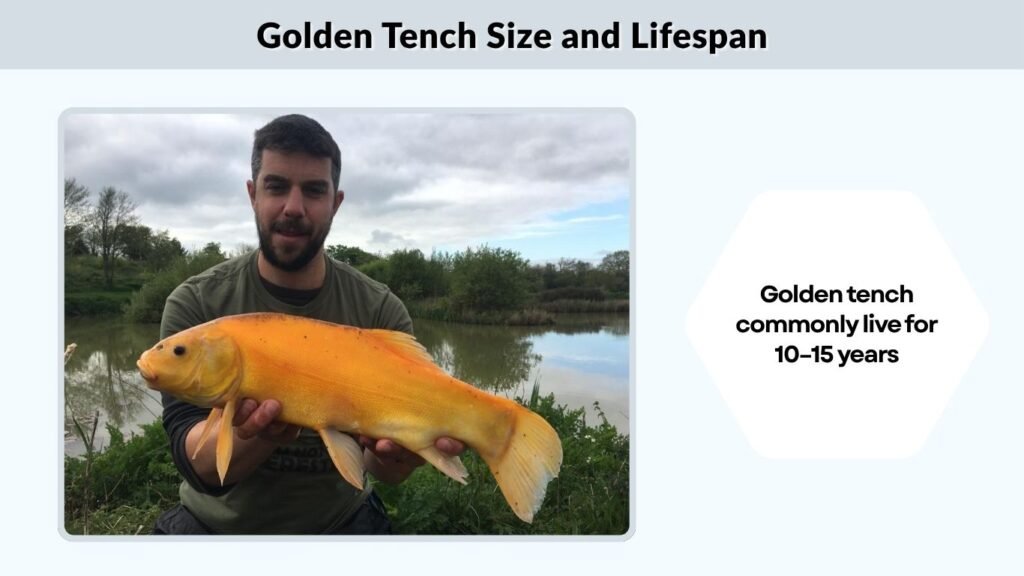
Golden tench can become considerably larger than their small juvenile appearance suggests. Like ordinary tench, they grow according to genetics, food availability, water quality, and environmental conditions.
How Big Do Golden Tench Grow?
Golden tench commonly reach approximately 30–40 centimeters (12–16 inches) in ornamental ponds. Larger individuals are possible because the species can exceed 60 centimeters under favorable conditions.
Young golden tench are often sold at only 2–6 inches long. However, they should never be considered permanently small pond fish.
Providing sufficient swimming space, nutritious food, and stable water conditions supports healthy development.
How Long Do Golden Tench Live?
Golden tench commonly live for 10–15 years, while some individuals may survive 20 years or longer in suitable environments.
Their longevity depends on pond conditions, nutrition, water quality, disease prevention, and protection from predators.
A properly maintained outdoor pond provides the space and seasonal conditions these fish need throughout their lives.
Golden Tench Pond Care and Setup
Golden tench are best suited to large outdoor ponds with adequate depth, biological filtration, and natural shelter. These fish naturally spend considerable time searching for food near the bottom, so their environment should include suitable substrate and aquatic vegetation.
Ideal Golden Tench Pond Size
A spacious pond of around 5,000 liters (approximately 1,320 US gallons) or more is a sensible target for keeping golden tench long-term. Actual capacity requirements depend on their number, adult size, and other pond inhabitants.
In climates with cold winters, approximately one meter of pond depth or more can help provide more stable overwintering conditions.
A suitable pond should include:
- Filtration: Efficient biological filtration to manage fish waste.
- Aquatic Plants: Vegetation for shelter and natural feeding opportunities.
- Substrate: Smooth gravel, sand, or suitable bottom areas for foraging.
- Aeration: Adequate oxygen through water movement or aeration.
- Shade: Sheltered areas to reduce excessive summer heating.
Golden Tench Water Temperature
Golden tench are temperate freshwater fish that tolerate seasonal temperature changes. For routine pond keeping, a moderate range of approximately 4–24°C (39–75°F) is often recommended, although this does not represent the species’ full biological tolerance.
Maintain stable water quality, with a pH around 7.0–8.0. Test ammonia and nitrite regularly and keep both undetectable.
During winter, avoid disturbing fish resting in deeper pond areas. In summer, provide aeration and shade.
What Do Golden Tench Eat?
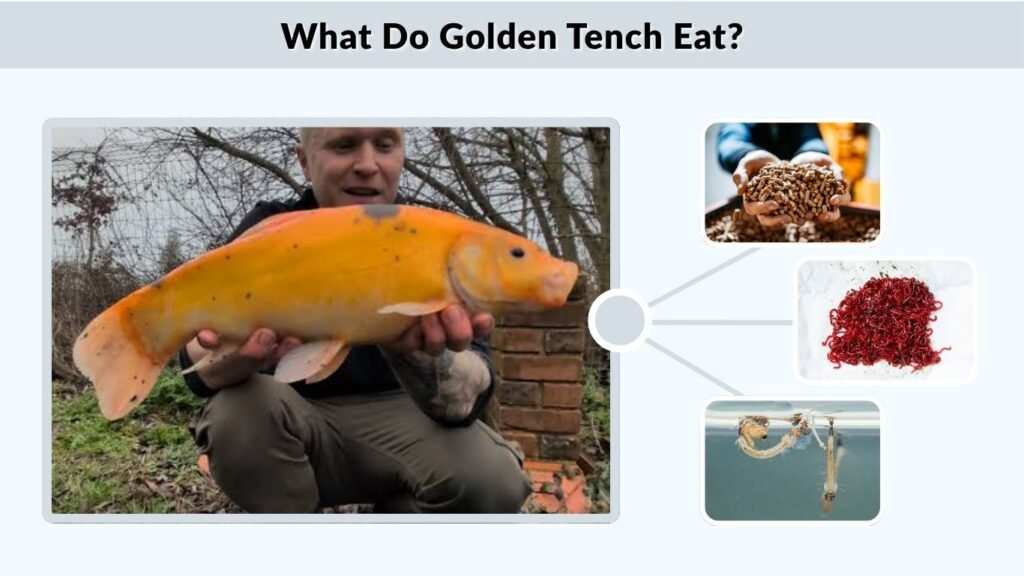
Golden tench are omnivorous bottom-feeding fish. In natural environments, they search through sediments for small aquatic organisms and plant material. Their sensitive barbels help them detect food around the pond bottom.
Best Food for Golden Tench
A balanced diet can include:
- Sinking Pellets: High-quality pond fish food designed for bottom-feeding species.
- Bloodworms: Protein-rich supplementary food.
- Daphnia: Small freshwater crustaceans suitable for additional nutrition.
- Earthworms: Natural food that provides animal protein.
- Aquatic Insects: Naturally occurring insect larvae and other invertebrates.
Offer suitable sinking food in small portions during warmer months. Observe the fish’s appetite and avoid leaving excessive uneaten food.
Feeding should be reduced as temperatures fall and may need to stop during very cold conditions when fish are inactive.
Golden tench sometimes consume organic material and leftover food, but they are not substitutes for proper pond cleaning or filtration.
Golden Tench Tank Mates and Compatibility
Golden tench are generally peaceful fish that can coexist with other suitable coldwater pond species. Their shy nature means they benefit from hiding places and adequate feeding opportunities.
Can Golden Tench Live With Koi?
Yes, golden tench can live with koi in sufficiently large ponds. However, koi become much bigger and may dominate feeding areas.
Common goldfish, Shubunkins, and other compatible coldwater pond fish can also make suitable companions.
Avoid overcrowding, aggressive species, and large predators. Always ensure golden tench receive enough food because they may remain near the bottom while more active fish feed at the surface.
Golden Tench Breeding and Reproduction
Golden tench reproduce by laying eggs among aquatic vegetation. Their breeding behavior resembles that of ordinary tench because both are the same species.
How Do Golden Tench Breed?
Breeding usually occurs during late spring or summer as water temperatures rise. Spawning commonly takes place in warm water around 22–24°C (72–75°F).
Females release numerous adhesive eggs that attach to underwater plants. Males fertilize the eggs externally, and the developing embryos hatch after several days under favorable conditions.
Young golden tench fry initially consume microscopic aquatic organisms before gradually eating larger foods.
Mature males typically have noticeably larger, thicker pelvic fins than females. Successful breeding requires mature fish, suitable vegetation, good water quality, and seasonal conditions.
Golden Tench vs. Golden Orfe

Golden tench and golden orfe are different freshwater fish, although both have attractive golden coloration and can inhabit ornamental ponds.
| Feature | Golden Tench | Golden Orfe |
| Scientific Name | Tinca tinca | Leuciscus idus |
| Body Shape | Stocky | Slender |
| Feeding Habit | Primarily bottom-feeding | Often midwater and surface-feeding |
| Behavior | Shy and relatively slow | Active and fast-swimming |
| Habitat | Vegetated pond bottoms | Open, oxygen-rich pond water |
Golden orfe are generally more active swimmers, while golden tench spend much of their time near the pond bottom.
Golden Tench Price and Buying Guide
Golden tench are available from specialist ornamental pond fish suppliers and freshwater fish breeders. Prices vary depending on fish size, coloration, region, availability, and supplier.
What to Check Before Buying Golden Tench
Choose healthy fish with clear eyes, intact fins, normal swimming behavior, and no visible wounds or unusual patches.
Ask the seller about age, feeding habits, quarantine history, and expected adult size.
Check whether keeping tench is legal in your area, particularly in parts of North America where they are introduced fish.
Quarantine newly purchased fish when practical, and never release unwanted golden tench into natural waterways.
FAQs
1. Are Golden Tench Rare?
Golden tench are ornamental color varieties that are less commonly encountered than ordinary green tench. Their availability depends on specialist breeders and pond fish suppliers.
2. Can Golden Tench Live in an Aquarium?
Young golden tench can temporarily live in suitably equipped large aquariums, but adults generally require considerably more space. Outdoor ponds are the better long-term choice.
3. Are Golden Tench and Golden Orfe the Same?
No. Golden tench belong to the species Tinca tinca, while golden orfe are a color variety of the ide, commonly classified as Leuciscus idus.
4. Can Golden Tench Survive Winter in a Pond?
Yes. Golden tench can survive winter in appropriately designed ponds with sufficient depth, suitable oxygen levels, and stable water conditions.
5. Do Golden Tench Keep Ponds Clean?
Golden tench consume small aquatic animals and some organic material near the bottom. However, they do not eliminate pond waste or replace filtration, water testing, and routine maintenance.