
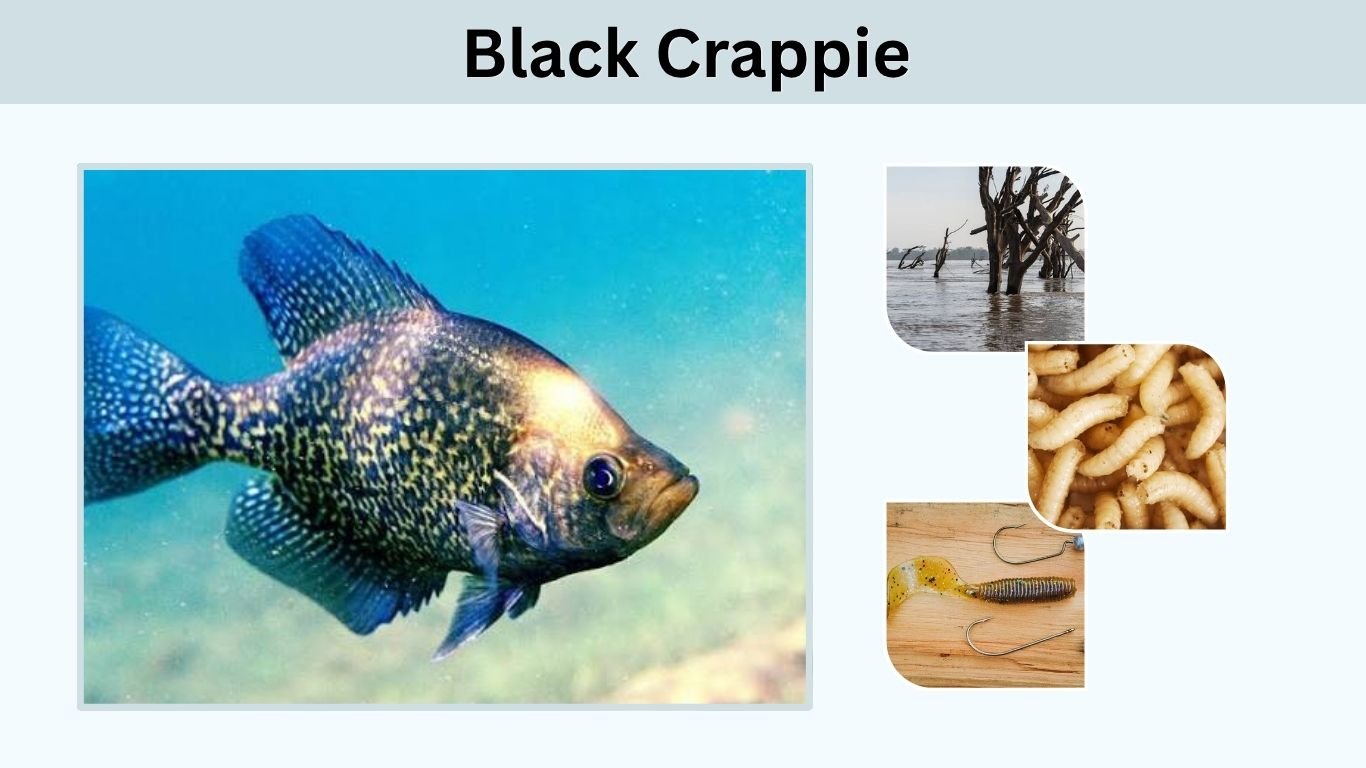
The black crappie (Pomoxis nigromaculatus) is a popular freshwater sport fish recognized by its silvery body, irregular dark spots, and large mouth. It belongs to the sunfish family and occurs naturally or through stocking across much of North America. Black crappie gather around vegetation, submerged trees, docks, and brush piles, where anglers catch them using minnows and small jigs. Although easily confused with white crappie, dorsal-spine count, body pattern, and shape provide reliable identification clues.
What Is a Black Crappie?
Black crappie are one of two recognized crappie species; the other is the white crappie. Both belong to the genus Pomoxis and family Centrarchidae, alongside bluegill, pumpkinseed, and largemouth bass. The scientific name nigromaculatus means “black spotted,” describing the fish’s irregular markings.
Characteristics and Range
- Scientific name: Pomoxis nigromaculatus
- Family: Centrarchidae
- Typical length: 8–12 inches
- Large adult: More than 14 inches
- Typical weight: Approximately ½–1½ pounds
- Trophy weight: 2 pounds or more
- Native range: Central and eastern North America
- Habitat: Lakes, ponds, reservoirs, backwaters and slow rivers
Black crappie have been introduced widely outside their original range. They perform particularly well in lakes containing clear or moderately clear water, vegetation, submerged wood, and abundant small fish.
Black Crappie Identification
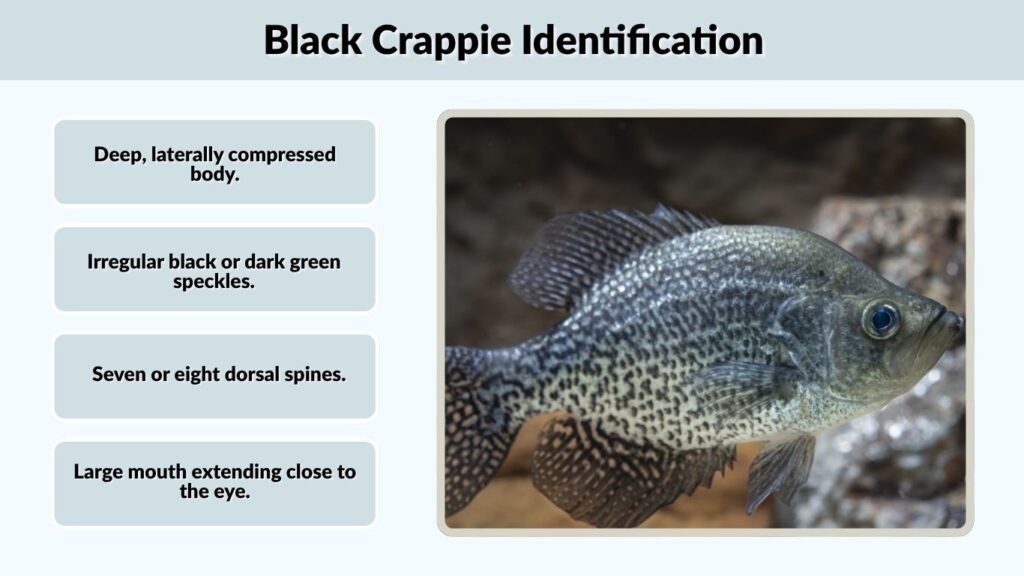
The name does not mean every individual looks completely black. Most have a silvery, olive, or greenish background covered with irregular dark speckles. Their compressed bodies allow them to move efficiently through vegetation and submerged branches.
Identification Features
- Deep, laterally compressed body
- Irregular black or dark green speckles
- Seven or eight dorsal spines
- Large mouth extending close to the eye
- Darkly mottled dorsal, tail, and anal fins
- Rounded, pan-shaped body
- No clearly defined vertical bars
Water conditions can affect coloration. Fish living in dark or heavily vegetated water may appear darker, while those from clear open water can look bright silver.
Black Crappie vs. White Crappie
| Feature | Black Crappie | White Crappie |
| Scientific name | P. nigromaculatus | P. annularis |
| Side pattern | Irregular speckles | Vertical dark bars |
| Dorsal spines | 7–8 | 5–6 |
| Body shape | Deeper and rounder | Slightly longer |
| Preferred water | Clearer and more vegetated | More tolerant of muddy water |
| Current world record | 5 lb 7 oz | 5 lb 3 oz |
Counting dorsal spines is usually more dependable than judging color. Hybrids can display mixed characteristics, so some fish may require professional or genetic identification.
Blacknose Crappie and Black-Stripe Crappie
A blacknose crappie is a naturally occurring color form of the black crappie. It has a bold stripe running from the upper jaw, across the forehead, and toward the dorsal fin.
It is not a separate species and does not receive its stripe from hybridization. Research indicates that the stripe is controlled by a dominant single-gene mutation. Blacknose crappie eat, grow, reproduce, and behave like ordinary black crappie. Some fisheries use the visible stripe to track stocked populations.
Why Do Some Male Crappie Turn Black?
Male black crappie commonly become much darker during spawning season. The head, throat, breast, and fins may appear nearly black. This temporary breeding coloration helps explain why anglers sometimes catch dramatically dark fish in spring.
A dark spawning male is not necessarily a blacknose crappie. Blacknose fish have a defined central stripe, while breeding males usually develop widespread dark coloration.
Black Crappie Habitat, Diet and Ecological Role
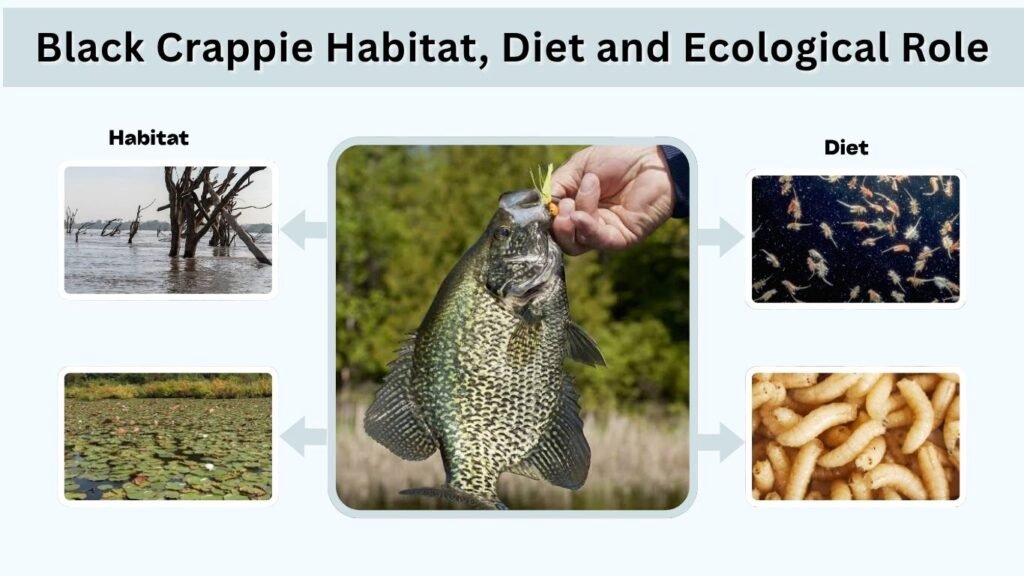
Black crappie use different habitats as seasons and water temperatures change. They often form schools, although large adults may gather in smaller groups. Locating the correct depth and nearby structure is usually more important than searching a large area randomly.
Where Do Black Crappie Live?
Productive habitat includes:
- Aquatic vegetation
- Flooded trees and standing timber
- Submerged brush piles
- Docks and boathouses
- Bridge supports
- Rock piles and points
- Creek-channel edges
- Protected coves
- Backwater sloughs
During spring, adults move into shallow protected areas. Summer heat often pushes them toward deeper brush, channels, or the thermocline. Fall fish follow schools of shad, while winter crappie may gather tightly over deep structure.
What Do Black Crappies Eat?
Young black crappie consume zooplankton, aquatic insects, insect larvae, and small crustaceans. As their mouths grow, fish become increasingly important prey.
Adults commonly eat:
- Minnows
- Young shad
- Small bluegill
- Young yellow perch
- Aquatic insects
- Crayfish
- Snails
- Occasionally smaller crappie
Black crappie are omnivorous predators rather than strict carnivores. Their trophic position changes with age and diet. Adults feeding on predatory fish can function as tertiary consumers, while juveniles eating zooplankton occupy a lower position in the food web.
Black Crappie Spawning
Black crappie spawn in spring, but timing varies with latitude and weather. Fish in southern waters may begin spawning months earlier than populations in northern lakes. Water temperature provides a better guide than the calendar.
Spawning Temperature and Nests
Spawning commonly occurs when water temperatures reach approximately 58–65°F. Males move shallow first and clear circular nests in water about 3–8 feet deep. Suitable sites may contain sand, gravel, vegetation, roots, or submerged wood.
Females enter the nesting area and deposit thousands of eggs. A large female may produce more than 100,000, although 20,000–60,000 is more common. Males fertilize the eggs and guard the nest until the fry disperse. Iowa DNR documents this spawning range and nesting behavior.
How to Catch Black Crappie
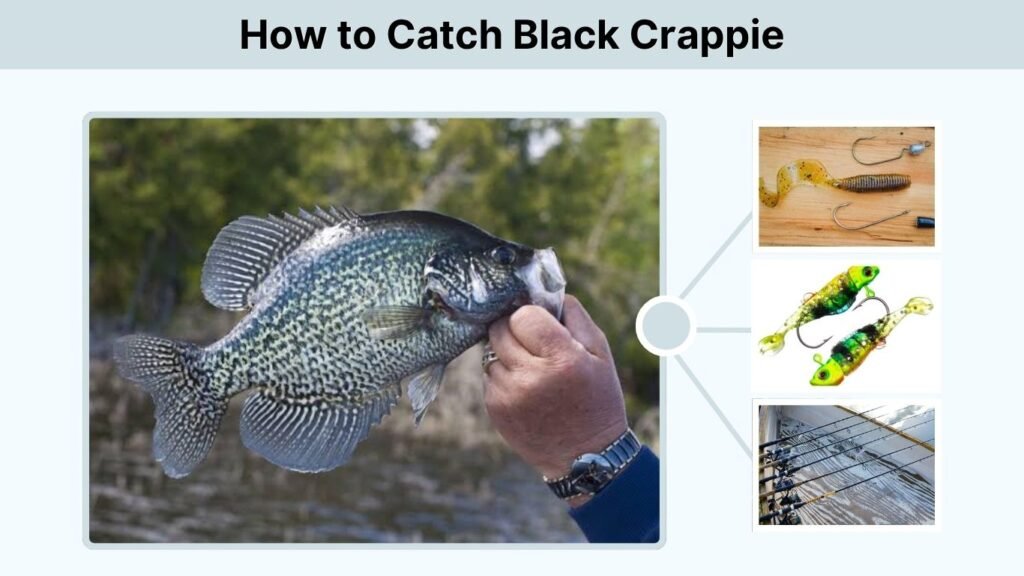
The best technique depends on season and depth. Because black crappie frequently look upward when feeding, present the bait at their level or slightly above them. Once one fish bites, work the area thoroughly because additional crappie are likely nearby.
Best Black Crappie Baits and Lures
- Live minnows
- Tube jigs
- Paddle-tail minnows
- Curly-tail grubs
- Marabou or hair jigs
- Small spinner jigs
- Miniature crankbaits
- Small worms and insect larvae
A live minnow under a slip float is dependable for beginners. Adjust the float so the minnow remains just above vegetation or brush.
Soft-plastic jigs measuring approximately 1.5–2.5 inches imitate young baitfish. Natural silver, gray, blue, and translucent patterns suit clear water. Black-and-chartreuse, black-and-blue, white, pink, and orange are productive in stained water or low light.
Jigs, Rods and Fishing Methods
A 1/16-ounce jig head is an effective general-purpose choice. Use 1/32-ounce heads for shallow, slow presentations and heavier 1/8-ounce heads for deep water or wind.
A 5- to 7-foot light or ultralight spinning rod with 4- to 6-pound line works for casting. Longer 10- to 14-foot poles are suitable for vertical jigging, dipping baits into cover, or spider rigging.
Effective methods include:
- Casting and slowly retrieving jigs
- Vertical jigging over brush
- Fishing minnows beneath slip floats
- Shooting jigs beneath docks
- Slow trolling with multiple rods
- Trolling small crankbaits
- Ice fishing with miniature jigs and minnows
Always check current local regulations governing licenses, minimum sizes, daily limits, rods, and multiple-hook rigs.
World and State-Record Black Crappie
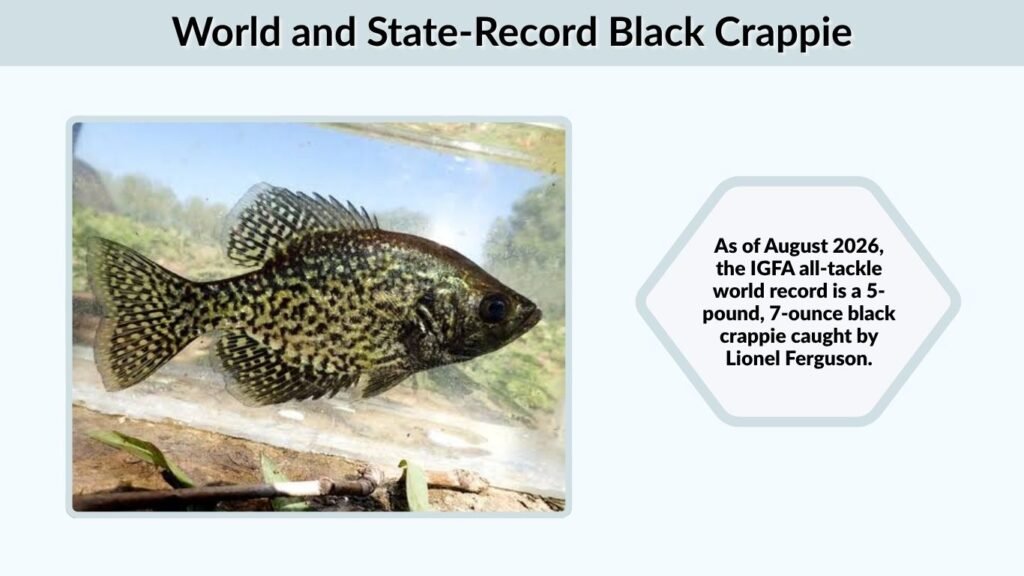
Record status can change, so anglers should confirm figures through IGFA or the appropriate state wildlife agency before publishing or submitting a potential record.
Biggest Black Crappie Ever Caught
As of August 2026, the IGFA all-tackle world record is a 5-pound, 7-ounce black crappie caught by Lionel Ferguson at Richeison Pond, Tennessee, on May 15, 2018. The approved record appears in the IGFA database.
Notable current state records include:
- West Virginia: Jerry Porter caught a 3.6-pound, 17.7-inch fish at East Lynn Lake on May 7, 2025. It holds the weight record, while a 17.76-inch fish retains the state length record.
- Iowa: Micaiah Thompson caught a 3.95-pound, 17.8-inch black crappie at Lake of Three Fires on February 8, 2026. The Iowa DNR lists it as the current state record.
- Arkansas: The state record is a 5-pound black crappie caught at Lake Wilhelmina in 2011.
Are Black Crappies Good to Eat?
Black crappie are excellent table fish with mild, white, flaky meat. Their flavor is similar to white crappie and other panfish. They can be fried, baked, grilled, or blackened.
To make a simple blackened crappie recipe, coat skinless fillets lightly with oil and season with paprika, garlic, pepper, thyme, and a small amount of salt. Cook them in a hot skillet until opaque and easily separated with a fork. Keep harvested fish cold and follow local fish-consumption advisories.
FAQs
How big do black crappie get?
Most measure 8–12 inches, while fish longer than 14 inches are large. Exceptional adults can exceed 4 pounds.
Are black and white crappie the same species?
No. They are closely related but separate species capable of hybridizing where their ranges overlap.
Is a black crappie different from a bluegill?
Yes. Black crappie have larger mouths and speckled bodies. Bluegill have smaller mouths, vertical bars, and dark ear flaps.
Can black crappie live in an aquarium?
They can be maintained in very large, properly filtered systems, but they are unsuitable for typical home aquariums. Possession and transport may require permits.
What are tumor-like lumps on a black crappie?
Some populations develop skin lesions sometimes called black crappie sarcoma. Because the cause and safety implications may be uncertain, avoid eating visibly diseased fish and report unusual cases to the local fisheries agency.