
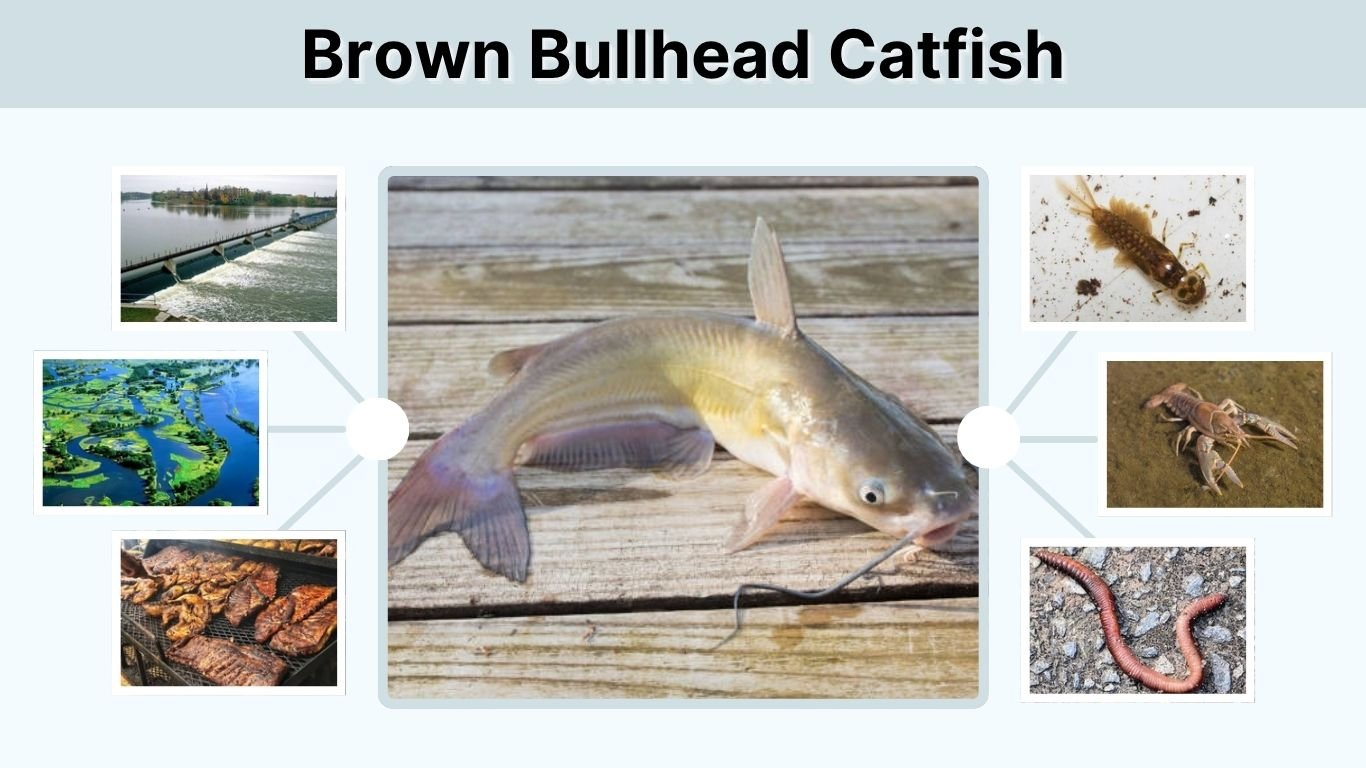
The brown bullhead catfish is a hardy freshwater fish known for its rounded tail, mottled coloration, dark barbels, and ability to survive in warm, muddy water. Also called a mud cat, mud pout, or hornpout, it is native to much of eastern and central North America. Brown bullheads are popular with anglers because they bite readily, fight well for their size, and can make good table fare when taken from clean water.
Brown Bullhead Catfish Overview
The scientific name of the brown bullhead is Ameiurus nebulosus. It belongs to Ictaluridae, the family containing North American freshwater catfish. Adults inhabit ponds, lakes, reservoirs, creek backwaters, and slow sections of rivers, especially where the bottom consists of mud, sand, or organic debris.
| Feature | Brown bullhead information |
| Scientific name | Ameiurus nebulosus |
| Family | Ictaluridae |
| Common length | Around 8–14 inches |
| Maximum recorded length | About 22 inches |
| Maximum published weight | Approximately 6 pounds |
| Diet | Omnivorous and opportunistic |
| Habitat | Ponds, lakes and slow-moving rivers |
| Activity | Primarily nocturnal |
| Maximum reported lifespan | About 9 years |
| Temperament | Predatory but not dangerous to people |
What Does a Brown Bullhead Look Like?
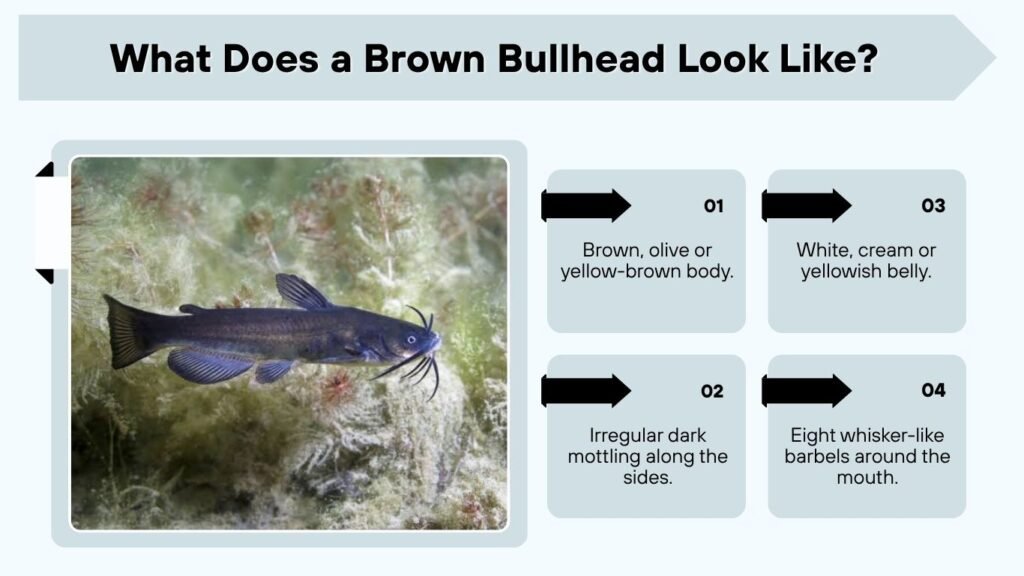
Brown bullheads have heavy heads, broad mouths and smooth, scaleless bodies. Their color varies considerably according to the water, substrate and age of the fish. Some are yellowish brown, while others are dark olive, chocolate brown or nearly black.
Brown Bullhead Identification
Look for the following characteristics:
- Brown, olive or yellow-brown body
- Irregular dark mottling along the sides
- White, cream or yellowish belly
- Eight whisker-like barbels around the mouth
- Dark gray or black chin barbels
- Broad, slightly flattened head
- Rounded or nearly square tail fin
- Rounded anal fin with approximately 19–23 rays
- Sharp dorsal and pectoral-fin spines
- Saw-like serrations along the rear of the pectoral spine
The combination of a mottled body, dark chin barbels and rounded tail is particularly useful for identification.
Brown Bullhead vs. Yellow Bullhead
A yellow bullhead usually has pale or white chin barbels, while the brown bullhead’s chin barbels are dark. Yellow bullheads may appear more uniformly yellow, brown or olive, whereas brown bullheads commonly have obvious mottling.
Brown Bullhead vs. Channel Catfish
Channel catfish generally grow much larger and have a deeply forked tail. Young channel catfish often display distinct black spots along their sides. Brown bullheads have a rounded tail, stockier body and mottled rather than clearly spotted coloration.
How Big Do Brown Bullhead Catfish Get?
Most adult brown bullheads measure approximately 8–14 inches and weigh well under two pounds. Fish between 15 and 18 inches are considered large in many waters, while individuals exceeding 20 inches are exceptional.
The maximum published length is about 55 centimeters, or 21.7 inches, and the maximum published weight is approximately 2.7 kilograms, or six pounds. Their maximum reported age is nine years. Growth depends on food availability, water temperature, competition and population density. Overcrowded ponds often contain numerous small bullheads because the available food must be shared among too many fish.
World Record Brown Bullhead Catfish
The widely recognized all-tackle record brown bullhead weighed 7 pounds, 6 ounces. Angler Glenn Collacuro caught the fish from Lake Mahopac, New York, on August 1, 2009. It measured approximately 22.2 inches. The catch remains listed as New York’s state record and is commonly reported as the IGFA all-tackle record.
Fishing records can be updated when a larger certified fish is caught. Anglers pursuing records should consult the current record database and follow its weighing, tackle and documentation requirements.
Habitat and Distribution
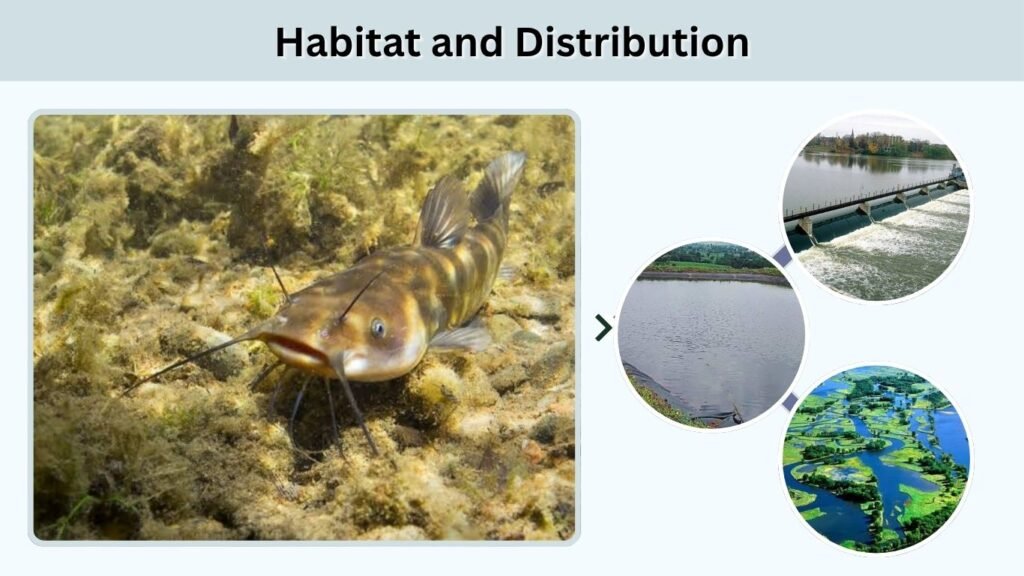
Brown bullheads are native to a broad part of North America. Their natural distribution includes Atlantic and Gulf drainages from eastern Canada southward into the United States, as well as the Great Lakes, Hudson Bay and Mississippi River systems. They have also been introduced outside their original range.
Preferred Habitat
They commonly occupy:
- Farm ponds
- Natural lakes
- Reservoirs and impoundments
- Oxbow lakes
- Creek pools and backwaters
- Slow river runs
- Weedy bays
- Muddy drainage channels
Brown bullheads tolerate conditions that many game fish cannot. They can survive warm temperatures, low dissolved oxygen, turbid water and moderate pollution. During unfavorable conditions, they may partially bury themselves in soft mud. However, their toughness does not mean dirty or poorly managed water is healthy for them.
What Do Brown Bullhead Catfish Eat?
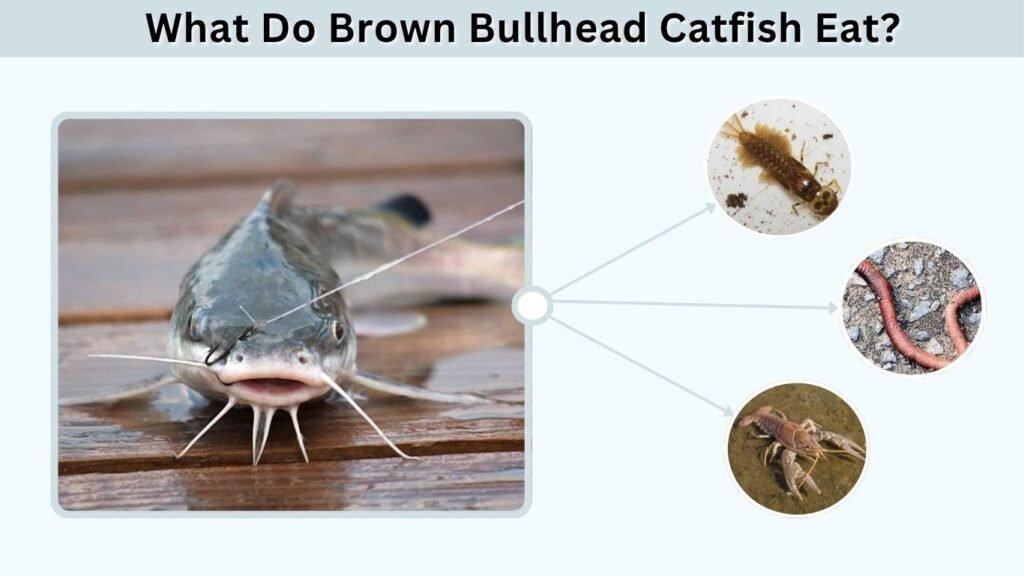
Brown bullheads are opportunistic omnivores. They use their barbels, smell and taste receptors to locate food along the bottom, especially after sunset.
Their natural diet includes:
- Aquatic insect larvae
- Worms and leeches
- Snails and clams
- Crayfish
- Amphipods and small crustaceans
- Fish eggs
- Small fish
- Algae
- Decaying plants
- Other organic material
Young brown bullheads feed heavily on tiny crustaceans, midge larvae, mayflies and other aquatic invertebrates. Larger fish gradually consume more mollusks, crayfish and small fish.
Brown bullheads are sometimes described as scavengers, but they do not rely exclusively on dead material. They actively search for and capture living prey.
How to Catch Brown Bullhead Catfish
Brown bullhead fishing is straightforward and suitable for beginners. Spring and summer are productive seasons, although local conditions influence when the fish feed most actively.
Best Time and Location
Fish during the evening, shortly after dark or before sunrise. Cast into shallow bays, muddy coves, slow creek mouths or the deeper edges of weed beds. After warm spring rains, bullheads may move into very shallow water to feed.
Place the bait directly on or slightly above the bottom. A light spinning rod, 6–10-pound line, small sinker and simple hook are normally sufficient.
Best Brown Bullhead Bait
Effective baits include:
- Nightcrawlers
- Garden worms
- Chicken liver
- Dough balls
- Cut bait
- Shrimp
- Small pieces of fish
- Insect larvae
New York’s fishing guidance recommends nightcrawlers, chicken liver or dough balls on a No. 4 or No. 6 hook fished along the bottom. A slip-sinker rig allows the fish to take the bait without immediately feeling heavy resistance.
Handle the fish carefully. The dorsal and pectoral spines can puncture the skin and cause a painful injury, although brown bullheads do not possess a separate stinger like a bee.
Are Brown Bullhead Catfish Good to Eat?
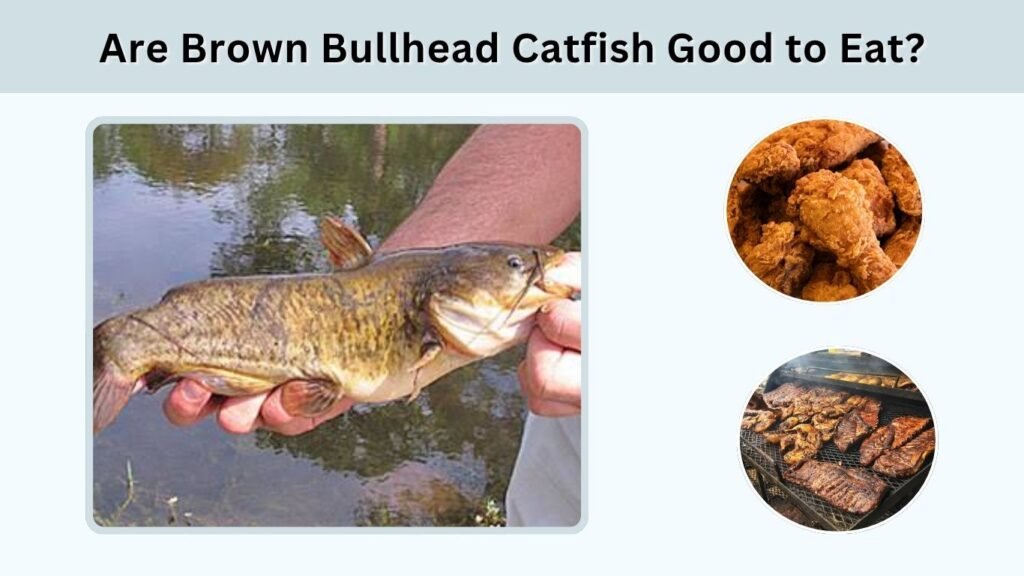
Brown bullheads are edible and can have firm, mild-tasting flesh. Fish taken from cool, clean water generally taste better than those from warm, stagnant or heavily muddy ponds. Smaller and medium-sized specimens are usually easier to clean and cook.
They can be fried, baked, grilled or smoked. Skinning is common because catfish skin is thick and scaleless. The fish should be chilled promptly after capture and cooked thoroughly.
Always check the fish-consumption advisory for the specific lake or river. Chemical contamination cannot reliably be detected from the fish’s appearance, smell or taste. Local authorities may recommend limiting or avoiding fish from particular waters.
Spawning and Life Cycle
Brown bullheads generally spawn when shallow water warms during late spring or early summer. One or both parents create a nest beneath cover or in a shallow depression. The nest may be located near vegetation, logs, rocks or an undercut bank.
After spawning, a parent guards and aerates the eggs by moving water over them with its fins. Parents may continue protecting the newly hatched young. Baby bullheads frequently form a dense, dark school that resembles a moving ball near the surface or shoreline.
Keeping Brown Bullheads in an Aquarium
A baby brown bullhead may appear manageable, but it can eventually exceed 12 inches and produce considerable waste. A single adult requires a very large aquarium—generally at least 75 gallons, with more space preferred.
Use strong filtration, secure decorations and a sand or smooth-gravel bottom. Potential tank mates must be too large to swallow and robust enough to tolerate nighttime activity. Small fish, shrimp and crayfish may be eaten. Never release an unwanted pet bullhead into natural water.
FAQs
Are brown bullheads and mud cats the same fish?
“Mud cat” is a common name applied to brown bullheads and sometimes other bullhead species. A fish called a mud cat is not automatically a brown bullhead, so its tail shape, barbels, coloration and fin characteristics should be examined before confirming its identity.
Do brown bullhead catfish bite people?
They may clamp their mouths on fingers, but their bite is not considered dangerous. The greater handling risk comes from their sharp dorsal and pectoral spines. Hold the fish securely behind the pectoral spines and avoid squeezing it carelessly.
What do baby brown bullhead catfish eat?
Baby bullheads consume zooplankton, tiny crustaceans, midge larvae, mayfly nymphs and other small aquatic organisms. As they grow, they begin eating larger insects, worms, mollusks, crayfish and small fish.
What is the legal size for brown bullhead catfish?
There is no universal legal size. Seasons, minimum lengths, possession limits and permitted fishing methods vary between countries, states and individual waterways. Anglers should check the current regulations for the exact location before keeping their catch.
How long do brown bullhead catfish live?
The maximum reported age is approximately nine years, although many wild fish live for a shorter period because of predation, fishing, disease and difficult environmental conditions. Food supply, population density and water quality also influence growth and survival.