
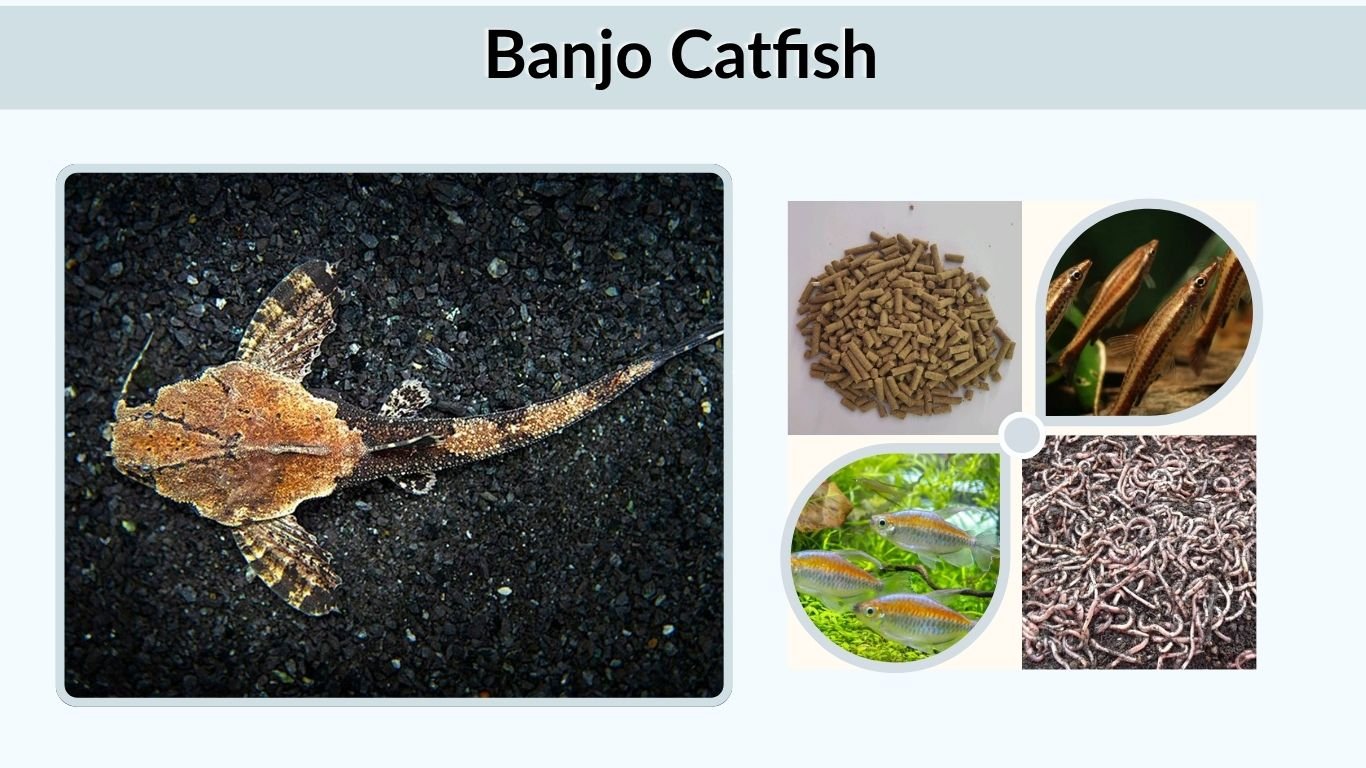
The banjo catfish is a peaceful freshwater fish recognized by its flattened head, narrow tail, rough skin, and leaf-like camouflage. It spends much of the day buried beneath sand or resting motionless among leaves and driftwood. Although easy to keep once established, this nocturnal fish requires soft substrate, gentle tank mates, targeted feeding, and clean water. This guide covers banjo catfish size, food, tank requirements, behavior, lifespan, breeding, and general care.
Banjo Catfish Overview
“Banjo catfish” can refer to several members of the family Aspredinidae. However, the species most commonly sold for home aquariums is Bunocephalus coracoideus, a small bottom-dwelling catfish native to the Amazon River basin.
| Care category | Recommended conditions |
| Scientific name | Bunocephalus coracoideus |
| Adult size | Approximately 4–6 inches |
| Minimum tank size | 20 gallons with a long footprint |
| Temperature | 75–82°F or 24–28°C |
| pH | 6.0–7.8 |
| Diet | Omnivorous; prefers sinking and meaty foods |
| Temperament | Peaceful and shy |
| Tank level | Bottom |
| Lifespan | Commonly estimated at 6–12 years |
| Difficulty | Beginner to intermediate |
What Does a Banjo Catfish Look Like?
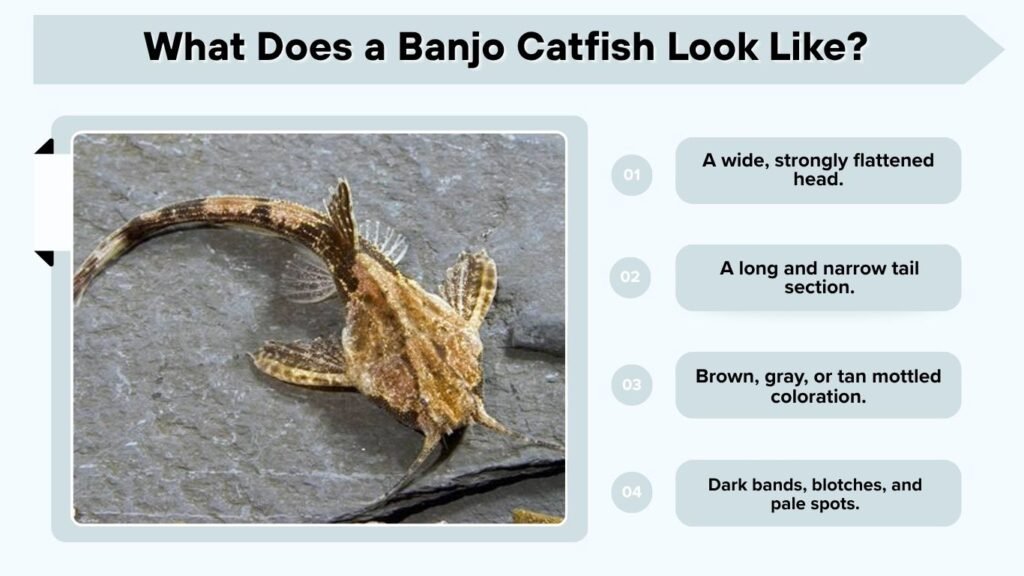
Banjo catfish are named for their unusual shape. Their broad, flattened front section resembles the body of a banjo, while the narrow tail resembles its neck.
Identification
A common banjo catfish can be identified by:
- A wide, strongly flattened head
- A long and narrow tail section
- Brown, gray, or tan mottled coloration
- Dark bands, blotches, and pale spots
- Three pairs of whisker-like barbels
- Small eyes positioned near the top of the head
- Rough, scaleless skin
- Strong, serrated pectoral-fin spines
- A pale belly with irregular brown markings
Its coloring allows it to resemble dead leaves, bark, or debris. This camouflage is so effective that owners may struggle to locate the fish even in a small aquarium.
Banjo Catfish Species
Not every fish sold under this name is Bunocephalus coracoideus. Eel-tailed, banded, Asian, whiptail, and bearded banjo catfish may belong to different species or genera.
Some eel-tailed species grow much larger than the common aquarium banjo. Therefore, buyers should confirm the scientific name before choosing a tank. The common B. coracoideus remains below approximately six inches, while certain eel-tailed banjo catfish can exceed 12 inches.
How Big Do Banjo Catfish Get?
A full-grown common banjo catfish usually reaches around 4–5 inches. FishBase records a maximum standard length of 11 centimeters, or approximately 4.3 inches, although some aquarium references list adults approaching 6 inches when total length is measured.
Growth is relatively slow and may be difficult to observe because the fish spends so much time hidden. Proper nutrition, stable water parameters, adequate space, and regular aquarium maintenance support healthy development.
Females may become wider and fuller through the abdomen, especially when carrying eggs. However, a rounded belly can also result from overeating, constipation, internal illness, or poor water quality.
Banjo Catfish Tank Size and Setup
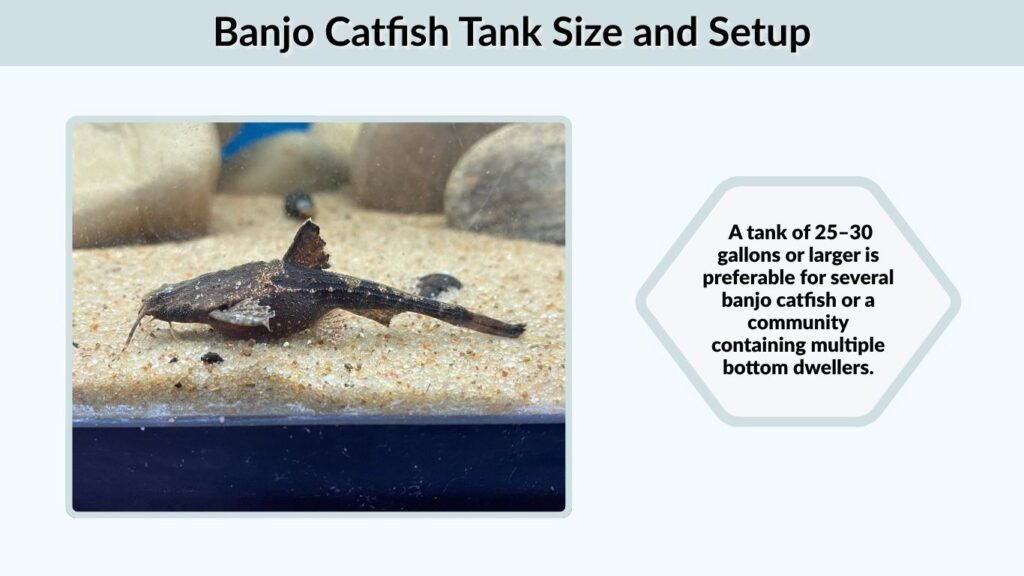
Despite being inactive, banjo catfish need adequate floor space. The aquarium’s length and bottom area matter more than its height.
Minimum Tank Size
A 20-gallon long aquarium is a practical minimum for one common banjo catfish. FishBase recommends an aquarium at least 80 centimeters long. A tank of 25–30 gallons or larger is preferable for several banjo catfish or a community containing multiple bottom dwellers.
Avoid overcrowding the bottom. Banjo catfish need enough open sand to bury themselves and separate feeding areas where faster fish cannot steal their food.
Water Conditions
Maintain the following general conditions:
- Temperature: 75–82°F
- pH: 6.0–7.8
- Water hardness: Soft to moderately hard
- Flow: Gentle to moderate
- Ammonia and nitrite: 0 ppm
Banjo catfish tolerate a reasonable range of water chemistry, but they do poorly when exposed to ammonia, nitrite, rapidly changing temperatures, or neglected substrate. Use an established biological filter and perform regular partial water changes.
Substrate and Decorations
Fine sand is the best substrate because these catfish naturally bury themselves. Smooth, fine gravel may work, but sharp or coarse material can damage the belly, skin, and barbels.
Create shaded resting areas with:
- Driftwood
- Smooth caves
- Broad-leaved plants
- Floating plants
- Dried Indian almond leaves
- Aquarium-safe leaf litter
Lighting should be dim or partially shaded. Strong lighting without cover may cause the fish to remain hidden throughout the day.
What Do Banjo Catfish Eat?
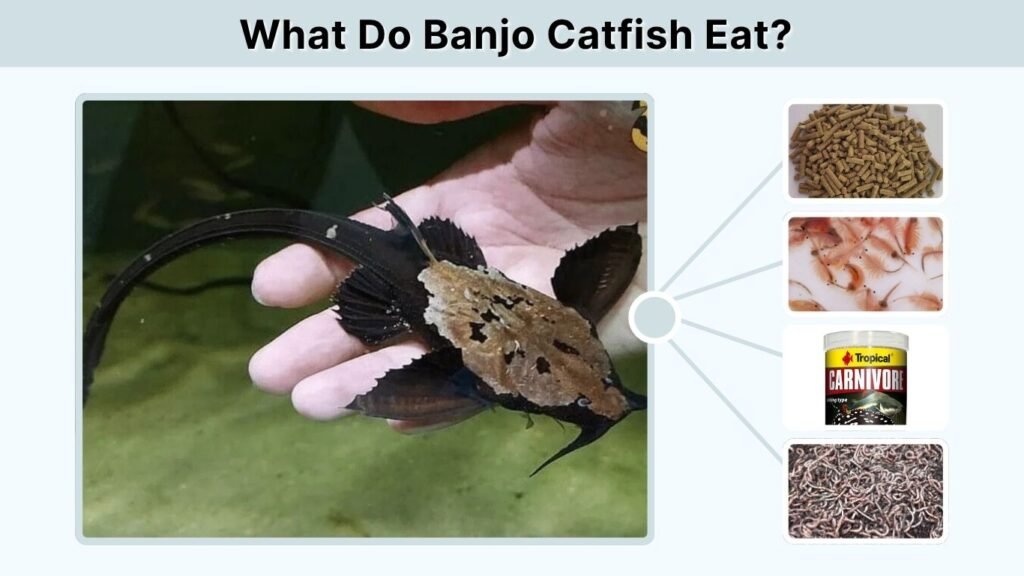
Banjo catfish are bottom-feeding omnivores that consume small animals, organic debris, and other edible material found along the substrate. They are scavengers, but they cannot survive solely on leftovers from other fish.
Best Banjo Catfish Food
Offer a varied diet containing:
- Sinking catfish pellets
- Soft carnivore pellets
- Frozen bloodworms
- Brine shrimp
- Daphnia
- Mosquito larvae
- Chopped earthworms
- Small pieces of shrimp or mussel
- Occasional algae-based wafers
Small meaty foods should form an important part of the diet. Choose foods that sink quickly because these catfish rarely compete successfully at the surface.
Feeding Schedule
Feed once daily, preferably shortly after the aquarium lights go out. Place food close to the fish’s hiding area with feeding tongs, a pipette, or a turkey baster.
Watch the other tank inhabitants during feeding. Tetras, loaches, cichlids, and other catfish may consume everything before the slower banjo catfish emerges. Target feeding is especially important for newly introduced or unusually shy individuals.
Behavior and Temperament
Banjo catfish are peaceful, nocturnal, and highly secretive. They normally remain beneath sand, leaf litter, driftwood, or plants during daylight hours.
Why Is My Banjo Catfish Not Moving?
Remaining motionless is usually normal. Their primary defense is camouflage rather than fast swimming. A resting fish may appear dead, particularly when partially buried with only its eyes or dorsal fin visible.
Check for gentle gill movement before disturbing it. Constantly digging up or handling a hidden catfish can cause stress and skin injuries.
Concern is appropriate when inactivity is accompanied by rapid breathing, red skin, open sores, severe swelling, loss of balance, floating, or refusal to eat for an extended period.
Are Banjo Catfish Aggressive?
Banjo catfish are not normally aggressive toward similarly sized fish. They are also generally tolerant of their own kind, although they do not need to form a tightly coordinated school.
Extremely small fry or newly hatched shrimp may be eaten when discovered at night. Avoid treating any catfish as completely safe with animals small enough to fit into its mouth.
Suitable Banjo Catfish Tank Mates
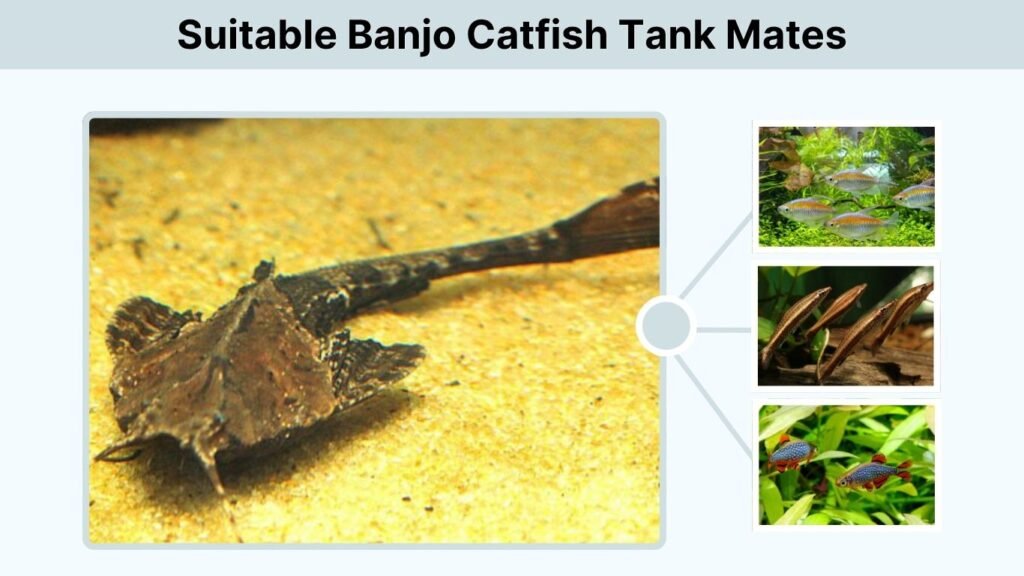
Choose peaceful species that prefer the middle or upper levels of the aquarium.
Suitable companions may include:
- Medium-sized tetras
- Rasboras
- Hatchetfish
- Pencilfish
- Corydoras
- Peaceful gouramis
- Small, calm barbs
- Gentle dwarf cichlids
Avoid highly aggressive cichlids, large predatory fish, crayfish, fin-nipping species, and boisterous bottom dwellers. Tank mates should not continually uncover, bite, or outcompete the banjo catfish.
Banjo Catfish Lifespan
Reliable species-specific longevity records are limited, but aquarium estimates commonly place the banjo catfish lifespan between approximately 6 and 12 years. Individual lifespan depends heavily on water quality, diet, tank stability, disease prevention, and correct species identification.
Long-term care should include stable temperatures, low nitrogenous waste, varied food, smooth substrate, and minimal unnecessary handling.
Banjo Catfish Breeding
Breeding in home aquariums is possible but uncommon. Mature fish normally spawn at night and scatter eggs over sandy substrate. FishBase reports that females may produce approximately 4,000–5,000 eggs and do not carry them on their bodies as some related banjo catfish do.
Adults may eat the eggs, so breeders usually remove the parents after spawning. Under suitable conditions, the eggs may hatch in approximately three days. The young initially require tiny foods such as microworms, newly hatched brine shrimp, and finely crushed tablets.
FAQs
Can banjo catfish live with betta fish?
A banjo catfish may live with a calm betta in a sufficiently large, heated aquarium. Provide a sandy bottom, several hiding areas, and separate feeding locations. Compatibility depends on the betta’s personality, as an aggressive individual may repeatedly bite or investigate the motionless catfish.
Will banjo catfish eat other fish?
They generally do not hunt ordinary community fish. However, they may consume very small fry or other animals that fit easily into their mouths. Select tank mates that are too large to be swallowed and provide enough food after dark.
Do banjo catfish eat shrimp?
Large adult shrimp may coexist with a well-fed banjo catfish, but baby shrimp can become food. Banjo catfish are opportunistic bottom feeders, so they should not be considered completely shrimp-safe in a breeding colony.
Why does my banjo catfish bury itself?
Burrowing is a natural camouflage and resting behavior. In the wild, these fish hide in soft sediment, plant debris, and leaf litter. Fine aquarium sand allows them to behave naturally and reduces stress during daylight hours.
Can banjo catfish live in brackish water?
The common Bunocephalus coracoideus is primarily a freshwater species and should be kept in freshwater. Some other members of the banjo catfish family naturally enter brackish environments, but their requirements should not be applied to every species sold under the same common name.