
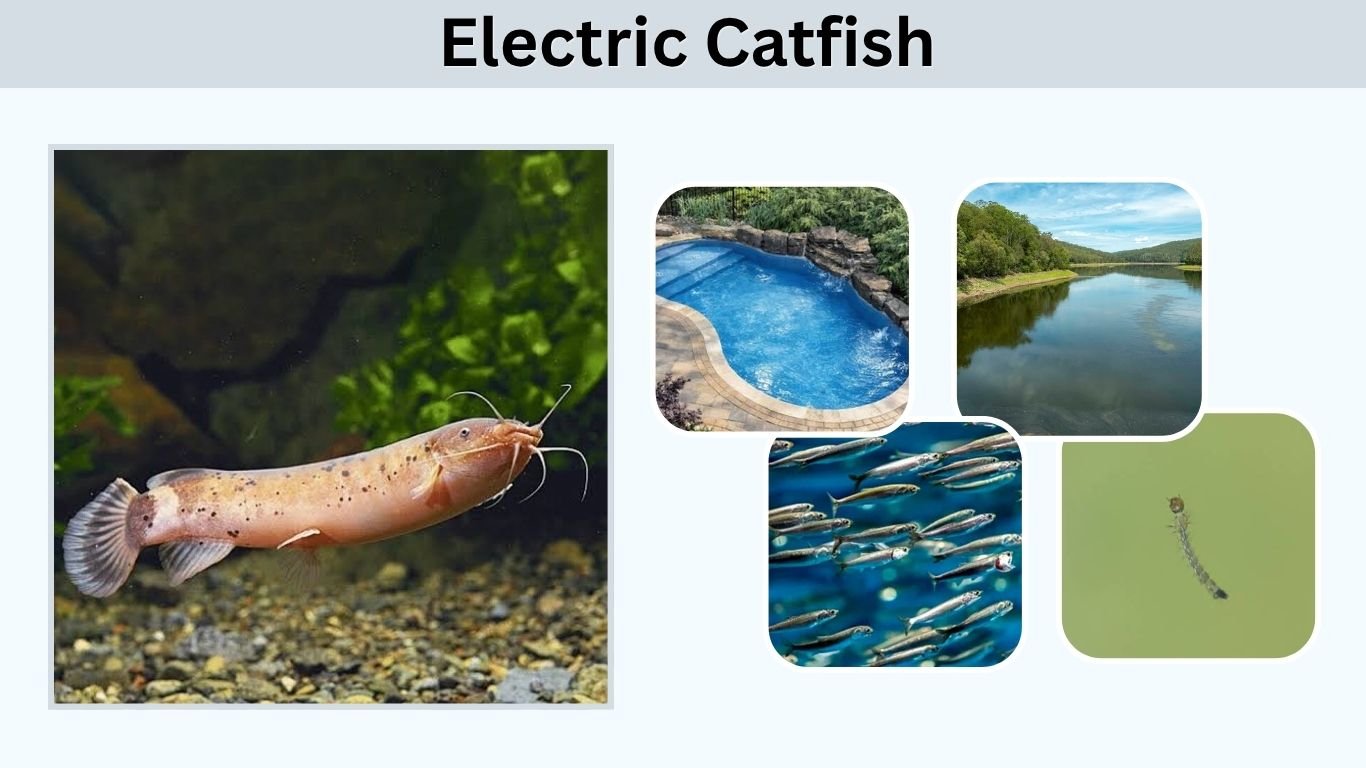
The electric catfish is an African freshwater fish capable of producing powerful electrical discharges to capture prey and defend itself. The name most commonly refers to Malapterurus electricus, a large, nocturnal catfish with smooth skin, small eyes, sensory barbels, and no conventional dorsal fin. Its electric organ surrounds much of its body and can generate approximately 300–400 volts. Although fascinating, this fish is potentially hazardous and unsuitable for an ordinary community aquarium.
Electric Catfish Quick Facts
| Feature | Description |
| Scientific name | Malapterurus electricus |
| Family | Malapteruridae |
| Native range | Tropical Africa |
| Habitat | Slow rivers, lakes, pools, and backwaters |
| Maximum recorded length | About 122 cm |
| Maximum published weight | About 20 kg |
| Maximum reported age | Around 10 years |
| Electrical output | Approximately 300–400 volts |
| Diet | Mainly fish and other aquatic animals |
| Activity | Primarily nocturnal |
| Aquarium suitability | Expert-only, usually kept alone |
FishBase records a maximum standard length of 122 cm, a published weight of 20 kg, and a maximum reported age of 10 years for Malapterurus electricus. Many individuals are considerably smaller, and several related electric-catfish species do not reach the same size.
What Does an Electric Catfish Look Like?
Electric catfish have thick, elongated bodies with rounded heads and smooth skin. Their bodies often appear brown, gray, pinkish brown, or olive, sometimes with irregular dark spots.
Identification Features
- Thick, cylindrical body
- Smooth skin without visible scales
- Broad, rounded head
- Small eyes
- Three pairs of sensory barbels
- Wide mouth
- No conventional dorsal fin
- Rounded pectoral and pelvic fins
- Low adipose fin close to the tail
- Brown or gray body with possible dark spotting
The absence of a regular dorsal fin is one of the group’s most noticeable characteristics. Electric catfish also have an adipose fin and a relatively short anal fin, unlike some long-bodied catfish with very extended anal fins.
Where Do Electric Catfish Live?
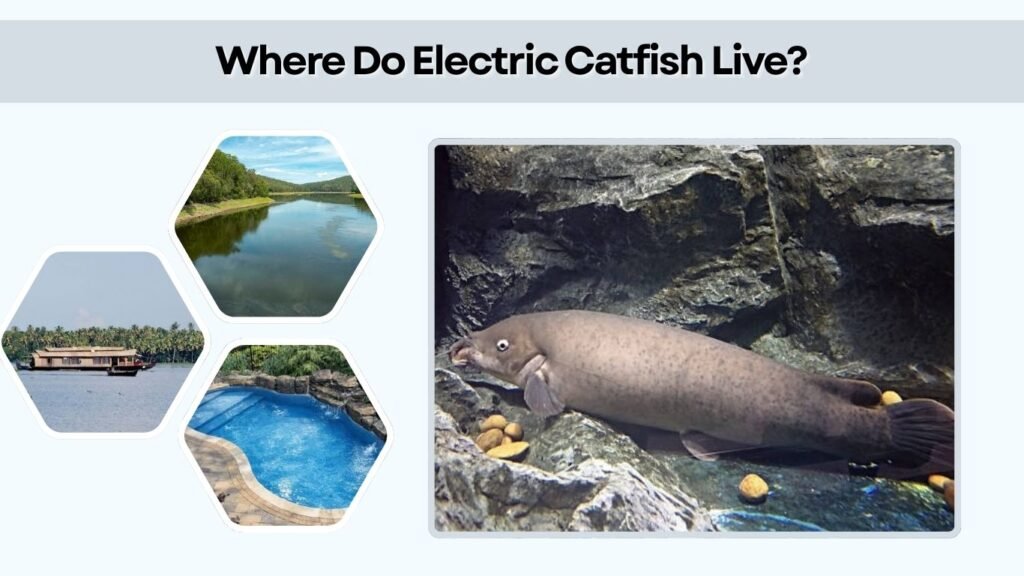
Malapterurus electricus is native to tropical Africa. Its distribution includes much of the Nile system, Lake Turkana, Lake Chad, the Senegal basin, the Niger system, and several West African river basins from Côte d’Ivoire through Ghana. Despite older reports, this particular species is considered absent from the Congo basin, where related species occur instead.
Preferred Habitat
Electric catfish favor:
- Slow-moving rivers
- Quiet backwaters
- Lakes and pools
- Flooded areas
- Rocky shelters
- Submerged roots
- Muddy or vegetated bottoms
- Warm tropical freshwater
They commonly rest among rocks, roots, or other cover during daylight and become more active after sunset. FishBase associates the species with sluggish or standing water and temperatures of approximately 23–30°C.
How Do Electric Catfish Produce Electricity?
The fish generates electricity through two large electric organs containing millions of specialized cells called electroplaques or electrocytes. These cells are arranged so their small individual electrical potentials combine into a much stronger external discharge.
The electric organs develop from modified muscle tissue and extend around much of the fish’s body beneath the skin. The discharge is controlled by a specialized electromotor system involving large nerve cells in the spinal cord and electric nerves connected to the organs.
Electric Catfish Voltage
A large Malapterurus electricus can produce discharges of roughly 300–400 volts. Discharge strength generally increases as the fish grows. These are brief pulses rather than a continuous electrical current like that supplied by a household outlet.
The fish may release pulses individually or as rapid volleys. Research shows that the timing and number of pulses change according to the situation, including prey encounters, territorial interactions, and defensive responses to threatening fish.
Why Does It Not Shock Itself?
Electric catfish are remarkably resistant to both their own discharges and electricity originating outside their bodies. Experiments found that shocks affecting control fish did not cause involuntary muscle contractions or disrupt normal sensorimotor responses in electric catfish. The complete biological mechanism providing this protection remains unclear.
What Do Electric Catfish Use Electricity For?
Electricity serves two primary purposes: hunting and defense.
Capturing Prey
The fish searches for prey mainly at night. When a suitable fish comes within range, the catfish releases a series of electrical pulses that can stun or immobilize it. The prey is then swallowed using the catfish’s broad mouth.
Defending Itself
An electric catfish can discharge when touched, cornered, attacked, or disturbed. Experiments found that the fish produced particularly intense, high-frequency volleys when confronted by a larger threatening catfish.
Electrical defense probably discourages many potential predators. However, producing electricity does not make the fish completely invulnerable to larger predators, environmental stress, disease, or human capture.
What Do Electric Catfish Eat?
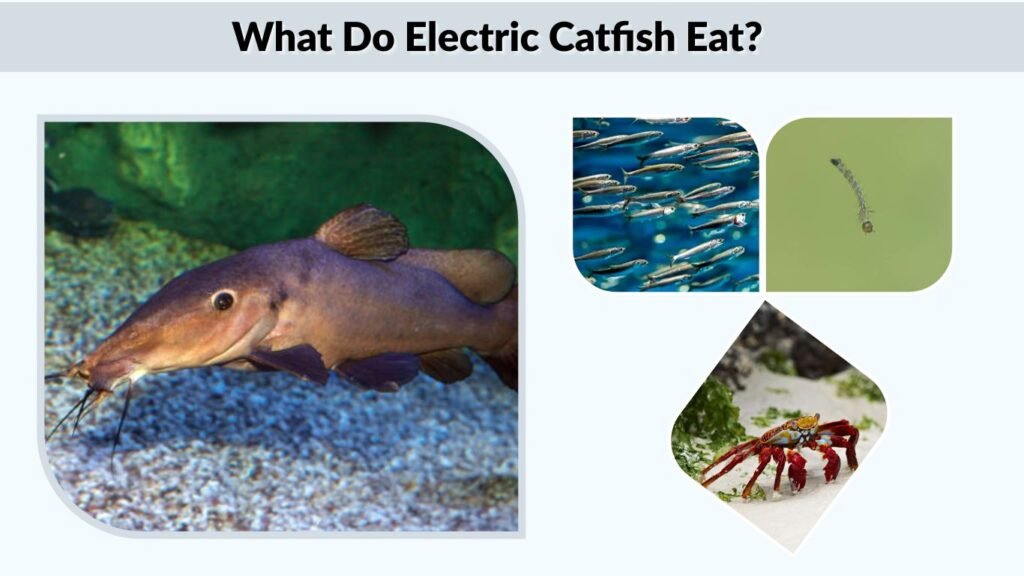
Electric catfish are carnivorous predators. Fish make up the main portion of the diet of large M. electricus, although smaller individuals may consume a wider range of aquatic animals.
Their diet may include:
- Small fish
- Fish eggs or fry
- Aquatic insects
- Crustaceans
- Worms
- Other appropriately sized animal prey
FishBase describes the species as a nocturnal fish-eater that primarily captures fish stunned by electrical shocks. Mollusks are reportedly consumed only rarely.
Can an Electric Catfish Kill a Human?
Electric catfish can deliver a powerful and painful shock, but Malapterurus electricus is not known to have caused a confirmed human death. Human encounters more commonly involve fishermen or handlers receiving an unpleasant shock after touching the fish.
That does not mean the fish is safe to handle. A shock could cause sudden muscle movement, loss of balance, dropping equipment, or panic in the water. Risk may be greater for someone with a heart condition, implanted medical device, or increased sensitivity to electrical current.
Never hold an electric catfish with bare hands. Aquarium owners should disconnect equipment before maintenance, keep their hands out of the occupied tank, and use secure containers and professional assistance when moving the fish.
Electric Catfish vs Electric Eel
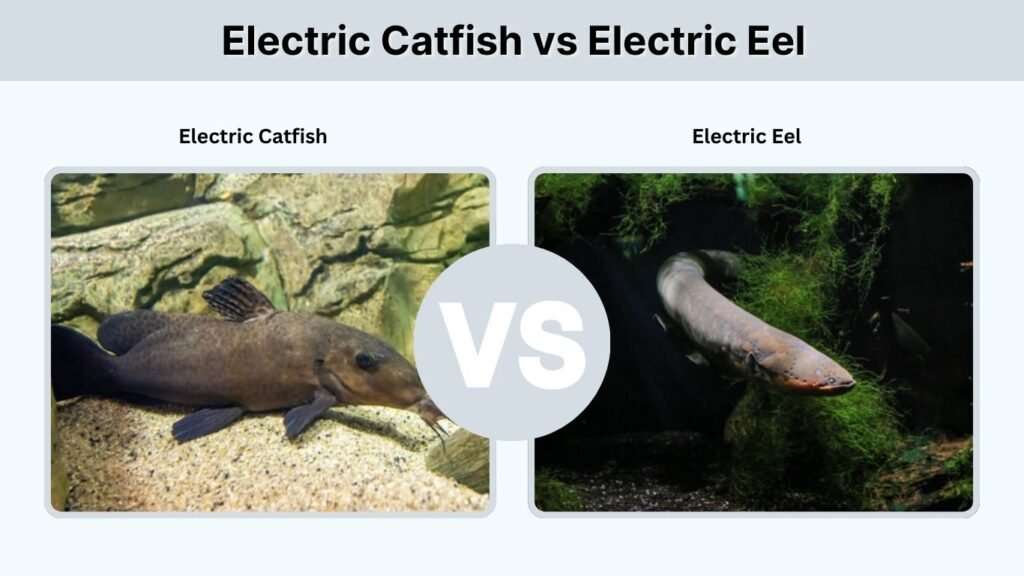
Electric catfish and electric eels independently evolved the ability to produce strong electrical discharges. They are not closely related and live on different continents.
| Feature | Electric Catfish | Electric Eel |
| Main group | Catfish | Knifefish |
| Native region | Africa | South America |
| Body shape | Thick and catfish-like | Long and eel-like |
| Barbels | Present | Absent |
| Typical maximum voltage | Around 300–400 volts | Up to 860 volts in E. voltai |
| Main uses of electricity | Hunting and defense | Hunting, defense, sensing, and communication |
| Air breathing | Not specialized like electric eels | Regularly surfaces to breathe air |
The strongest measured electric-eel species, Electrophorus voltai, produced a discharge of 860 volts. This is considerably higher than the commonly reported maximum for Malapterurus electricus.
Voltage alone does not provide a complete comparison of danger. Pulse duration, current, contact area, water conductivity, distance, body size, and the pathway through the recipient all affect the result of an electrical discharge.
Are All Catfish Electric?
Most catfish cannot produce the powerful shocks associated with electric catfish. Strong electrical discharge is characteristic of the African family Malapteruridae.
Some other catfish, including certain Synodontis species, can generate extremely weak electrical signals. These millivolt-level signals are entirely different from the hundreds of volts produced by electric catfish.
Cory catfish, pictus catfish, channel catfish, and similar aquarium species are not strong electric fish. An “electric green” cory is named for its color rather than an ability to shock.
Electric Catfish Aquarium Care
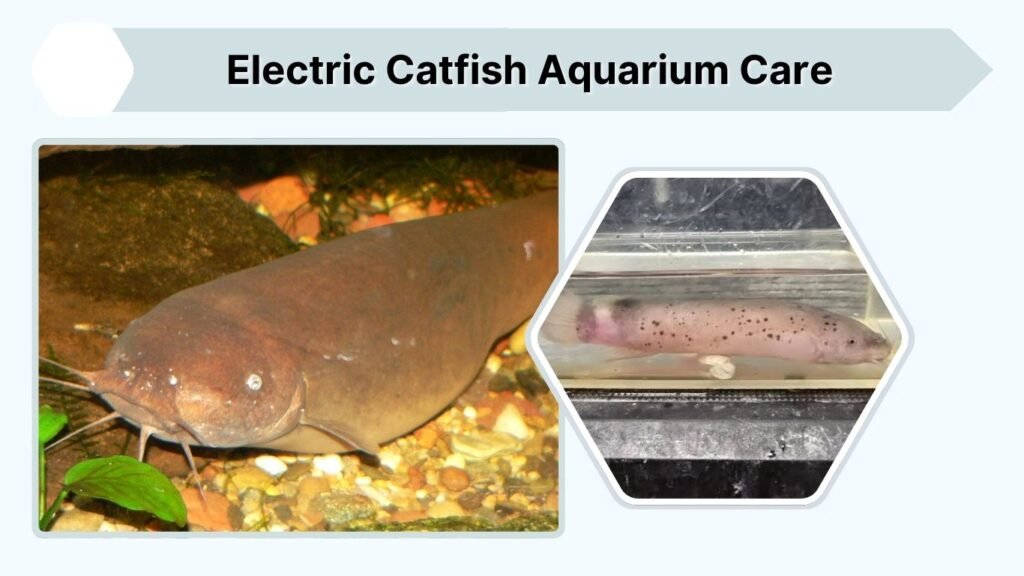
Electric catfish occasionally appear for sale in the aquarium trade, but they are specialist animals rather than ordinary pets. The exact species must be confirmed because different members of the family have very different adult sizes. FishBase currently recognizes numerous species within the electric-catfish family, including both small species and fish approaching or exceeding one meter.
Aquarium Requirements
An electric catfish aquarium should provide:
- A very large footprint suited to its expected adult size
- Warm, clean freshwater
- Strong biological filtration
- Gentle water movement
- Secure caves, roots, or other shelters
- Dim lighting
- A tightly secured lid
- Equipment protected from a large, powerful fish
- A safe maintenance method that avoids direct contact
The aquarium must be planned around the confirmed species’ adult size rather than its size at purchase. Malapterurus electricus can potentially exceed one meter, making many specimens unsuitable for a conventional home aquarium.
Electric Catfish Tank Mates
Keeping an electric catfish alone is the safest practical approach. It is a predatory fish that can stun or eat smaller tank mates, while electrical discharges may affect fish that are too large to swallow.
Scientific observations show that electric catfish discharge during encounters with prey, competitors, threatening species, and members of their own kind. This makes a community aquarium unnecessarily risky.
Feeding in Captivity
Captive individuals may accept suitable carnivore pellets, pieces of aquatic animal food, shrimp, worms, and other prepared foods. Feeder fish should not be considered essential and may introduce parasites or disease.
Avoid hand-feeding. Food should be delivered with long, nonconductive tools while minimizing disturbance around the fish.
Can an Electric Catfish Power a Device?
Despite its high voltage, an electric catfish is not a practical biological battery. Its discharges occur as brief pulses, and voltage alone does not determine the usable energy available to operate a lamp, charger, or other electrical device.
Attempting to connect equipment to a living fish would also be unsafe and harmful to the animal. The catfish’s electricity evolved for brief biological functions—not continuous power generation.
Electric Catfish Lifespan
FishBase lists a maximum reported age of approximately 10 years for Malapterurus electricus. Lifespan may vary according to species, water quality, temperature, diet, disease, predation, and captive care.
FAQs
Are electric catfish dangerous?
Yes. They can deliver painful shocks reaching several hundred volts. A shock is not known to be normally fatal to humans, but the fish should never be touched or handled casually.
How much electricity can an electric catfish produce?
Large Malapterurus electricus can produce approximately 300–400 volts. The output generally becomes stronger as the fish grows.
Where are electric catfish found?
They occur naturally in tropical African freshwater systems, including parts of the Nile, Niger, Senegal, Lake Chad, Lake Turkana, and several West African drainage basins.
Can electric catfish live with other fish?
Keeping them alone is safer. They are predators and may use electrical discharges against prey, competitors, threats, and even other electric catfish.
Is an electric catfish the same as an electric eel?
No. Electric catfish are African catfish, while electric eels are South American knifefishes. They evolved their electric organs independently and differ in anatomy, habitat, and maximum voltage.