
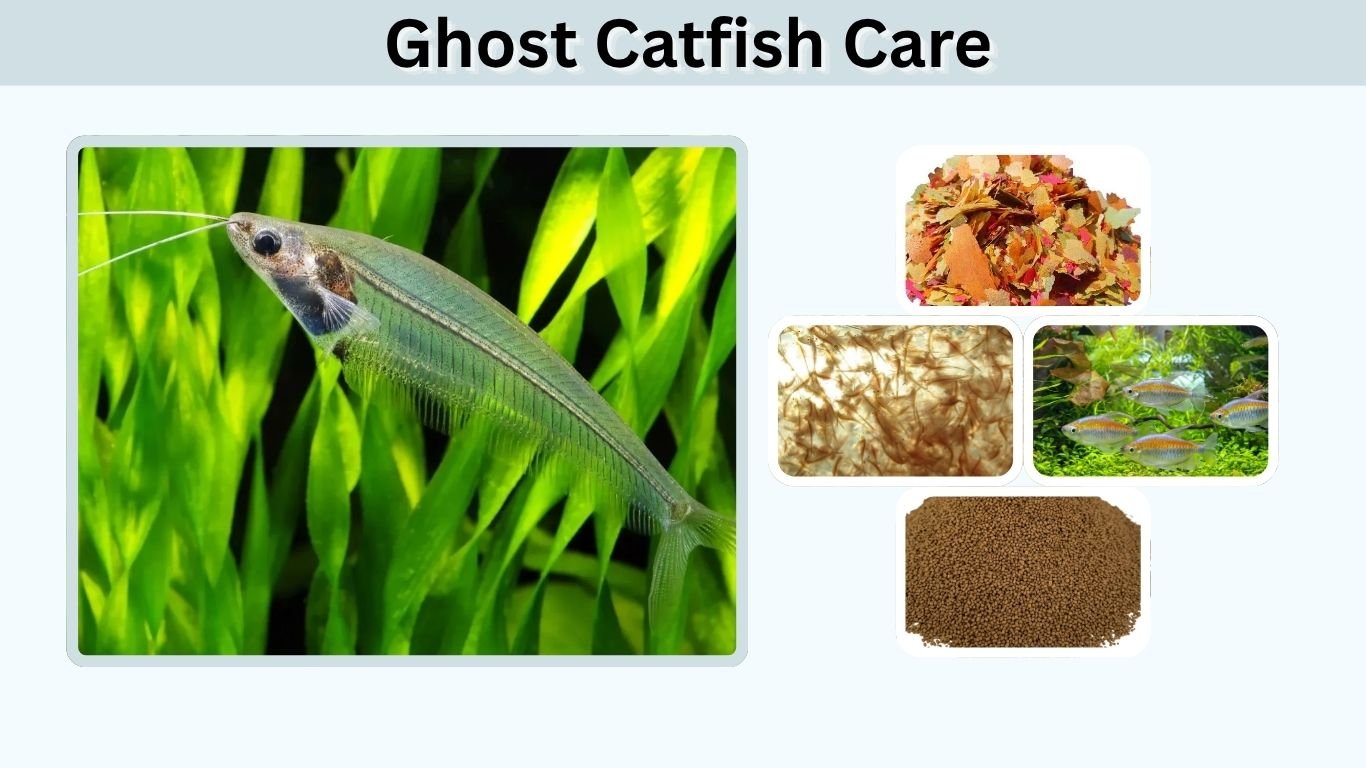
Ghost catfish are among the most unusual freshwater aquarium fish because much of their body is almost completely transparent. Also called ghost glass catfish or glass catfish, these peaceful schooling fish allow you to see their backbone and internal structures through the body. The aquarium species is generally Kryptopterus vitreolus, a small catfish native to Thailand. Although delicate in appearance, ghost catfish can thrive in a peaceful, well-maintained aquarium when provided with stable water, suitable companions, and a proper group.
What Is a Ghost Catfish?
The ghost catfish is a freshwater member of the Siluridae family. Its scientific name is Kryptopterus vitreolus. For many years, aquarium specimens were incorrectly identified as Kryptopterus bicirrhis or Kryptopterus minor. Researchers formally described K. vitreolus as a separate species in 2013.
Ghost Catfish Appearance
Ghost catfish have several distinctive features:
- Nearly transparent body
- Visible backbone and internal structures
- Long, slender body shape
- Two prominent sensory barbels near the mouth
- Very small dorsal fin
- Long anal fin
- Clear fins
- Slight rainbow-like shine under certain lighting
Their transparent appearance is natural rather than the result of artificial coloring. Research has shown that their unusual transparency and iridescence are related to the structure and pigmentation of their tissues.
Ghost Catfish Habitat
Wild ghost catfish are known from peninsular and southeastern Thailand. They occur in freshwater environments, including slow-moving or nearly still waters that can be brown or dark in appearance.
In an aquarium, plants, driftwood, and shaded areas can help create a more comfortable environment.
How Big Do Ghost Catfish Get?
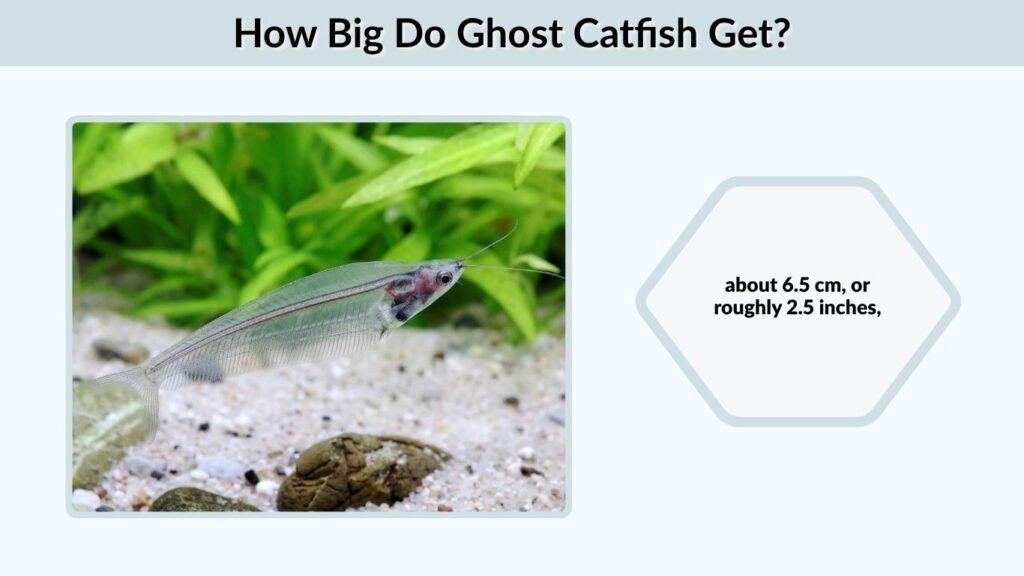
Ghost catfish remain relatively small compared with many other catfish. FishBase records a maximum standard length of about 6.5 cm, or roughly 2.5 inches, for Kryptopterus vitreolus.
This modest adult size makes them suitable for community aquariums, although their schooling behavior means several should be housed together.
Ghost Catfish Tank Size
A 20-gallon aquarium or larger can work for a small group, although a larger and longer tank provides more swimming room. Aquarium Co-Op recommends keeping at least six ghost catfish together in a tank of 20 gallons or more.
A suitable setup should include:
- Good filtration
- Stable water quality
- Open middle-level swimming space
- Live or artificial plants
- Driftwood or other cover
- Moderate to subdued lighting
- Gentle to moderate water movement
Avoid overcrowding the aquarium.
Ghost Catfish Care
Ghost catfish are not usually difficult because of their diet or aggression. Their main challenge is that they do best in stable conditions and may become stressed when kept alone or with aggressive fish.
Ghost Catfish Temperature and Water
A practical aquarium temperature range is approximately 72–82°F (22–28°C), with mildly acidic to neutral water commonly recommended.
More specialized aquarium references list temperatures around 20–26°C and acidic to neutral conditions, reflecting the soft-water environments associated with the species.
Rather than constantly changing the water chemistry to reach an exact number, maintaining clean and stable conditions is especially important.
Should Ghost Catfish Be Kept in Groups?
Yes. Ghost catfish are schooling fish and are best maintained with other members of their species.
A group of six or more is a useful starting point. In a group, they are more likely to swim openly through the middle of the aquarium instead of continually hiding.
Keeping only one or two can result in shy behavior and reduced activity.
What Do Ghost Catfish Eat?
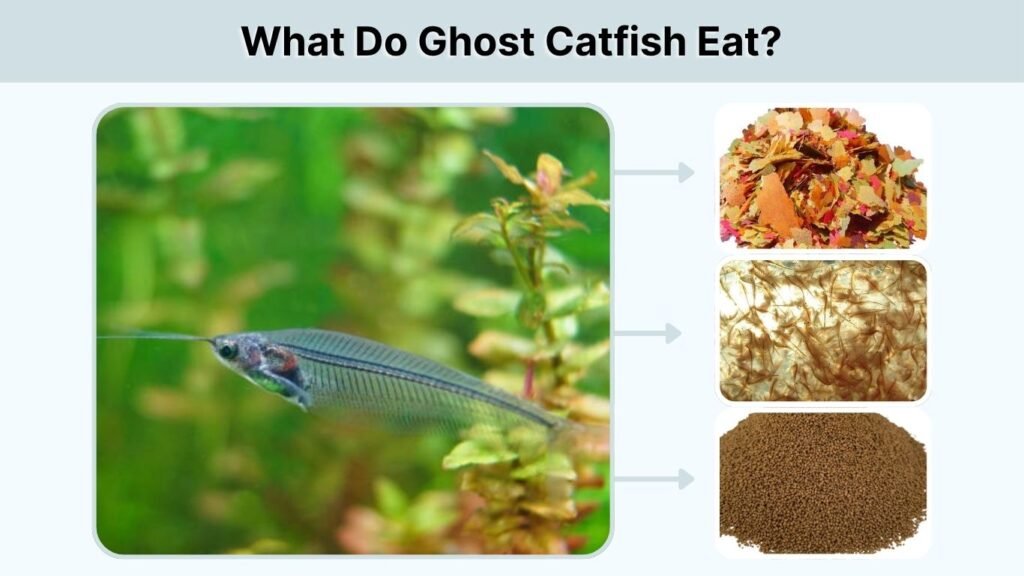
Ghost catfish accept a variety of appropriately sized aquarium foods. Because they have relatively small mouths and commonly feed in the middle of the water column, smaller foods are easier for them to consume.
Best Ghost Catfish Foods
Suitable foods include:
- Quality fish flakes
- Small or nano pellets
- Baby brine shrimp
- Daphnia
- Small frozen foods
- Other appropriately sized community fish foods
Aquarium Co-Op specifically recommends small foods such as flakes, nano pellets, baby brine shrimp, and daphnia.
Offer a varied diet instead of depending on only one type of food.
Feeding Ghost Catfish
Feed portions small enough to be consumed without leaving large amounts of food in the aquarium. Since ghost catfish tend to occupy the middle of the tank, make sure faster surface-feeding fish do not consume everything before the catfish receive their share.
Ghost Catfish Tank Mates
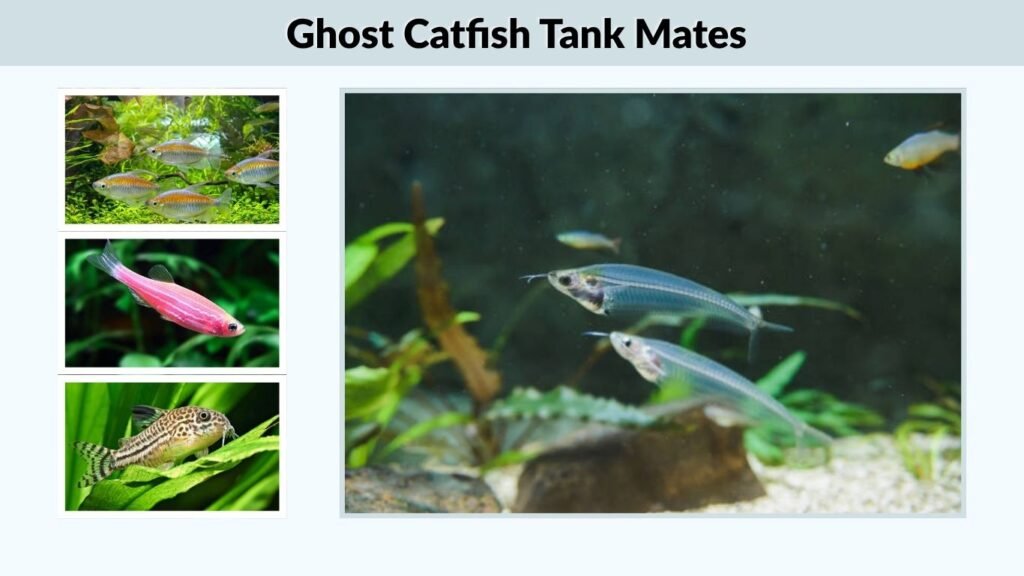
Ghost catfish are peaceful community fish. Their best companions are generally peaceful species of similar or smaller size that will not chase, nip, or intimidate them.
Best Tank Mates for Ghost Catfish
Possible companions include:
- Peaceful tetras
- Danios
- Corydoras catfish
- Smaller peaceful gouramis
- Rasboras
- Other non-aggressive community fish
Tetras, danios, Corydoras, and smaller gouramis are among the community companions recommended for glass catfish.
Avoid large predatory fish and highly territorial species.
Are Ghost Catfish Aggressive?
No. Ghost catfish are generally peaceful and are much more likely to retreat from conflict than initiate it.
Their timid nature means aggression from other fish can become a bigger problem than aggression from the ghost catfish themselves.
Can Ghost Catfish Live With Bettas?
It may be possible in some carefully selected community setups, but the combination is not automatically ideal.
Betta personalities vary considerably. A calm betta may ignore a school of ghost catfish, while a territorial individual may chase them. A spacious, planted aquarium with hiding areas gives the combination a better chance of working, but the fish should be closely observed.
Ghost Catfish Lifespan
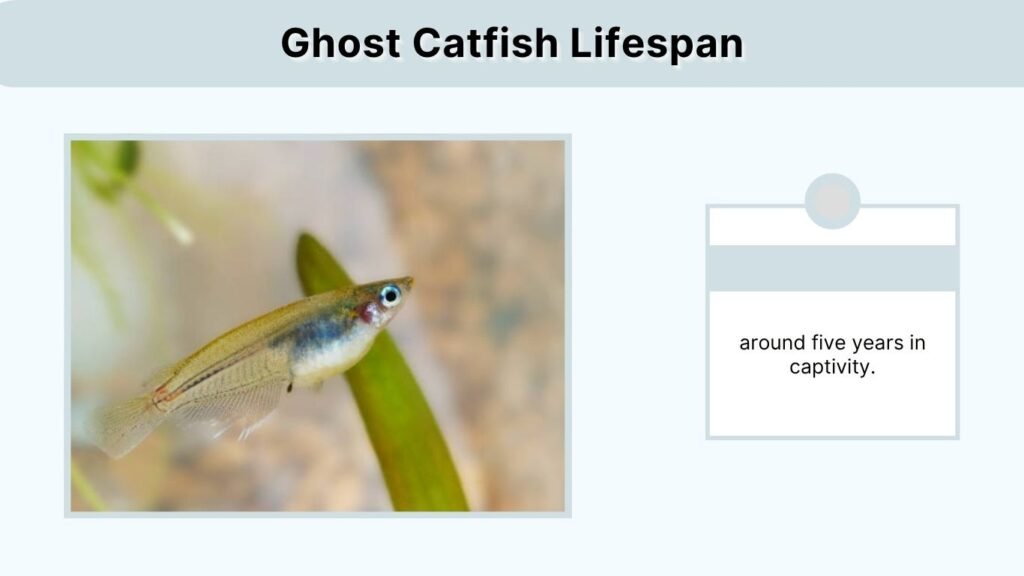
Ghost catfish are commonly reported to live around five years in captivity when cared for appropriately, although reliable scientific information on their maximum lifespan in the wild is limited.
Their long-term health depends heavily on stable water quality, suitable nutrition, low stress, and being maintained in a proper school.
Ghost Catfish Breeding
Breeding ghost catfish in ordinary home aquariums is considered challenging, and reproduction is far less commonly documented by hobbyists than with fish such as guppies or Corydoras.
However, captive breeding is possible. A published study from Thailand investigated induced breeding of Kryptopterus vitreolus, demonstrating that the species can be propagated under controlled conditions.
Are Pregnant Ghost Catfish Really Pregnant?
Ghost catfish are egg-laying fish, so females do not become pregnant in the same way as livebearing fish.
A female carrying developing eggs may appear fuller through the abdomen. Because the body is transparent, internal structures can also be unusually visible, which may lead owners to assume the fish is pregnant.
Why Does a Ghost Catfish Look Rainbow-Colored?
A healthy ghost catfish may display subtle blue, green, yellow, or rainbow-like colors when light strikes its transparent body at certain angles.
This does not mean it is a separate “rainbow ghost catfish” species. Research found that light interacting with structures within the fish’s muscles can produce its characteristic iridescent appearance.
FAQs
Are ghost catfish good beginner fish?
Ghost catfish can work for aquarists who understand basic aquarium cycling and water maintenance, but they are not the most forgiving beginner fish. They perform best in a mature, stable aquarium and should be kept in a proper school rather than individually.
How many ghost catfish should be kept together?
Keep at least six whenever tank space allows. Ghost catfish naturally prefer groups, and keeping several together generally encourages more confident schooling behavior. A larger group can be maintained when the aquarium provides adequate swimming space and filtration.
How big is a full-grown ghost catfish?
The commonly sold Kryptopterus vitreolus reaches about 6.5 cm, or roughly 2.5 inches, in standard length. Older aquarium information may list much larger sizes because ghost catfish were historically confused with other Kryptopterus species.
Why is my ghost catfish hiding?
Hiding can occur when a ghost catfish is newly introduced, kept in too small a group, exposed to aggressive tank mates, or uncomfortable with bright surroundings. Providing plants, shaded areas, peaceful companions, and a group of six or more can help them become more confident.
Do ghost catfish eat ghost shrimp?
A ghost catfish has a relatively small mouth and is not considered a major shrimp predator, but very small shrimp or newborn shrimplets may still be vulnerable. Adult shrimp are generally safer, especially when the aquarium contains dense plants and hiding places.