
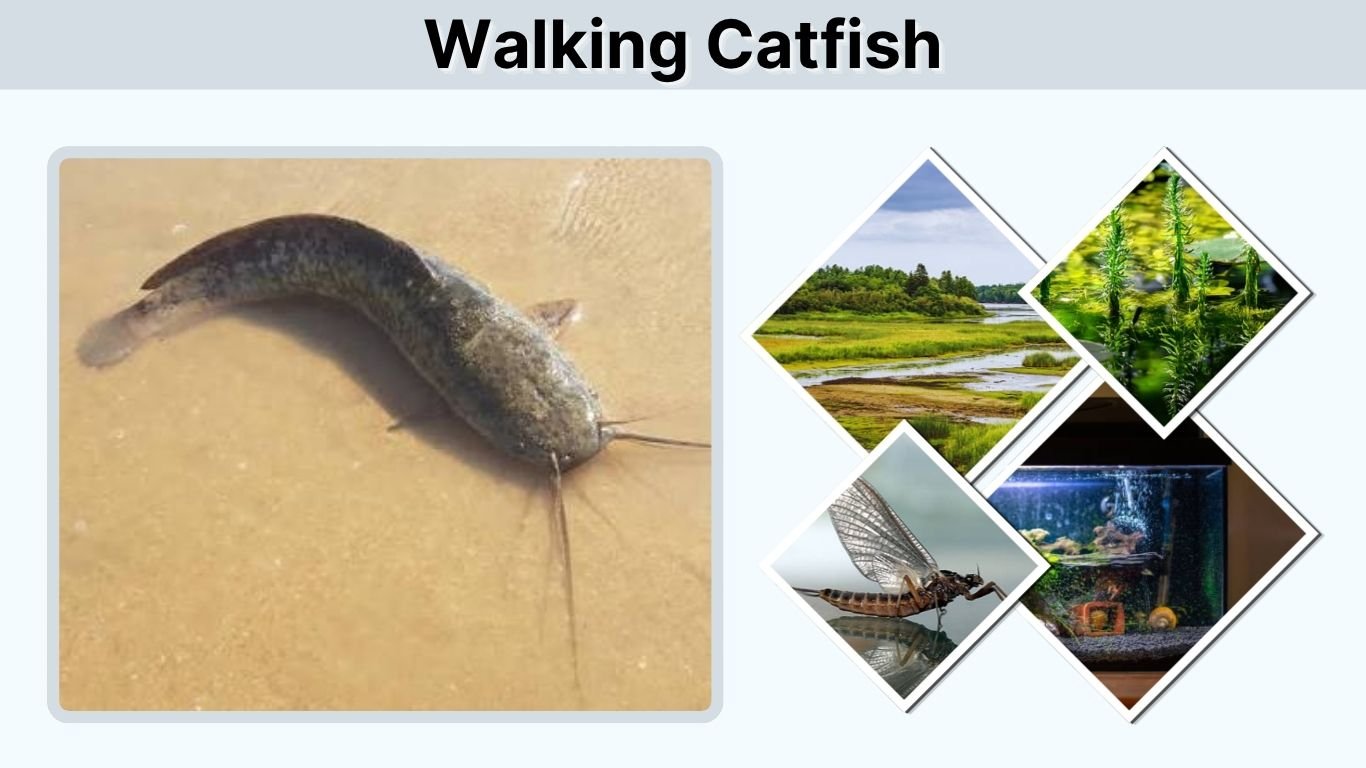
The walking catfish is an unusual air-breathing freshwater fish famous for moving across wet ground. Instead of truly walking, it wriggles its long body while using its strong pectoral fins for support. This ability allows it to leave shrinking ponds and search for another body of water. Native to tropical Asia, the fish has also established invasive populations in Florida, where possessing or transporting a live specimen is generally illegal without special permits.
What Is a Walking Catfish?
The walking catfish is a member of the air-breathing catfish family Clariidae. The name most commonly refers to Clarias batrachus, although several closely related Asian species have historically been identified under the same name.
It is primarily a freshwater fish but can tolerate some brackish conditions. It commonly inhabits warm, shallow waters where dissolved oxygen may fall to extremely low levels.
| Feature | Information |
| Scientific name | Clarias batrachus |
| Family | Clariidae |
| Common length | Around 26 cm or 10 inches |
| Maximum recorded length | About 47 cm or 18.5 inches |
| Maximum recorded weight | Around 1.2 kg or 2.6 pounds |
| Diet | Omnivorous and opportunistic |
| Habitat | Ponds, swamps, canals and rice fields |
| Activity | Mainly nocturnal |
| Special ability | Breathes air and moves over land |
Florida wildlife authorities report that local specimens commonly reach about 12 inches, while exceptionally large individuals may approach 20 inches and three pounds.
Walking Catfish Identification
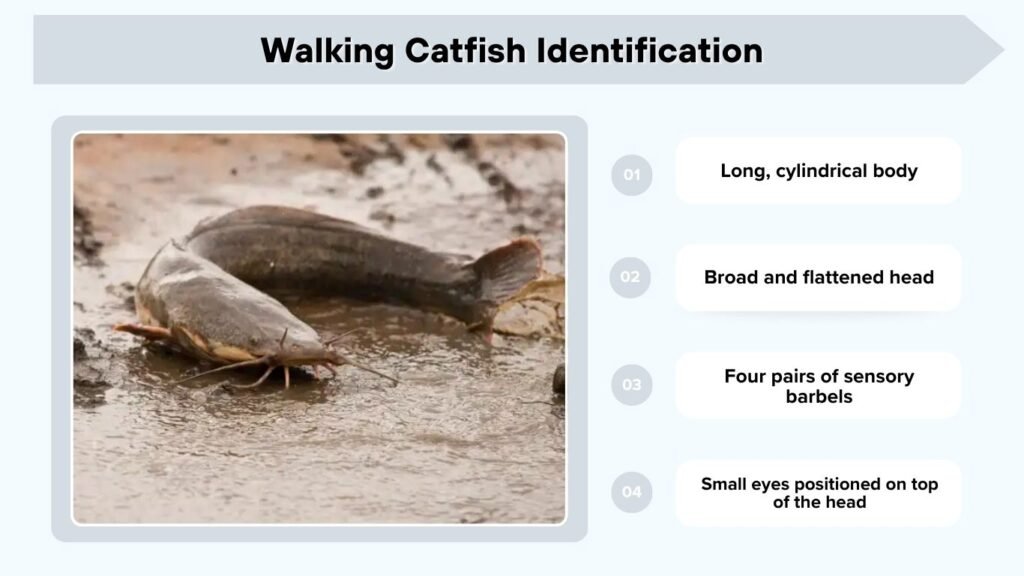
The walking catfish has a long, eel-like body and a broad, flattened head. Its skin has no scales and is covered by slippery mucus that helps prevent rapid drying when the fish leaves water.
Identification Features
- Long, cylindrical body
- Broad and flattened head
- Four pairs of sensory barbels
- Small eyes positioned on top of the head
- Long dorsal and anal fins
- Rounded tail rather than a deeply forked tail
- Dark grey, brown, olive or nearly black coloration
- Scaleless, mucus-covered skin
- Strong, serrated pectoral-fin spines
Albino and pale marbled walking catfish also occur in the aquarium and aquaculture trades. Their bodies may appear white, cream, yellowish or irregularly patterned instead of dark brown.
Can Walking Catfish Walk on Land?
Walking catfish can travel short distances over land, but the movement is not a true legged walk. The fish bends its body from side to side and braces itself with the pectoral fins, producing a slow, wriggling motion.
They are most likely to leave the water during rainy, humid conditions. Wet grass, mud and flooded roads help keep their skin moist while they move between ponds, canals or drainage areas.
The fish possess an accessory respiratory organ above the gills. This organ contains highly vascular tissue that absorbs oxygen directly from atmospheric air. It allows the fish to survive low-oxygen water and remain alive outside water for many hours under moist conditions. However, it cannot live indefinitely on dry land and will eventually die from dehydration or physical stress.
Why Do They Leave the Water?
Walking catfish may move over land to:
- Escape a drying pond
- Find deeper or better-oxygenated water
- Search for food
- Reach seasonally flooded habitat
- Escape overcrowding
- Enter nearby fish-farming ponds
Florida residents occasionally find them in yards, streets and drainage systems after heavy rain or flooding.
Walking Catfish Habitat and Natural Range
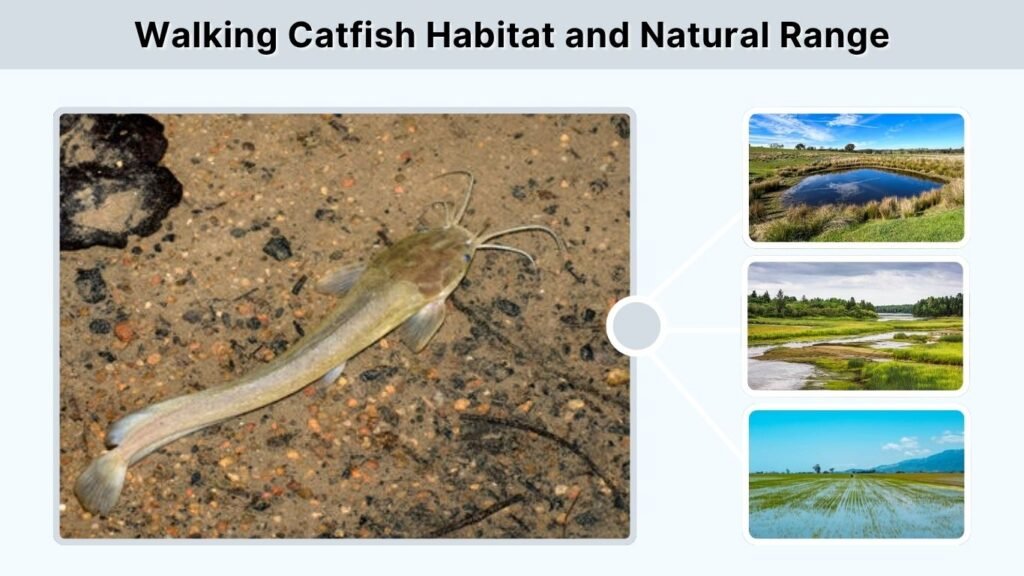
Walking catfish are associated with tropical Asia, although the exact natural ranges of Clarias batrachus and several closely related species have been confused historically.
Typical habitats include:
- Muddy ponds
- Swamps and marshes
- Slow-moving streams
- Roadside ditches
- Irrigation canals
- Flooded rice fields
- Temporary pools
- Shallow, vegetated wetlands
They are particularly successful in warm, stagnant water that would contain too little oxygen for many other fish. Walking catfish regularly rise to the surface to gulp air when underwater oxygen becomes limited.
What Do Walking Catfish Eat?
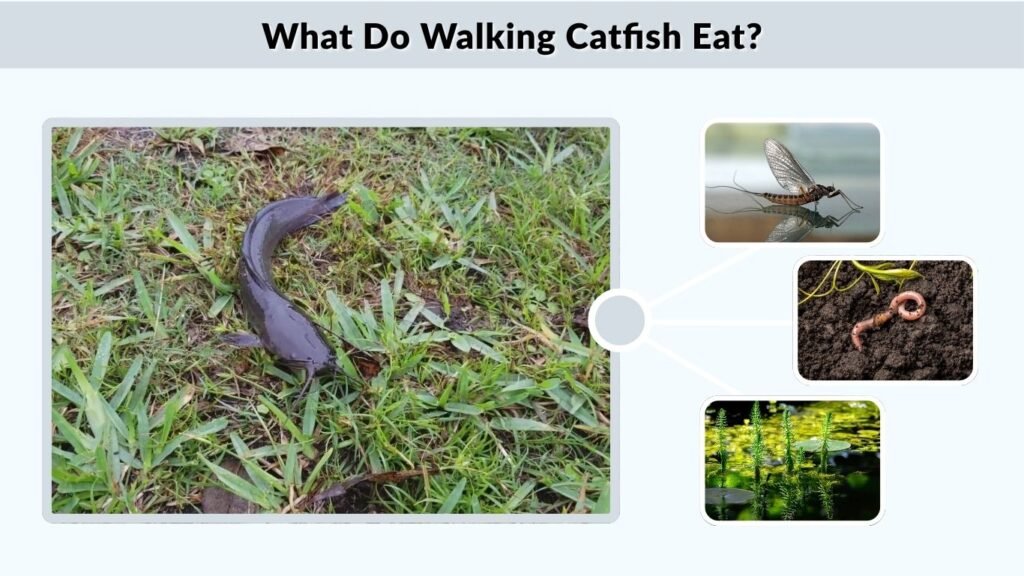
Walking catfish are opportunistic omnivores. They search along muddy bottoms and among vegetation, consuming both animals and plant material.
Their diet can include:
- Aquatic insects and larvae
- Earthworms
- Shrimp and small crustaceans
- Snails and other molluscs
- Fish eggs
- Small fish
- Aquatic plants
- Organic debris
- Dead animals
They often feed at night, using their sensitive barbels to locate food in dark or cloudy water. Their ability to consume many types of food helps them survive in temporary and disturbed habitats.
Walking Catfish Breeding and Life Cycle
Breeding usually corresponds with warm temperatures, rainfall and rising water levels. In their native region, walking catfish commonly spawn during the rainy season when flooded areas offer vegetation and shallow nursery habitat.
The pair may prepare a nest in submerged vegetation or along a muddy bank. During spawning, the male curves around the female as she releases adhesive eggs. The eggs attach to the nest or surrounding vegetation.
Florida wildlife authorities report that the male guards the eggs. After hatching, young catfish initially depend on their yolk sacs before beginning to consume tiny aquatic organisms. Their accessory air-breathing organs develop as they grow.
Walking Catfish in Florida
Walking catfish are not native to Florida. Introduced populations became established in southern Florida during the twentieth century and have been recorded in the Everglades and Big Cypress regions since at least the 1970s. Aquarium and aquaculture releases contributed to their establishment.
The warm climate, extensive canal systems, shallow wetlands and seasonal flooding allow the fish to spread between connected waterways. Cold weather limits their movement farther north because severe temperature drops can cause population die-offs.
Why Are Walking Catfish Invasive?
Their invasive characteristics include:
- Ability to tolerate poorly oxygenated water
- Movement between isolated water bodies
- Broad and flexible diet
- Feeding on fish, insects and eggs
- Survival in temporary muddy pools
- Entry into aquaculture ponds
Walking catfish have entered commercial fish ponds and consumed stocked fish. However, Florida wildlife authorities note that their preference for shallow, heavily vegetated habitats may reduce their overall effects on some native communities.
Florida Possession Rules
Walking catfish are classified as a conditional species in Florida. Possession and transportation of a live walking catfish are illegal without the necessary state and federal permits. An angler keeping one for food must kill it and place it on ice rather than transporting it alive.
Are Walking Catfish Dangerous or Poisonous?
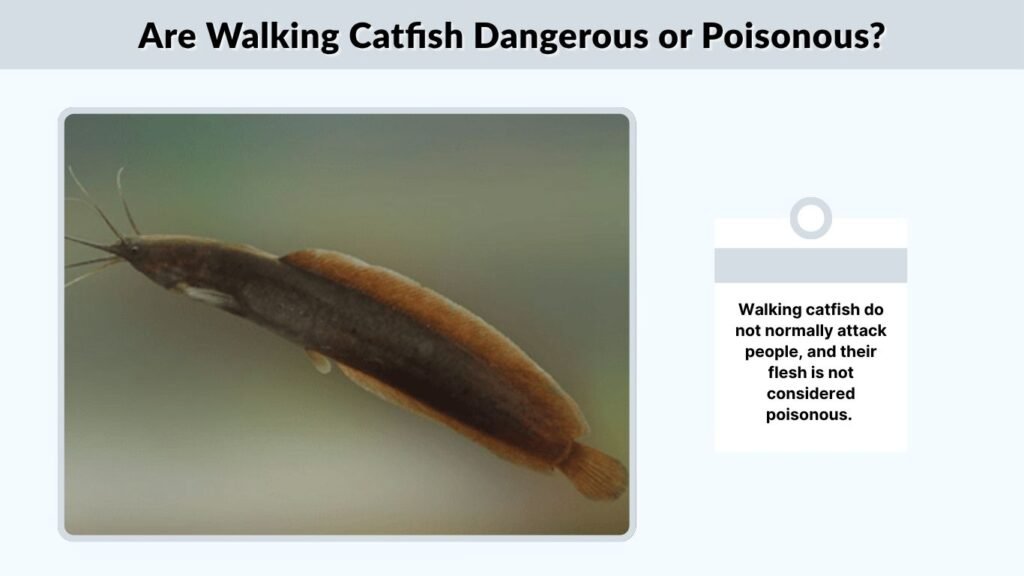
Walking catfish do not normally attack people, and their flesh is not considered poisonous. The main danger is the strong pectoral spine located on each side of the body.
These spines are sharp, rough and serrated. A struggling fish can drive one into a person’s hand or foot, producing a painful puncture. Research on Clarias catfish also indicates that spine and skin secretions may contribute to pain, redness and swelling after an injury.
Wear protective gloves and use a landing net or fish gripper. A deep puncture, retained spine fragment, severe swelling or increasing redness should receive medical attention because catfish wounds can become infected.
Can You Eat Walking Catfish?
Yes. Walking catfish are important food fish in parts of Asia and are sold fresh, frozen or alive in their native region. Their flesh can be fried, grilled, baked or added to curries and soups.
Florida authorities describe them as edible but note that they are not commonly eaten in Western countries. Anyone preparing one should avoid the pectoral spines, clean the fish hygienically and cook the flesh thoroughly. Local water-quality and fish-consumption advisories should also be followed.
Walking Catfish as an Aquarium Fish
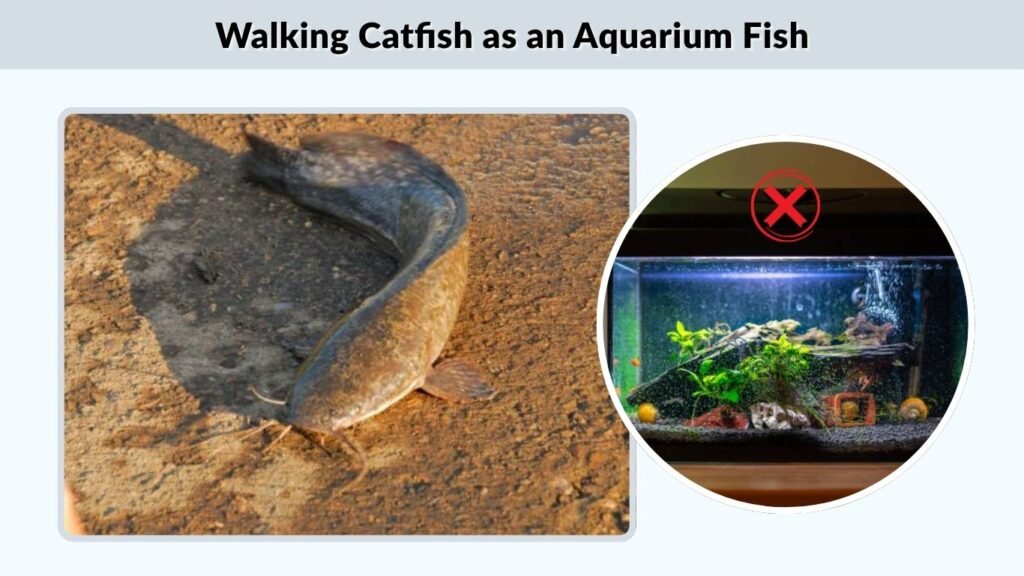
Walking catfish are unsuitable for most community aquariums. They grow quickly, produce substantial waste and may swallow nearly any tank mate that fits into their mouth.
A suitable aquarium would require:
- A large tank with strong filtration
- An extremely secure, weighted lid
- Open access to the water’s surface
- Smooth hiding structures
- No small tank mates
- Frequent water testing and maintenance
They are powerful escape artists and may push through loose covers. Ownership is prohibited or restricted in several places, including Florida, so local regulations must be checked before purchasing any walking catfish.
FAQs
Do walking catfish have lungs?
They do not possess mammalian lungs. Instead, they have specialized accessory breathing organs above their gills that absorb oxygen from swallowed atmospheric air.
How long can walking catfish stay out of water?
They may survive for many hours when their skin and breathing chambers remain moist. Survival time changes with temperature, humidity, body condition and exposure to sunlight.
How big do walking catfish get?
Typical individuals are around 10–12 inches long. The recorded maximum for Clarias batrachus is approximately 18.5 inches, while Florida authorities mention occasional fish approaching 20 inches.
Are walking catfish good to eat?
Yes. They are valued as food in parts of Asia. They must be obtained legally, cleaned carefully and cooked thoroughly because their sharp pectoral spines can cause injury.
What is a giant walking catfish?
The name often refers informally to larger Clarias species, particularly the African sharptooth catfish. It is a separate species and can grow considerably larger than the Asian walking catfish.