
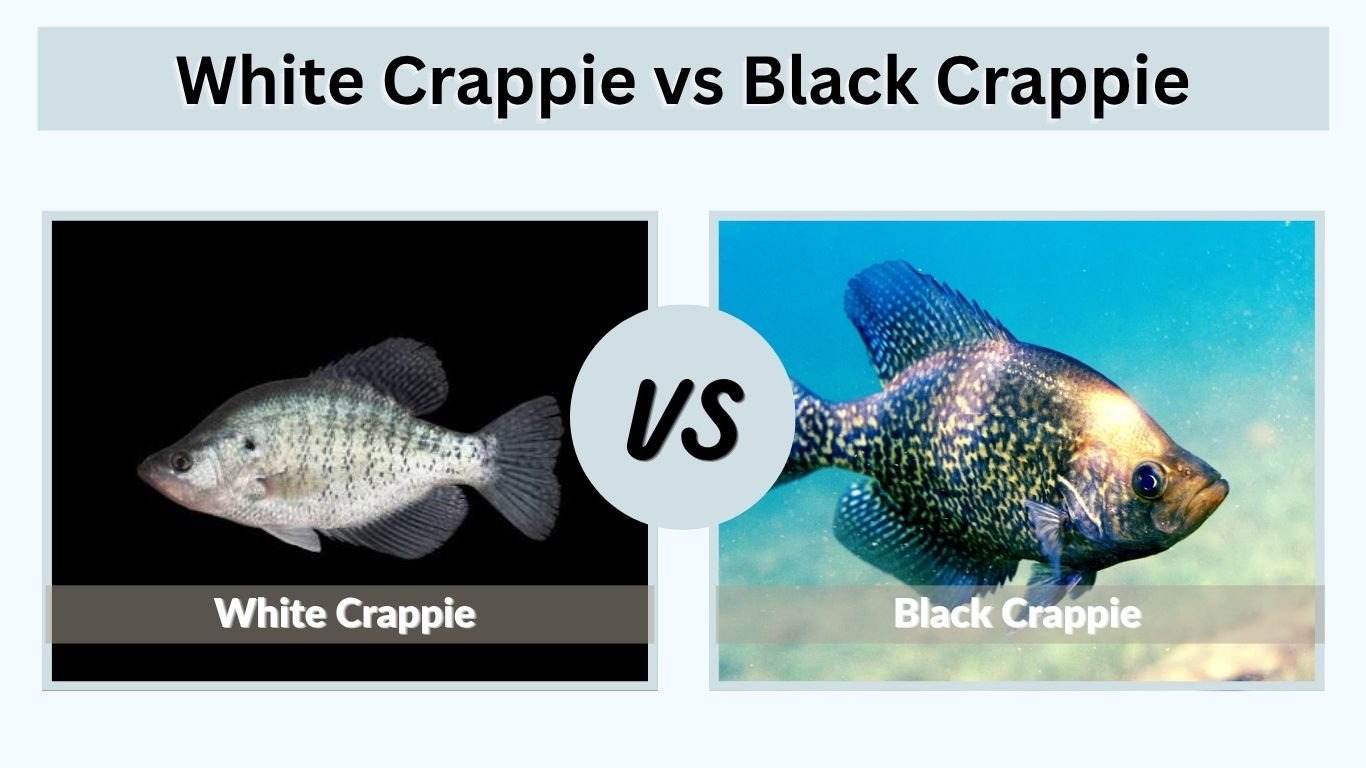
The easiest way to compare white crappie vs black crappie is to examine their markings and count their dorsal-fin spines. White crappie usually have vertical bars and five or six spines, while black crappie have scattered dark spots and seven or eight spines. Color alone can be misleading, especially during spawning season. Although these closely related fish share many habits, they differ in body shape and habitat preferences. Understanding those differences helps anglers identify their catch, choose fishing locations, and avoid common misconceptions about size and taste.
White Crappie vs Black Crappie at a Glance
White crappie and black crappie are separate species within the sunfish family, Centrarchidae. Neither name describes a male, female, or seasonal form of the other. Both can inhabit the same lake, so location alone cannot establish identification.
Quick Comparison
| Feature | White crappie | Black crappie |
| Scientific name | Pomoxis annularis | Pomoxis nigromaculatus |
| Dorsal-fin spines | Usually 5–6 | Usually 7–8 |
| Dark markings | Arranged in vertical bars | Irregular spots and blotches |
| Body shape | Generally more elongated | Generally deeper and rounder |
| Habitat preference | More tolerant of turbid water | Often favors clearer water |
| Eating quality | Mild, delicate flesh | Mild, delicate flesh |
The strongest identification features are spine count and marking pattern. Body shape and water clarity provide supporting clues, not definitive answers.
How to Tell White and Black Crappie Apart
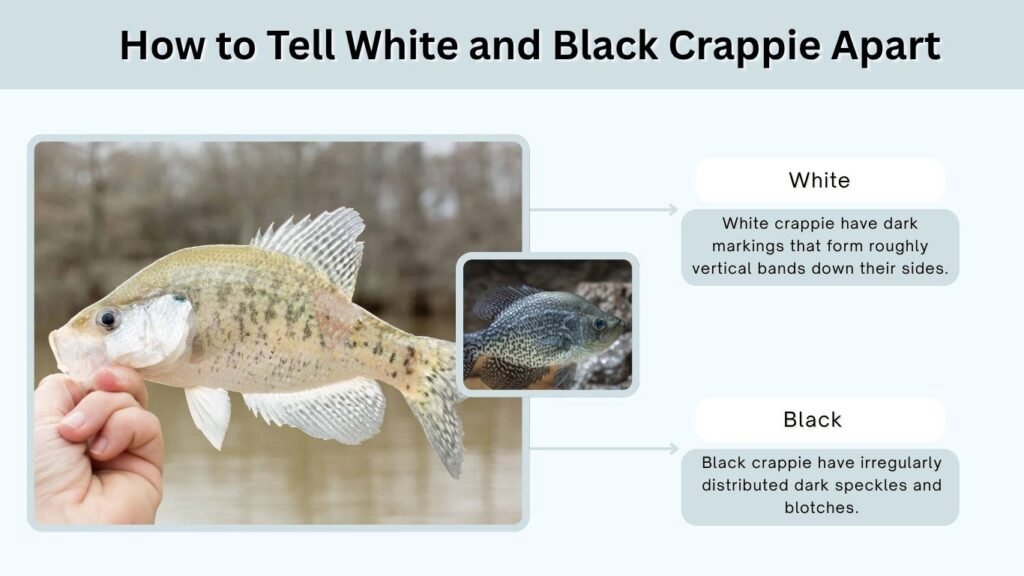
A fish viewed briefly in the water may be difficult to identify. For a more dependable comparison, examine its side and dorsal fin. Photographs are most useful when they show the entire fish with the dorsal fin raised.
Check the Markings
White crappie have dark markings that form roughly vertical bands down their sides. These bars may be faint, particularly on pale individuals.
Black crappie have irregularly distributed dark speckles and blotches. Their markings generally do not form the orderly vertical pattern characteristic of white crappie.
Count the Dorsal Spines
Count the stiff, pointed spines at the front of the dorsal fin—not the flexible rays behind them:
- Five or six spines: Usually white crappie.
- Seven or eight spines: Usually black crappie.
If markings and spine count seem inconsistent, check again rather than forcing an identification.
Why Color Can Be Misleading
A white crappie can look surprisingly dark. Breeding males develop stronger coloration, particularly during spring. Lighting, water conditions, and individual variation also affect appearance. A dark fish is not automatically a black crappie.
White Crappie vs Black Crappie Size
Neither species is consistently larger in every lake. Their size ranges overlap substantially, and local food supply, age structure, population density, and growing conditions influence the fish anglers encounter.
Which Species Gets Bigger?
Black crappie generally have deeper bodies and may weigh more than white crappie of the same length. White crappie can grow faster under some conditions, but that does not guarantee they will be the largest fish in a particular waterbody.
A two-pound fish is an impressive catch for either species in many regions. Compare local fisheries information rather than assuming one species always produces bigger fish.
World Record Comparison
The IGFA all-tackle weight records are:
| Species | Record weight | Angler | Location and date |
| White crappie | 5 pounds, 3 ounces | Fred Bright | Enid Dam, Mississippi; July 31, 1957 |
| Black crappie | 5 pounds, 7 ounces | Lionel Ferguson | Richeison Pond, Tennessee; May 15, 2018 |
The black crappie record is four ounces heavier. These exceptional fish do not establish which species averages larger in ordinary catches.
Habitat and Feeding Differences
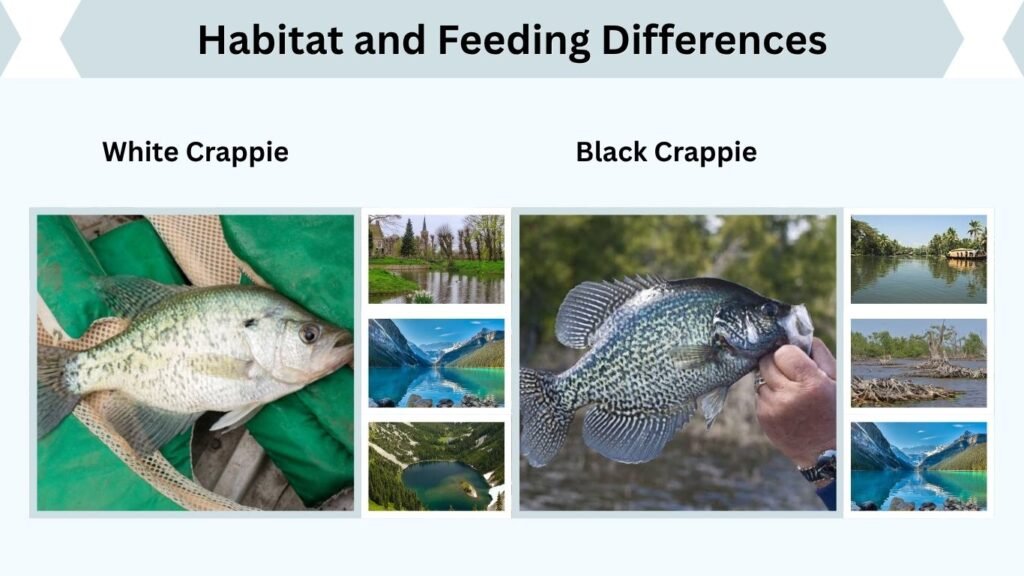
Both species use lakes, reservoirs, and slow-moving waters. Their habitat preferences overlap, but differences in water clarity and vegetation can influence which species is more abundant.
White Crappie Habitat
White crappie tolerate turbid, silty water better than black crappie. They commonly occupy reservoirs, river backwaters, and other waters containing submerged timber or similar cover.
This tolerance does not mean they require muddy water. White crappie also inhabit clearer lakes, especially where suitable food and shelter are available.
Black Crappie Habitat
Black crappie often favor clearer water with aquatic vegetation, submerged wood, and other cover. In a mixed-species reservoir, clearer arms or vegetated areas may be useful places to begin searching.
These are tendencies rather than strict divisions. Both species may gather around the same brush pile.
Do They Eat Different Foods?
Both eat zooplankton when young and add insects and small fish as they grow. Adult white crappie often rely heavily on fish, while insects can remain especially important to black crappie.
Neither has an exclusive diet. Available prey helps determine what a local population eats.
White Crappie vs Black Crappie Taste
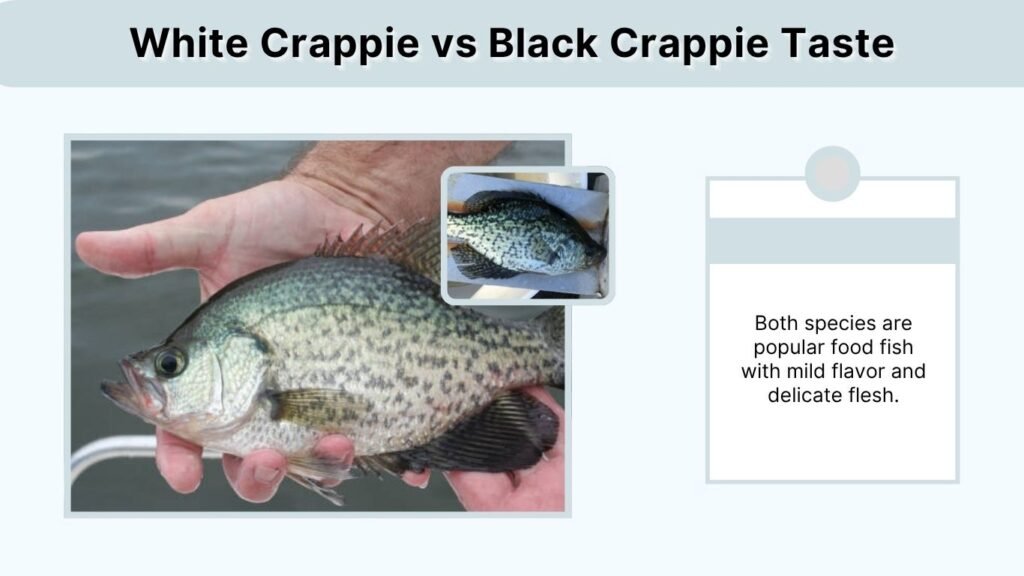
Both species are popular food fish with mild flavor and delicate flesh. Choosing which tastes better is largely a matter of preference, not a dependable biological distinction.
Is One Better to Eat?
Claims that black crappie always tastes sweeter or white crappie always tastes stronger should not be treated as universal rules. Fish size, handling, storage, and preparation complicate comparisons.
For a fair taste test, compare similarly sized fish from the same waterbody, stored and cooked the same way. Either species can be suitable for frying, baking, or other familiar fish recipes.
Check Consumption Advisories
Before eating locally caught fish, check the advisory for that specific waterbody. Clear water and a healthy-looking fish do not prove that the catch is free of harmful contaminants. Species identification does not replace local food-safety guidance.
Spawning and Hybridization
Both crappie species reproduce in spring and use nesting areas in sheltered water. Their spawning periods can overlap, but timing varies with geography, temperature, and local conditions.
Do They Spawn at the Same Time?
Not necessarily. Both respond to seasonal warming, but avoid treating a single date or temperature as a universal trigger.
Males prepare nesting depressions, and females deposit eggs in these breeding areas. Nest depth varies with the waterbody and conditions. Local observations are more useful than assuming every lake follows the same schedule.
Can They Crossbreed?
Yes. White and black crappie can produce hybrids. Some hybrids resemble one parent closely, making visual identification uncertain. Genetic testing has confirmed hybrid catches that were initially assigned to one species.
Targeting White Crappie vs Black Crappie
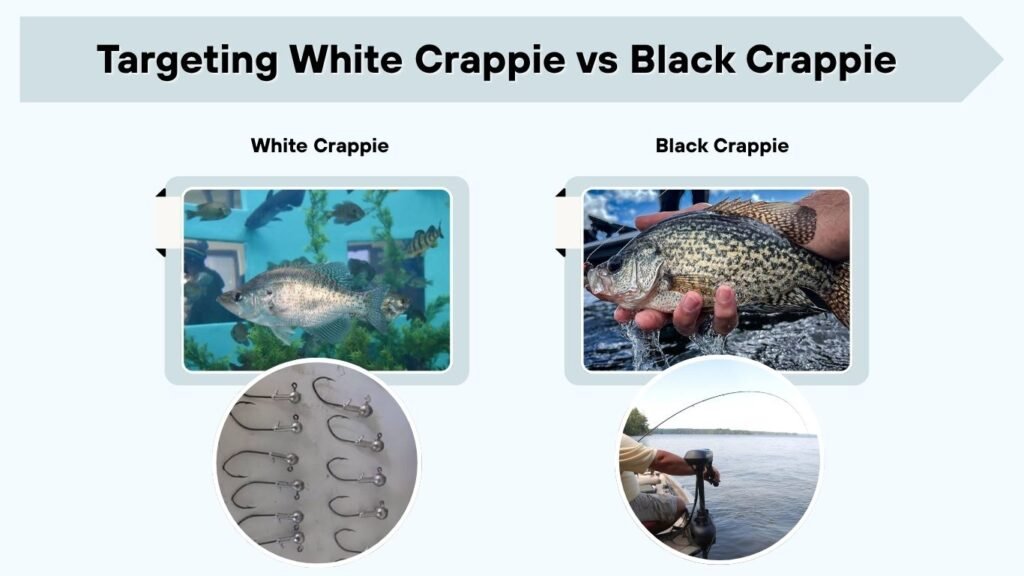
Fishing methods overlap more than their names might suggest. Locating fish and presenting bait at the correct depth usually matters more than having separate equipment for each species.
Practical Starting Points
- For white crappie: Investigate submerged timber, brush, and productive reservoir areas, including stained water.
- For black crappie: Check vegetation edges, clearer coves, and submerged cover.
- For either species: Try small minnows or small jigs.
- When bites stop: Adjust depth and presentation before repeatedly changing colors.
Adapt to the Season
Spring often brings fish into shallower areas. During other seasons, they may gather around deeper cover or suspend away from shore.
Use a slow presentation when fish are inactive. Once you catch one, repeat that depth and approach before moving. Always check current local fishing and harvest rules.
FAQs
These answers address the most common identification and comparison questions.
What Is the Main Difference Between White and Black Crappie?
White crappie usually have vertical bars and five or six dorsal spines. Black crappie have irregular spots and seven or eight spines.
Can White and Black Crappie Live Together?
Yes. Many lakes and reservoirs support both species, sometimes around the same underwater cover.
Which Crappie Has the Larger World Record?
Black crappie. Its IGFA all-tackle record is 5 pounds, 7 ounces, compared with 5 pounds, 3 ounces for white crappie.
Do White and Black Crappie Taste Different?
Some anglers have preferences, but both are mild-flavored food fish. There is no reliable rule that one always tastes better.
Is a Dark Crappie Always a Black Crappie?
No. White crappie can become dark, especially during breeding. Check the markings and dorsal spines instead of relying on overall color.