
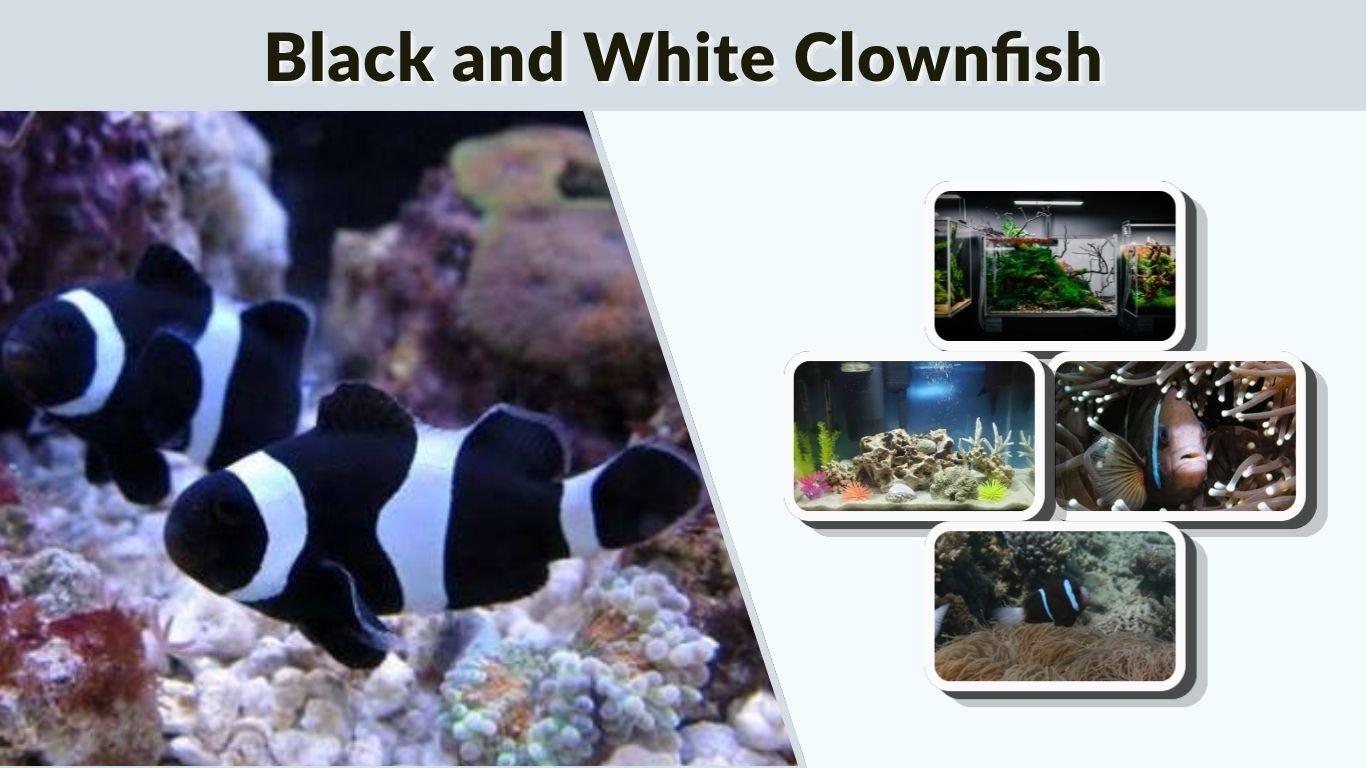
Black and white clownfish are popular saltwater aquarium fish known for their bold contrast, hardy nature, and wide range of designer patterns. Some are naturally dark ocellaris varieties, while others are captive-bred morphs such as Wyoming White, Snowflake, or Storm clownfish. Before buying one, it is important to understand their care needs, tank setup, behavior, anemone compatibility, and common health warning signs.
What Is a Black and White Clownfish?
A black and white clownfish is usually a color variety of clownfish with a dark body and white bands, or a white body with black markings. Most black and white clownfish in the aquarium trade are varieties of ocellaris clownfish, though some may be percula, maroon, clarkii, or designer hybrids depending on the seller.
The classic black and white ocellaris clownfish looks similar to the common orange ocellaris, but its orange color is replaced by deep black as it matures. Juveniles may still show some orange on the face or fins before developing darker adult coloring.
White clownfish varieties, such as Wyoming White and some Storm or Platinum morphs, are usually captive-bred designer clownfish. These fish are selected for unusual white patterns, reduced striping, or mostly white bodies.
Black and White Clownfish Types
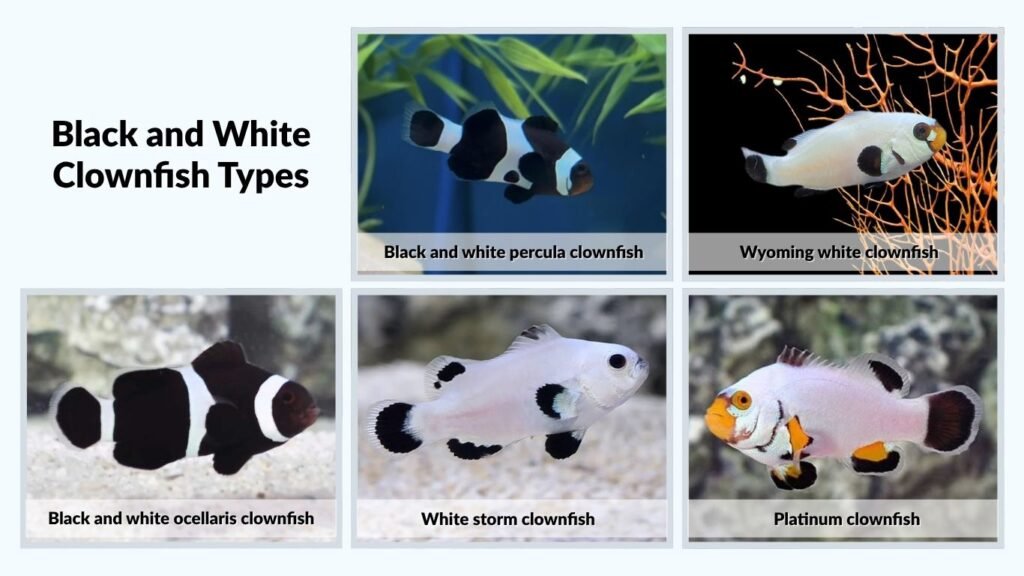
There are several types of black, white, and mixed-pattern clownfish. Some are natural-looking varieties, while others are designer morphs created through selective breeding.
| Type | Appearance | Notes |
|---|---|---|
| Black and white ocellaris clownfish | Black body with white bands | One of the most common black clownfish types |
| Black and white percula clownfish | Black, white, and sometimes orange markings | Often confused with ocellaris |
| Wyoming white clownfish | Mostly white body with orange face or fins | Ocellaris designer morph |
| White storm clownfish | White body with bold black patterning | Designer ocellaris-type morph |
| Platinum clownfish | Mostly white body | Often compared with Wyoming White |
| Snowflake clownfish | Irregular white markings | Available in orange, black, and mixed forms |
| Black and white snowflake clownfish | Dark body with irregular white pattern | Popular designer variety |
| Black and white clownfish with orange face | Black and white body with remaining orange facial color | Common in young or mixed-color forms |
Black and White Ocellaris Clownfish
The black and white ocellaris clownfish is one of the most popular dark clownfish varieties. It is closely related to the common ocellaris clownfish, often known as the false percula clownfish.
These fish are popular because they are hardy, usually peaceful, reef-safe, and available as captive-bred specimens. They are also a good choice for many beginner saltwater aquarists who already understand basic marine aquarium care.
Black ocellaris clownfish may not be fully black when young. Many juveniles show orange or brown tones around the face, belly, or fins. As they mature, the body often darkens.
Wyoming White Clownfish
The Wyoming White clownfish is a designer ocellaris clownfish morph known for its mostly white body. It may have an orange face, orange fins, or soft black edging depending on the individual fish.
Many people compare Wyoming White clownfish with Platinum clownfish because both can appear mostly white. The difference depends on genetics, lineage, and pattern expression. In general, Wyoming White clownfish are prized for their clean white body and ocellaris background.
A Wyoming White clownfish has similar care needs to other ocellaris clownfish. It does not need special treatment just because of its color, but it still needs stable saltwater conditions, proper diet, and low-stress tank mates.
Black and White Clownfish Care
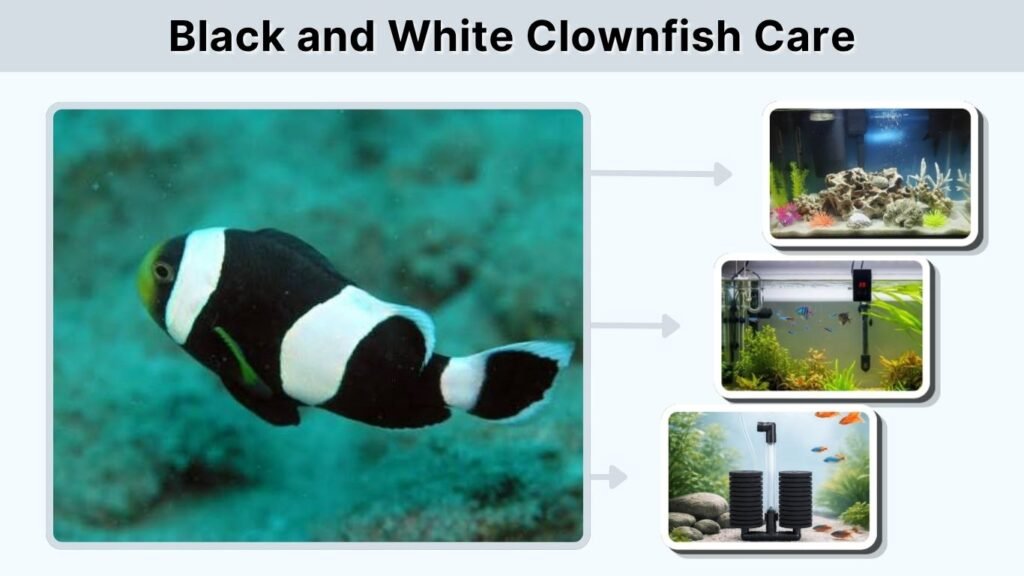
Black and white clownfish care is similar to standard ocellaris clownfish care. They are hardy for saltwater fish, but they still need a cycled marine aquarium and stable water parameters.
A fish-only saltwater tank can work well for beginners, while reef tanks are also suitable because clownfish are generally reef-safe. They usually do not harm corals, though they may choose a coral, anemone, or corner of the tank as their territory.
Basic Care Needs
- Keep them in a fully cycled saltwater aquarium.
- Use a heater to maintain stable tropical temperature.
- Provide good filtration and water movement.
- Keep salinity stable.
- Feed a varied marine diet.
- Avoid aggressive tank mates.
- Test water regularly.
- Quarantine new fish when possible.
Clownfish are hardy, but poor water quality, sudden salinity changes, and stress can still make them sick.
Tank Size for Black and White Clownfish
A single black and white clownfish or a bonded pair can live in a modest-sized saltwater aquarium, but bigger is usually better. A tank around 20 gallons or larger is a more comfortable starting point for most hobbyists, especially for a pair.
A larger tank provides more stable water conditions, more swimming room, and more flexibility for tank mates. Small tanks can work, but they require careful maintenance because saltwater conditions can change quickly in low water volume.
If you plan to add an anemone, corals, or several fish, choose a larger aquarium with proper lighting, filtration, and flow.
Water Parameters and Tank Setup
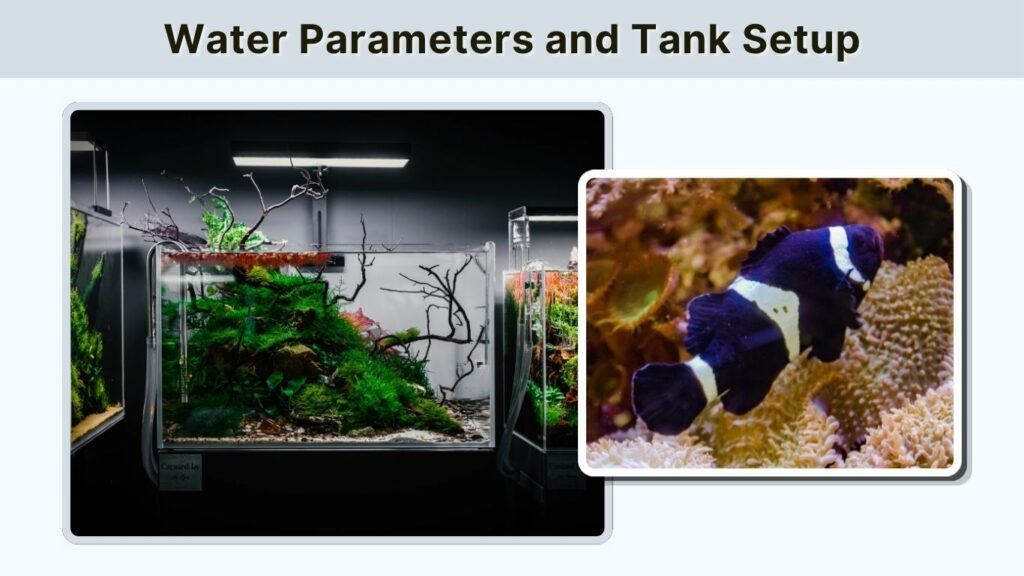
Black and white clownfish need stable marine water conditions. Sudden changes are more dangerous than slight variation within a safe range.
A typical clownfish tank should have warm tropical temperature, proper salinity, and zero ammonia or nitrite. Nitrate should be kept low with water changes and good filtration.
The tank should include live rock or aquascaping for shelter. Clownfish do not require caves, but they appreciate structure and territory. Many will choose one area of the tank and stay close to it.
Tank Setup Tips
- Use marine salt mix, not freshwater aquarium salt.
- Cycle the tank before adding clownfish.
- Add live rock or reef-safe structure.
- Maintain consistent salinity.
- Use a quality heater and thermometer.
- Perform regular water changes.
- Avoid overfeeding.
- Test ammonia, nitrite, nitrate, pH, and salinity.
What Do Black and White Clownfish Eat?
Black and white clownfish are omnivores. In aquariums, they usually accept pellets, flakes, frozen foods, and small meaty foods. A varied diet helps maintain color, energy, immune health, and breeding condition.
Good foods include marine pellets, quality flakes, mysis shrimp, brine shrimp, chopped seafood, copepods, and frozen marine blends. Some foods should include plant or algae-based ingredients because clownfish benefit from a mixed diet.
Feed small amounts once or twice daily. Give only what they can eat quickly. Extra food can pollute the water and increase nitrate.
Black and White Clownfish Behavior
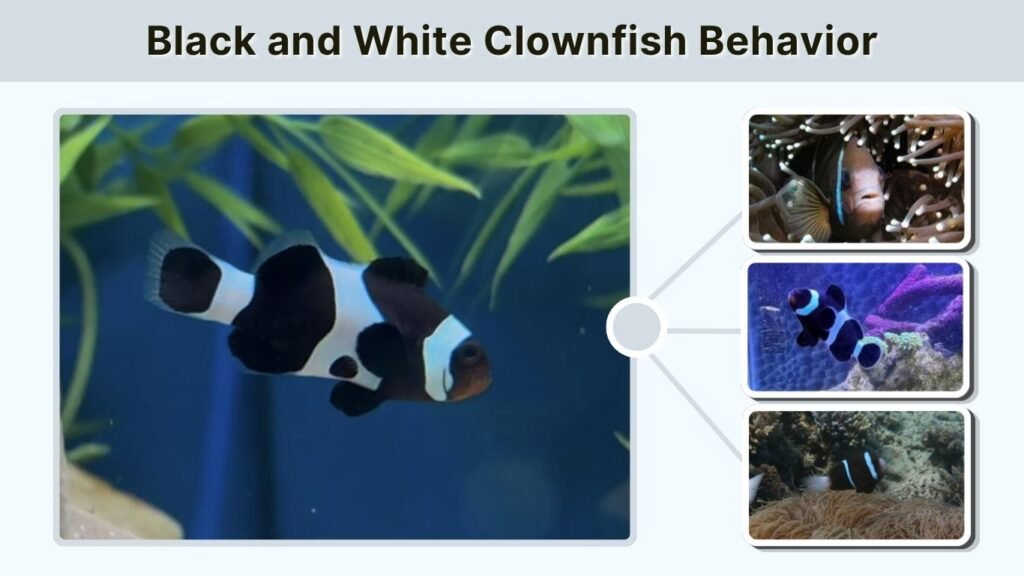
Black and white clownfish are usually peaceful, but they can become territorial. A pair may defend a corner, rock, coral, or anemone. The female is usually larger and more dominant, while the male is smaller.
Clownfish can change sex. They are born male, and the dominant fish in a pair becomes female. This is why bonded pairs usually include one larger female and one smaller male.
If two clownfish are fighting heavily, they may not be compatible. Some chasing and dominance behavior is normal, but constant biting, torn fins, or one fish hiding all day is a warning sign.
Best Tank Mates for Black and White Clownfish
Black and white clownfish can live with many peaceful saltwater fish. Good tank mates should not be large enough to eat them or aggressive enough to bully them.
Suitable tank mates may include gobies, blennies, firefish, royal grammas, cardinalfish, chromis, and some peaceful wrasses. Avoid aggressive damsels, large predatory fish, or overly territorial species in small tanks.
Clownfish can also live in reef tanks with many corals and invertebrates. However, some clownfish may irritate certain corals if they try to host in them.
Do Black and White Clownfish Need an Anemone?
Black and white clownfish do not need an anemone to survive in an aquarium. Captive-bred clownfish often live perfectly well without one. They may host in a coral, rock, powerhead corner, or even a bare section of the tank.
That said, many aquarists enjoy seeing clownfish with a host anemone. If you want an anemone, make sure your tank is mature and stable. Anemones usually need stronger lighting, good water quality, and careful placement.
Best Anemone for Black and White Clownfish
Bubble tip anemones are commonly kept with captive clownfish because they are more available than many host anemones. However, hosting is never guaranteed. A clownfish may ignore the anemone completely or choose something else in the tank.
Do not buy an anemone for a new tank. Wait until the aquarium is stable and you understand reef lighting and water quality.
Black and White Clownfish Price
Black and white clownfish price depends on type, size, pattern, source, and whether the fish is sold alone or as a pair. Standard black and white ocellaris clownfish are usually more affordable than rare designer morphs.
Wyoming White, White Storm, Snowflake, Platinum, and other designer clownfish can cost more because they are selectively bred. A bonded pair or mated pair is usually more expensive than a single juvenile.
When shopping for black and white clownfish for sale, choose healthy captive-bred fish from a reputable seller. Captive-bred clownfish are usually better adapted to aquarium life and help reduce pressure on wild populations.
White Spots on Clownfish: Color or Disease?
White markings can be normal on black and white clownfish, but sudden white spots may be a health warning. It is important to tell the difference between natural pattern and disease.
Natural white markings are smooth, symmetrical or pattern-based, and present from the time you bought the fish. Disease spots often appear suddenly, spread, look raised, or come with symptoms such as scratching, heavy breathing, hiding, or loss of appetite.
Possible causes of white spots or white patches include:
- Marine ich
- Brooklynella
- Lymphocystis
- Fungal-looking growth
- Bacterial infection
- Injury
- Stress-related slime coat changes
If a clownfish has new white spots, white film, rapid breathing, clamped fins, or is sitting at the bottom, test the water and consider quarantine. Marine fish diseases can spread quickly in a display tank.
White Stringy Poop, White Mouth, or White Film
Some keyword searches are about white poop, white mouth, white film, or fuzzy white material on clownfish. These signs may point to stress, parasites, bacterial infection, poor diet, injury, or water quality problems.
White stringy poop can sometimes be related to internal parasites or digestive issues, but it should be judged with other symptoms. A white mouth may be injury, infection, or irritation. White film on the body may be excess mucus, parasite irritation, or disease.
Do not guess based only on one symptom. Check water quality first, observe breathing and appetite, and consider isolating the fish if symptoms worsen.
Black and White Clownfish Sitting on Bottom
A black and white clownfish sitting at the bottom of the tank is not always sick. Some clownfish sleep near the bottom, host a corner, or rest in unusual positions. However, it can also signal stress or illness.
Check for warning signs:
- Heavy breathing
- Not eating
- Clamped fins
- White film or spots
- Rapid color fading
- Bullying from tank mates
- Poor water test results
- Recent shipping or tank transfer
If the fish is new, it may be adjusting. If symptoms continue or worsen, take action quickly.
Black and White Clownfish Names
Black and white clownfish have a bold look, so they are easy to name. Popular name ideas include Panda, Oreo, Domino, Storm, Marble, Pepper, Ink, Ghost, Moon, Tux, Shadow, Snow, and Patch.
For pairs, names like Salt and Pepper, Yin and Yang, Moon and Shadow, or Oreo and Cream can fit their color pattern.
Buying Tips for Black and White Clownfish
When buying a clownfish, look for active swimming, clear eyes, smooth fins, steady breathing, and strong appetite. Avoid fish with white film, torn fins, sunken belly, cloudy eyes, rapid breathing, or unusual spots.
Ask whether the fish is captive-bred. Also ask what it has been eating. A clownfish already eating pellets or frozen foods is usually easier to transition into your aquarium.
If possible, quarantine new clownfish before adding them to a display tank. This helps prevent disease from spreading to established fish.
FAQs
Are black and white clownfish good for beginners?
Yes, black and white clownfish can be good beginner saltwater fish when kept in a cycled marine aquarium. They are hardy compared with many marine fish, but they still need stable salinity, warm temperature, clean water, and a proper diet.
What is a black and white clownfish called?
Many black and white clownfish are black and white ocellaris clownfish. Some may be black snowflake, black ice, Wyoming White, White Storm, Platinum, or other designer morphs. The exact name depends on color pattern, species background, and breeder.
Do black and white clownfish need an anemone?
No, black and white clownfish do not need an anemone to survive. Captive-bred clownfish often live well without one. They may host in rocks, corals, tank corners, or equipment. Anemones require mature tanks, strong lighting, and stable water.
Why does my clownfish have white spots?
White spots may be natural markings if they were always present. New white spots can signal marine ich, Brooklynella, infection, injury, or stress. Watch for heavy breathing, scratching, hiding, or not eating. Test water and consider quarantine if symptoms appear.
How much does a black and white clownfish cost?
The price depends on variety, size, pattern, and seller. Standard black and white ocellaris clownfish are usually less expensive than designer types like Wyoming White, White Storm, Snowflake, or Platinum. Pairs and rare patterns typically cost more.