
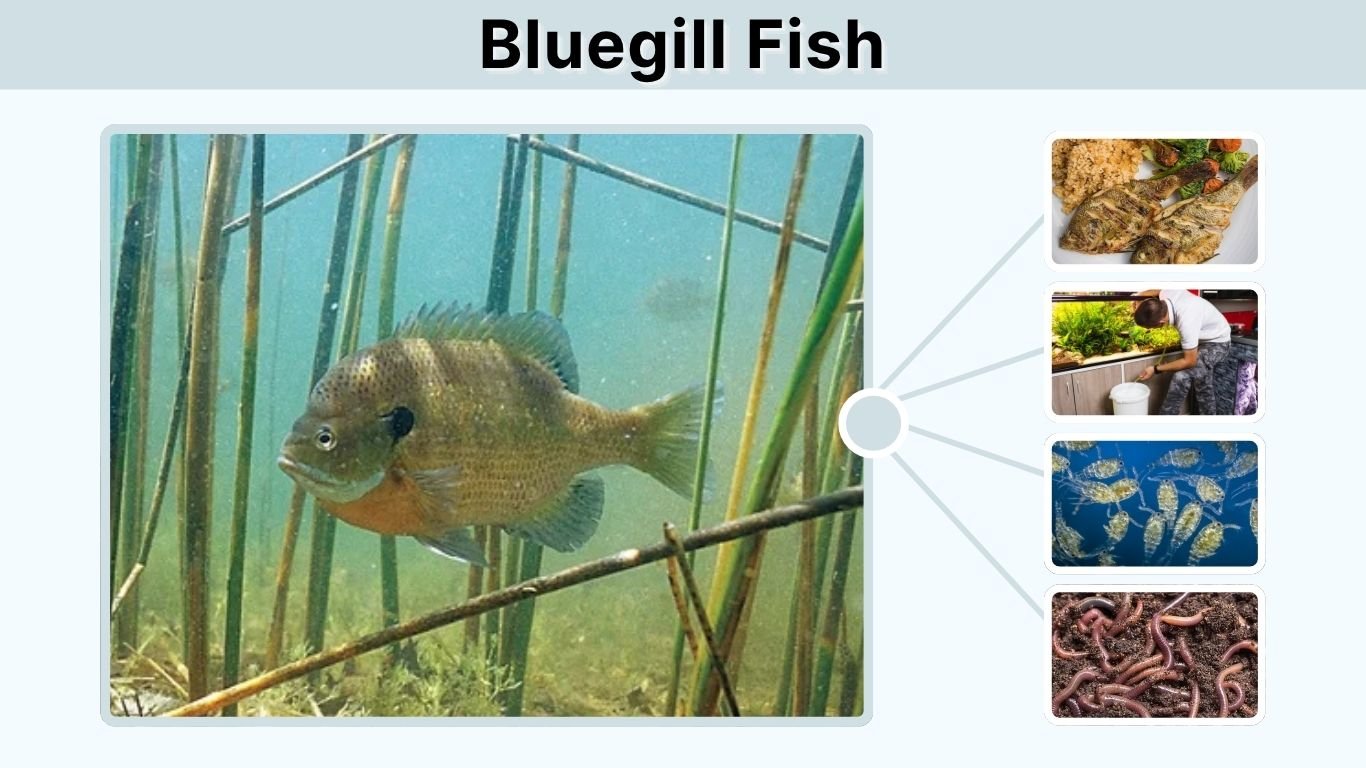
Bluegill fish are among the most familiar freshwater sunfish in North America. Their colorful cheeks, deep bodies, and willingness to bite make them popular with anglers of every experience level. Bluegill inhabit ponds, lakes, reservoirs, streams, and slow-moving rivers, usually remaining near vegetation or submerged cover. They consume insects, crustaceans, plankton, and small fish while supporting larger predators such as bass and catfish. This guide explains bluegill identification, habitat, diet, size, reproduction, lifespan, varieties, fishing, tank care, and suitability as food.
What Is a Bluegill Fish?
The bluegill is a warm-water freshwater fish belonging to the sunfish family. It is native to central and eastern North America but has been introduced into many other regions. Bluegill are commonly stocked in recreational ponds because they reproduce readily, provide enjoyable fishing, and serve as an important food source for predatory fish.
Scientific Classification
Bluegill are classified as follows:
- Common name: Bluegill
- Scientific name: Lepomis macrochirus
- Family: Centrarchidae
- Genus: Lepomis
- Order: Centrarchiformes
- Environment: Freshwater
- Native region: Central and eastern North America
Bluegill are true sunfish, although they are sometimes incorrectly called perch. True perch belong to a different fish family.
Other Names for Bluegill
Regional names include bream, brim, sun perch, blue sunfish, copperbelly, and blue bream. In the southern United States, “bream” may refer to bluegill as well as several related sunfish.
The name bluegill comes from the blue or turquoise coloring that often appears around the lower jaw and gill area. This coloration is particularly noticeable on mature breeding males.
Bluegill Identification and Appearance
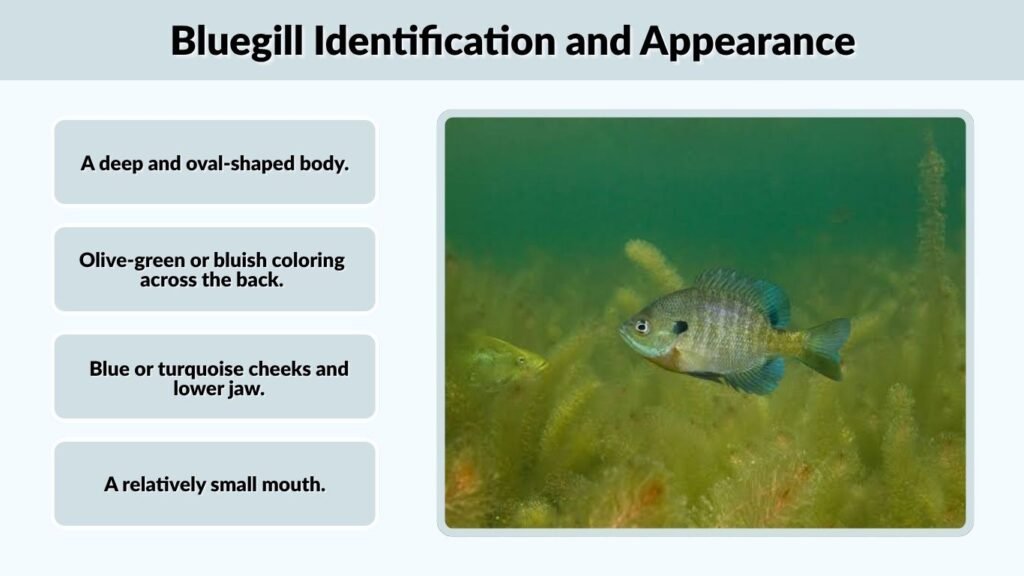
Bluegill have deep, laterally compressed bodies that are thin when viewed from above. Their exact appearance varies according to age, sex, habitat, water clarity, and breeding condition. Checking the mouth, ear flap, dorsal fin, facial color, and body bars together provides the most dependable identification.
Identification Features
A typical bluegill has:
- A deep and oval-shaped body
- Olive-green or bluish coloring across the back
- Blue or turquoise cheeks and lower jaw
- A relatively small mouth
- Five to nine faint vertical bars on its sides
- A solid dark-blue or black ear flap
- A dark spot near the rear of the dorsal fin
- A yellow, orange, or copper-colored belly
- Spiny front and soft rear portions of the dorsal fin
The dark ear flap generally lacks the colorful border found on pumpkinseed and redear sunfish.
Size and Color
Most adult bluegill measure approximately 4–10 inches long and weigh less than one pound. Fish exceeding 10 inches are considered large in many waters, while a 12-inch bluegill is an exceptional catch.
Mature breeding males develop the most intense colors. Their cheeks may appear dark blue, while their breasts and bellies become copper, orange, or reddish. Females and young fish usually have lighter coloration and more visible vertical bars.
The widely recognized world-record bluegill weighed 4 pounds, 12 ounces. T. S. Hudson caught it from Ketona Lake, Alabama, in 1950. It measured approximately 15 inches long.
Bluegill Fish Habitat, Diet, and Behavior
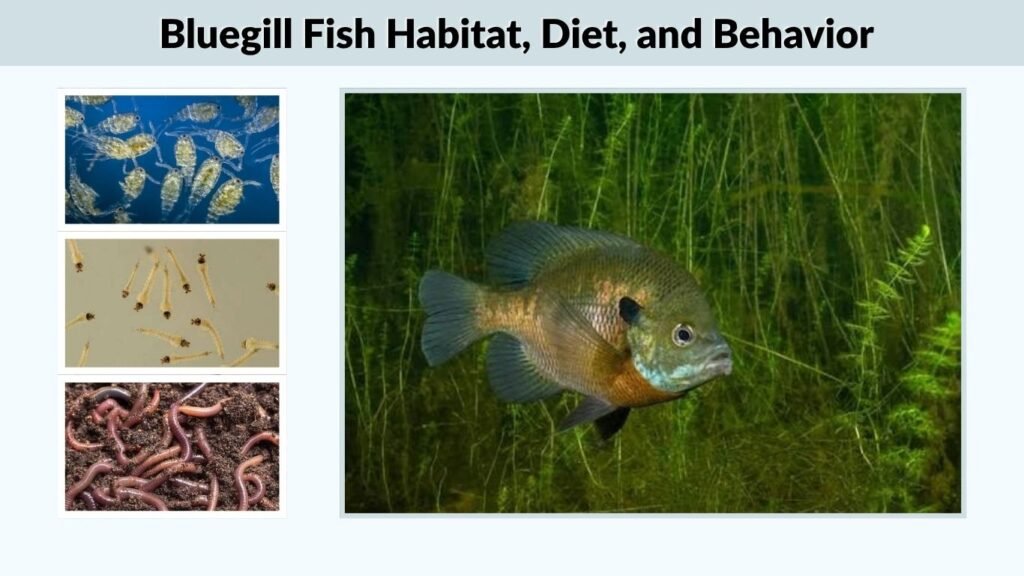
Bluegill are adaptable, but they prefer warm, calm, or slow-moving water containing vegetation and other protective structures. Their preferred depth changes throughout the year. They move into shallow areas to feed and reproduce during warm periods but may occupy deeper water during winter or extremely hot weather.
Natural Habitat and Range
Bluegill live in farm ponds, natural lakes, reservoirs, wetlands, creeks, river backwaters, and slow-moving streams. They frequently gather near aquatic plants, docks, fallen trees, brush piles, rocks, and submerged logs.
Young bluegill remain close to dense vegetation, where they can avoid predators. Larger individuals may move along deeper weed lines, underwater ledges, and drop-offs during daylight. They often return to shallower feeding areas around dawn and evening.
What Do Bluegill Eat?
Bluegill are opportunistic feeders that consume:
- Zooplankton
- Aquatic insect larvae
- Mosquito larvae
- Worms
- Insects that fall onto the water
- Tiny crustaceans
- Freshwater snails
- Fish eggs
- Small minnows
- Newly hatched fish
- Limited amounts of plant material
Young fish depend heavily on plankton and microscopic organisms. Larger bluegill increasingly target insects, crustaceans, and small fish.
Natural Predators
Bluegill provide food for largemouth bass, catfish, northern pike, walleye, crappie, turtles, snakes, herons, kingfishers, and aquatic mammals. Dense vegetation helps small fish hide, but it can also shelter so many juveniles that a pond becomes overcrowded.
In balanced ponds, bass and other predators control bluegill numbers. Without enough predation, the population may contain numerous slow-growing fish competing for limited food.
Bluegill Fish Reproduction, Growth, and Lifespan
Bluegill reproduce successfully in warm, shallow water. Their extended spawning season and large number of offspring allow populations to grow quickly. Water temperature, food availability, competition, and predator abundance determine how rapidly individual fish develop and whether a pond produces many small fish or fewer large ones.
Spawning and Nesting
Spawning generally begins during late spring or early summer after shallow water warms. In southern climates, breeding may continue through much of the summer, and females may spawn more than once.
A male creates a round nest by sweeping sand, gravel, or soft material with his tail. Multiple males often build nests close together, forming a honeycomb-like colony. After attracting a female, the male fertilizes the eggs and guards them from predators.
He continues protecting the nest after the eggs hatch. The young eventually leave and gather around vegetation, where they feed on tiny aquatic organisms.
Growth Rate
Bluegill growth differs considerably between bodies of water. Fish grow rapidly when food is plentiful and competition is controlled. In overcrowded ponds, growth slows because too many fish rely on the same food supply.
Genetics, water temperature, water quality, growing-season length, and predator numbers also affect size. Pond managers sometimes remove smaller fish or maintain a suitable bass population to produce larger bluegill.
Bluegill Lifespan
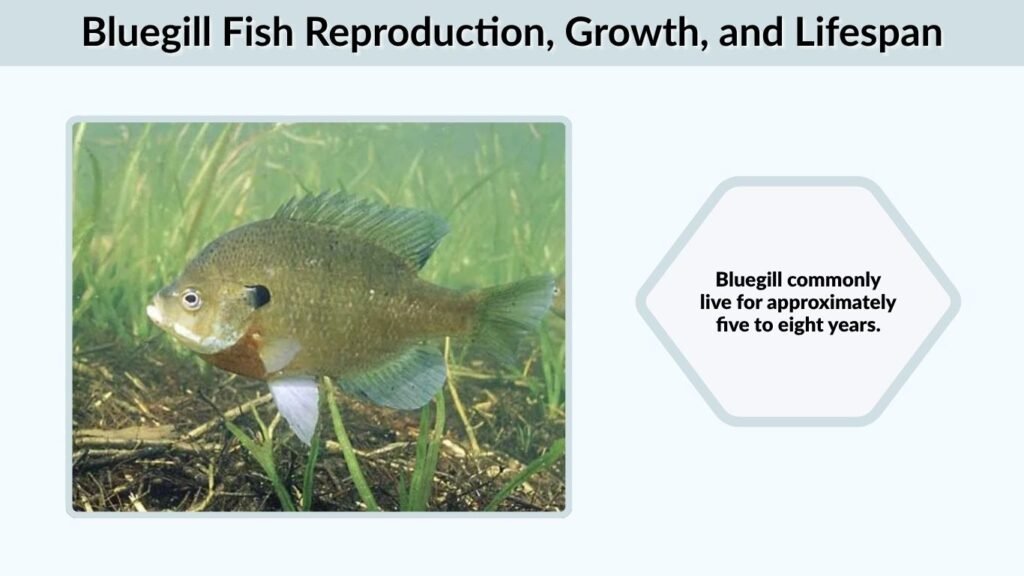
Bluegill commonly live for approximately five to eight years. Some individuals may survive for around ten years or longer under favorable conditions.
Older fish are not always exceptionally large. A bluegill living in an overcrowded or unproductive habitat may remain small despite its age, while one with abundant food can grow much faster.
Types of Bluegill and Similar Fish
The bluegill is one species, but geographic forms, hatchery crosses, and closely related sunfish are often described as different “types.” Color alone can be misleading because water conditions, breeding activity, and age can dramatically change a fish’s appearance.
Coppernose and Hybrid Bluegill
Coppernose bluegill are a southern form adapted to warm climates. Mature males may develop a noticeable copper-colored band across the forehead. These fish are commonly stocked in southern ponds because they grow well under suitable conditions.
Hybrid bluegill are usually created by crossing a male bluegill with a female green sunfish. They often grow quickly, bite aggressively, and perform well in managed ponds. However, their reproductive characteristics differ from ordinary bluegill, so stocking decisions should be based on the pond’s long-term management goals.
Bluegill vs. Similar Fish
Important differences include:
- Green sunfish: Longer body, larger mouth, and yellow or orange fin margins
- Pumpkinseed: Colorful facial lines and a red or orange spot on the ear flap
- Redear sunfish: Red or orange ear-flap border and a strong preference for snails
- Crappie: Silvery body, dark spots or bars, and a much larger mouth
- Perch: More elongated body and membership in a different fish family
- Bluegill: Small mouth, blue-green face, plain dark ear flap, and dorsal-fin spot
All bluegill are sunfish, but not every sunfish is a bluegill.
Bluegill Fishing, Eating, and Tank Care
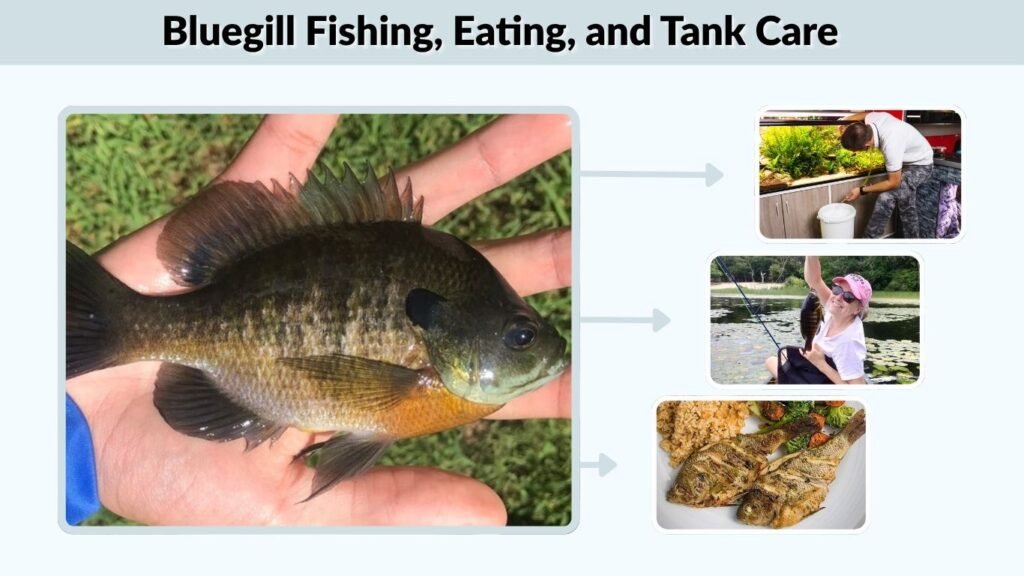
Bluegill are widely caught for recreation and food. Their small mouths and gentle bites make lightweight fishing equipment most effective. Although juveniles are sometimes sold for pond stocking or aquarium care, adult bluegill require considerably more space and filtration than an ordinary home aquarium provides.
How to Catch Bluegill
Use an ultralight or light-power rod with two- to six-pound-test line. Small hooks between sizes 8 and 12 work well with worms, crickets, wax worms, and mealworms. Tiny jigs, insect imitations, spinners, flies, and surface poppers are also effective.
During spring, fish around shallow spawning beds. In summer, concentrate on docks, weed edges, shaded banks, and deeper structures. Slow presentations near deeper cover work better during winter.
Can You Eat Bluegill?
Bluegill are edible and considered excellent table fish. Their meat is white, mild, slightly sweet, and tender. Small fish can be scaled and cooked whole, while larger individuals may be filleted.
Frying is traditional, but bluegill can also be baked, grilled, or pan-seared. Always observe fishing regulations and local consumption advisories, particularly in waters affected by mercury or other contaminants.
Keeping Bluegill in a Fish Tank
Bluegill are active, territorial, and capable of reaching substantial sizes. An adult requires a very large aquarium with strong filtration, stable water quality, and sufficient swimming space. Smaller community aquariums are unsuitable.
They may eat prepared pellets, insects, worms, crustaceans, and small fish. Before purchasing or collecting bluegill, check local wildlife regulations because keeping native gamefish may require authorization.
FAQs
Bluegill are familiar fish, but their regional names and resemblance to other sunfish often create confusion. These answers address five common questions.
Is Bluegill a Sunfish or a Perch?
Bluegill are sunfish in the family Centrarchidae. They are not true perch, even though “sun perch” and “bluegill perch” are sometimes used regionally.
How Big Can a Bluegill Get?
Most are 4–10 inches long. Trophy fish may exceed 10 inches, while the world-record specimen measured about 15 inches and weighed 4 pounds, 12 ounces.
Are Bluegill Aggressive?
Bluegill can be territorial, particularly when males guard spawning nests. They may chase other fish and can become aggressive in crowded aquariums.
Can Bluegill Live With Bass?
Bluegill and largemouth bass commonly live together in balanced ponds. Bluegill provide forage for bass, while bass help prevent bluegill overpopulation.
Do Bluegill Bite Humans?
Bluegill do not normally attack people. They may nibble at skin or defend nesting areas, but their small mouths make them generally harmless.