
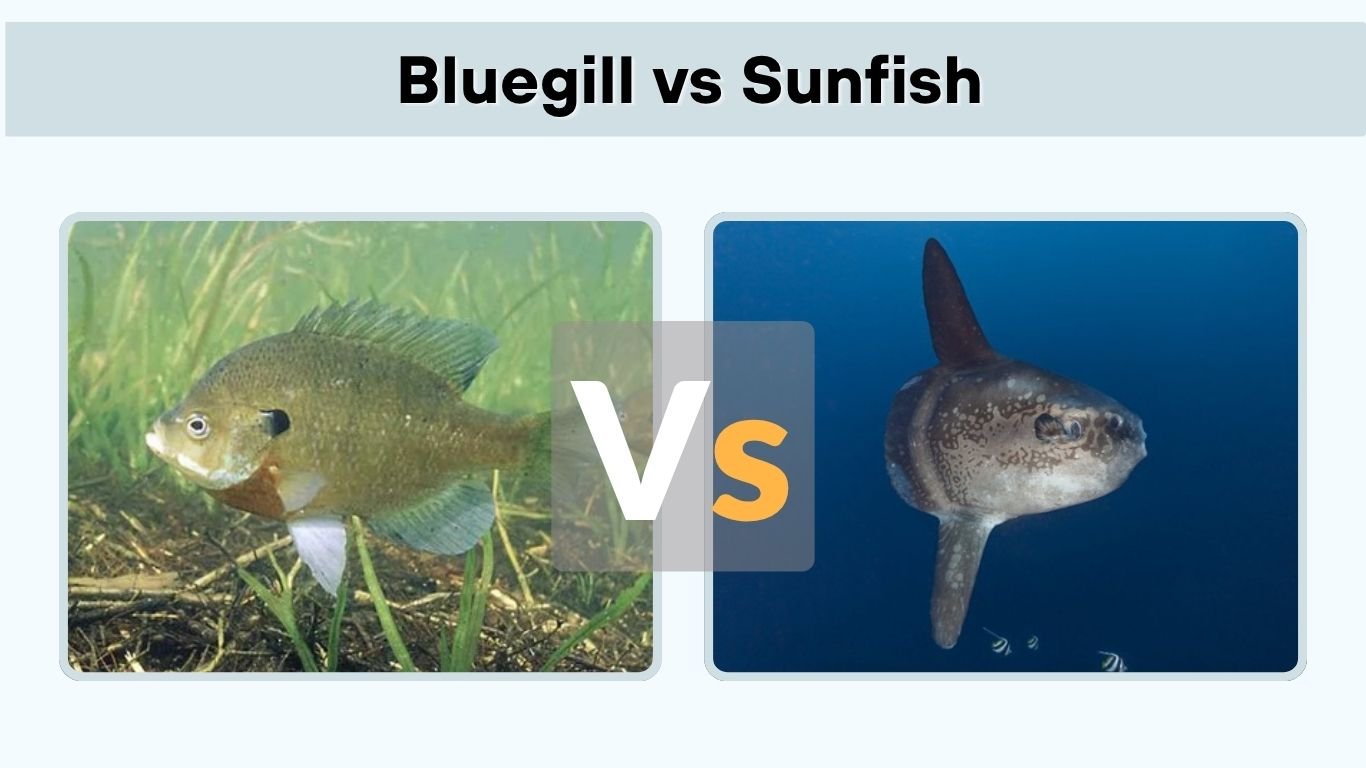
Bluegill and sunfish are not completely different fish. A bluegill is one species within the freshwater sunfish family, while “sunfish” is a broader name covering bluegill, green sunfish, pumpkinseed, redear, and several related species. Their similar body shapes and changing colors can make identification difficult, especially among young or hybrid fish. However, differences in mouth size, ear-flap markings, fin colors, body depth, and habitat provide useful clues. This guide compares bluegill with common sunfish, crappie, perch, and unrelated ocean sunfish.
Are Bluegill and Sunfish the Same?
Bluegill are sunfish, but not every sunfish is a bluegill. The bluegill’s scientific name is Lepomis macrochirus, and it belongs to the freshwater sunfish family, Centrarchidae. The word “sunfish” may describe the entire family or, in everyday fishing conversations, several colorful and deep-bodied species within the genus Lepomis.
Understanding the Classification
The freshwater sunfish family includes bluegill, pumpkinseed, green sunfish, redear sunfish, longear sunfish, crappie, and black bass. However, anglers commonly use “sunfish” for the smaller, deep-bodied species rather than bass or crappie.
Bluegill are therefore a specific type of sunfish. Asking whether a fish is a bluegill or sunfish is similar to asking whether an animal is a Labrador or a dog: one term identifies a particular species or type, while the other describes a larger group.
Common Names and Their Meanings
These names frequently create confusion:
- Bluegill: One specific species, Lepomis macrochirus
- Sunfish: A broad group of related freshwater species
- Bream or brim: A regional name for bluegill and other sunfish
- Sun perch: An informal name sometimes applied to bluegill
- Shellcracker: A common name for the redear sunfish
- Lake sunfish: A vague regional term that may describe several species
- Panfish: Any small fish commonly prepared whole or in a frying pan
A local name cannot always confirm the species. Physical characteristics provide more dependable identification.
Bluegill Identification
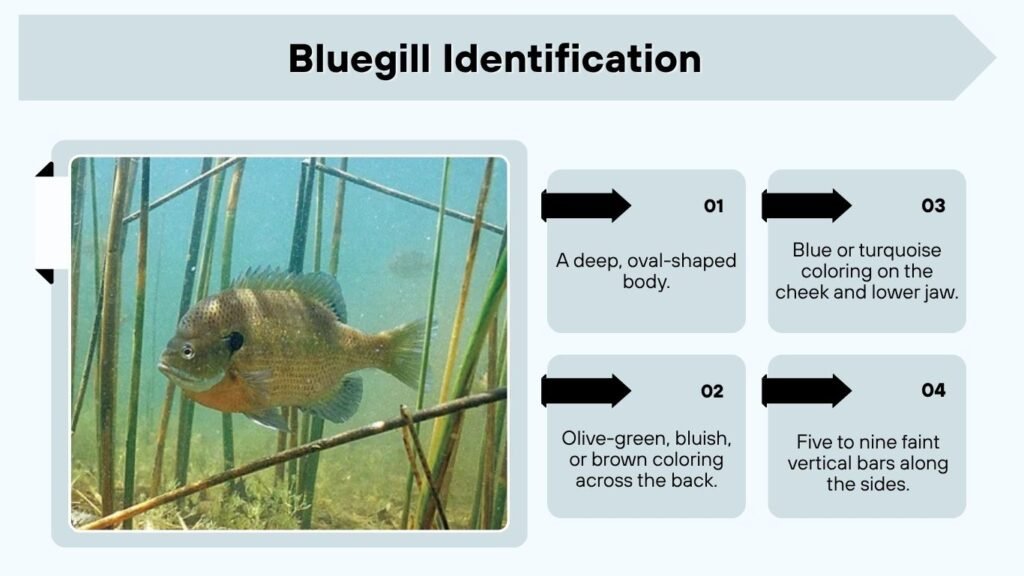
Bluegill have the deep, compressed body shared by many sunfish, but their small mouth, dark ear flap, and dorsal-fin spot help distinguish them. Their color changes according to age, sex, breeding condition, water quality, and habitat, so anglers should examine several features rather than depending on color alone.
Key Bluegill Features
Look for the following characteristics:
- A deep, oval-shaped body
- Olive-green, bluish, or brown coloring across the back
- Blue or turquoise coloring on the cheek and lower jaw
- Five to nine faint vertical bars along the sides
- A relatively small mouth
- A solid dark-blue or black ear flap
- A noticeable black spot near the rear of the dorsal fin
- A yellow, orange, or copper-colored belly
- A typical adult length of approximately 4–10 inches
Breeding males often have darker cheeks and brilliant copper or orange bellies. Females and young bluegill are generally lighter and display more noticeable vertical bars.
How Other Sunfish Look
Other sunfish can share the bluegill’s round body, spiny dorsal fin, and colorful face. However, their mouths may be larger, their ear flaps may have colored borders, or their fins may show bright margins.
Geographic location also provides a clue because some species have limited ranges. Nevertheless, sunfish are frequently stocked outside their native distributions, and natural hybrids can combine features from two parent species.
Green Sunfish vs. Bluegill
Green sunfish and bluegill frequently share ponds, streams, and reservoirs. They also hybridize naturally, creating individuals with intermediate characteristics. Mouth size, body shape, fin margins, and dorsal markings are usually the most helpful features for separating pure adults.
Appearance and Mouth Size
A bluegill has a deep, rounded body and a small mouth that generally does not extend beneath the center of the eye. It usually displays vertical side bars and a black spot at the back of its soft dorsal fin.
The green sunfish has a more elongated body and a noticeably larger mouth that extends closer to or beyond the middle of the eye. Its cheeks have bright blue-green lines, and its dorsal, tail, and anal fins commonly have yellow, white, or orange margins.
Young green sunfish can look like bluegill, but their larger mouths and colorful fin edges remain useful clues.
Habitat and Behavior
Bluegill favor ponds, lakes, reservoirs, and slow water with vegetation. They frequently form schools and feed on zooplankton, insects, crustaceans, and other small prey.
Green sunfish tolerate warmer, shallower, muddier, and more oxygen-limited water. They are aggressive predators and readily eat insects, crayfish, and small fish. Their larger mouths allow them to capture prey that an equal-sized bluegill might be unable to swallow.
Bluegill vs. Other Common Sunfish
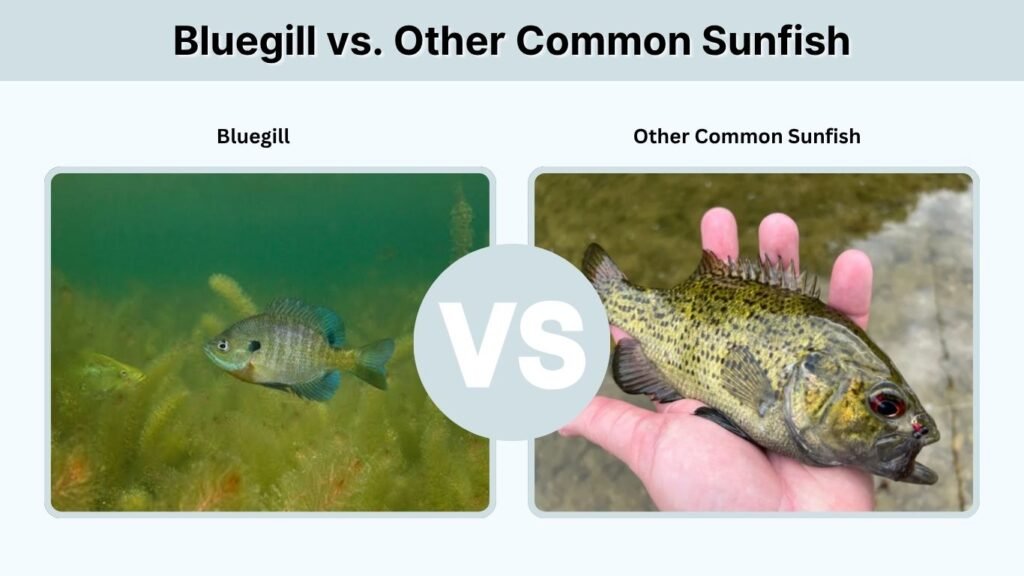
Pumpkinseed, redear, longear, redbreast, and spotted sunfish may be mistaken for bluegill. The most useful comparison points are the ear flap, facial pattern, mouth size, body markings, and fin color. Males in breeding condition usually show the clearest differences, while females and juveniles can be considerably harder to identify.
Important Identification Differences
Compare these common species:
- Redear sunfish: Has a red or orange border on the dark ear flap and often feeds on snails
- Pumpkinseed: Displays turquoise facial lines and a bright red or orange ear-flap spot
- Longear sunfish: Has an elongated ear flap, intense orange coloring, and blue-green facial patterns
- Redbreast sunfish: Possesses a long, narrow ear flap and reddish or orange breast
- Spotted sunfish: Shows rows of small dark spots along the sides
- Bluegill: Has a plain dark ear flap, small mouth, vertical bars, and black dorsal-fin spot
The bluegill typically has less elaborate facial patterning than pumpkinseed or longear sunfish.
Coppernose and Hybrid Bluegill
Coppernose bluegill are a southern form of bluegill rather than a separate sunfish species. Mature males may develop a copper-colored band across the forehead. They are commonly stocked in warm-climate ponds.
Hybrid bluegill are usually created by crossing a male bluegill with a female green sunfish. They often have larger mouths, colorful fin margins, and incomplete vertical bars. Fingerlings can be especially difficult to identify without knowing their source.
Bluegill vs. Crappie, Perch, and Ocean Sunfish
Crappie belong to the same freshwater family as bluegill, but they belong to a different genus and are rarely called sunfish in everyday conversation. True perch and ocean sunfish are more distantly related and should not be identified using bluegill characteristics.
Freshwater Fish Comparisons
Important differences include:
- Bluegill: Deep body, small mouth, blue-green cheek, and dark ear flap
- Black crappie: Silvery body covered with irregular black spots and a large mouth
- White crappie: Silvery body with vertical dark bars and a large mouth
- Yellow perch: Elongated yellowish body with distinct dark vertical bands
- Bluegill-sized bass: Longer body, substantially larger mouth, and no typical bluegill ear flap
- Freshwater sunfish: A broad term covering bluegill and multiple related species
Crappie and bluegill are both popular panfish, but crappie typically grow longer and have thinner, more elongated profiles.
Bluegill vs. Ocean Sunfish
The ocean sunfish, or mola, is unrelated to the freshwater sunfish family. It is an enormous marine fish with a flattened body, reduced tail, and tall dorsal and anal fins.
An ocean sunfish can weigh hundreds or even thousands of pounds, while a bluegill usually weighs less than one pound. Their shared common name reflects their basking behavior or appearance rather than a close biological relationship.
Size, Diet, Habitat, and Taste
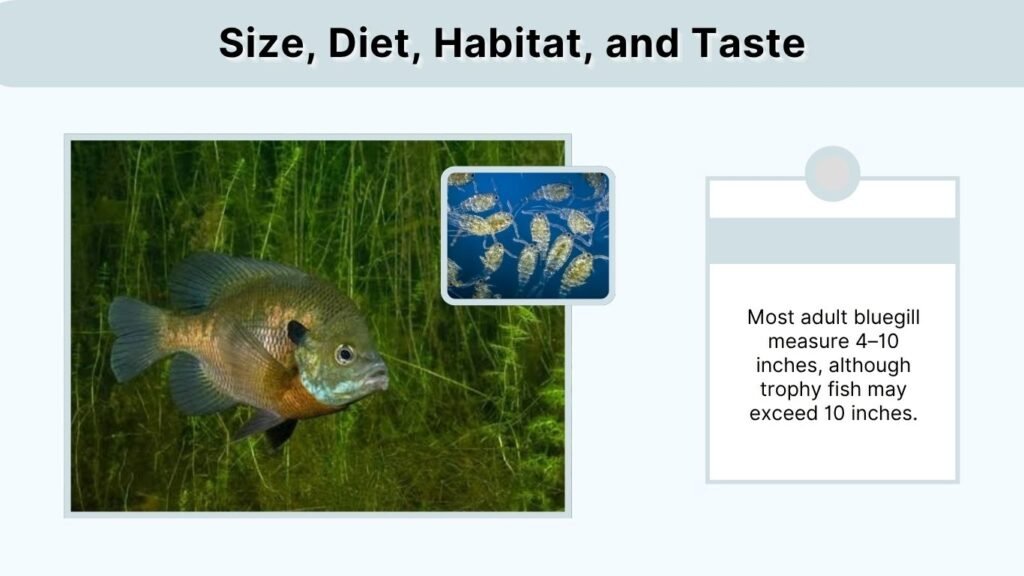
Most freshwater sunfish occupy similar environments and consume comparable foods, but differences in mouth structure influence what they can capture. Their adult size also varies among species. Taste differences are usually subtle and may be influenced more by water quality, diet, freshness, and preparation than by species.
Size and Growth
Most adult bluegill measure 4–10 inches, although trophy fish may exceed 10 inches. Green sunfish commonly remain within a similar range but have longer, less rounded bodies. Redear sunfish can grow larger and heavier than typical bluegill, while pumpkinseed and spotted sunfish often remain smaller.
Food availability, competition, genetics, temperature, and predator numbers determine growth. Overcrowded ponds may produce numerous mature but undersized fish.
Diet and Feeding
Bluegill mainly eat zooplankton, insects, worms, crustaceans, fish eggs, and occasional small fish. Green sunfish consume larger prey because of their bigger mouths. Redear sunfish have specialized throat structures that help crush snails and other hard-shelled animals.
Pumpkinseed also consume snails, insects, and crustaceans. All these species are opportunistic and adjust their diets according to available food.
Bluegill vs. Sunfish Taste
Bluegill have mild, slightly sweet, white flesh with a delicate texture. Pumpkinseed, redear, green sunfish, and other clean-water sunfish have similarly mild flavors.
Redear may provide thicker fillets because larger individuals have deeper bodies. Green sunfish may offer less meat when they are small. Proper icing, cleaning, and cooking usually affect flavor more noticeably than the species itself.
Bluegill and other sunfish can be fried, baked, grilled, or pan-seared. Anglers should follow local harvest limits and fish-consumption advisories.
FAQs
Because “sunfish” is used as both a family name and a casual name for several species, identification questions are common. These answers clarify five frequent points.
Is Every Bluegill a Sunfish?
Yes. Bluegill are one species within the freshwater sunfish family. However, many sunfish species are not bluegill.
Which Is Bigger, Bluegill or Green Sunfish?
Their size ranges overlap, but trophy bluegill generally grow heavier and deeper-bodied. Green sunfish appear longer and have larger mouths.
Is a Pumpkinseed a Bluegill?
No. Pumpkinseed and bluegill are separate species. Pumpkinseed have turquoise facial lines and a red or orange spot on the ear flap.
Are Bluegill and Bream the Same?
In many parts of the United States, people call bluegill “bream.” However, bream can also refer to other sunfish, so the term is not species-specific.
Can Bluegill and Green Sunfish Hybridize?
Yes. They can produce hybrid offspring naturally or through hatchery breeding. Hybrids often combine a bluegill-like body with the green sunfish’s larger mouth and colorful fin edges.