
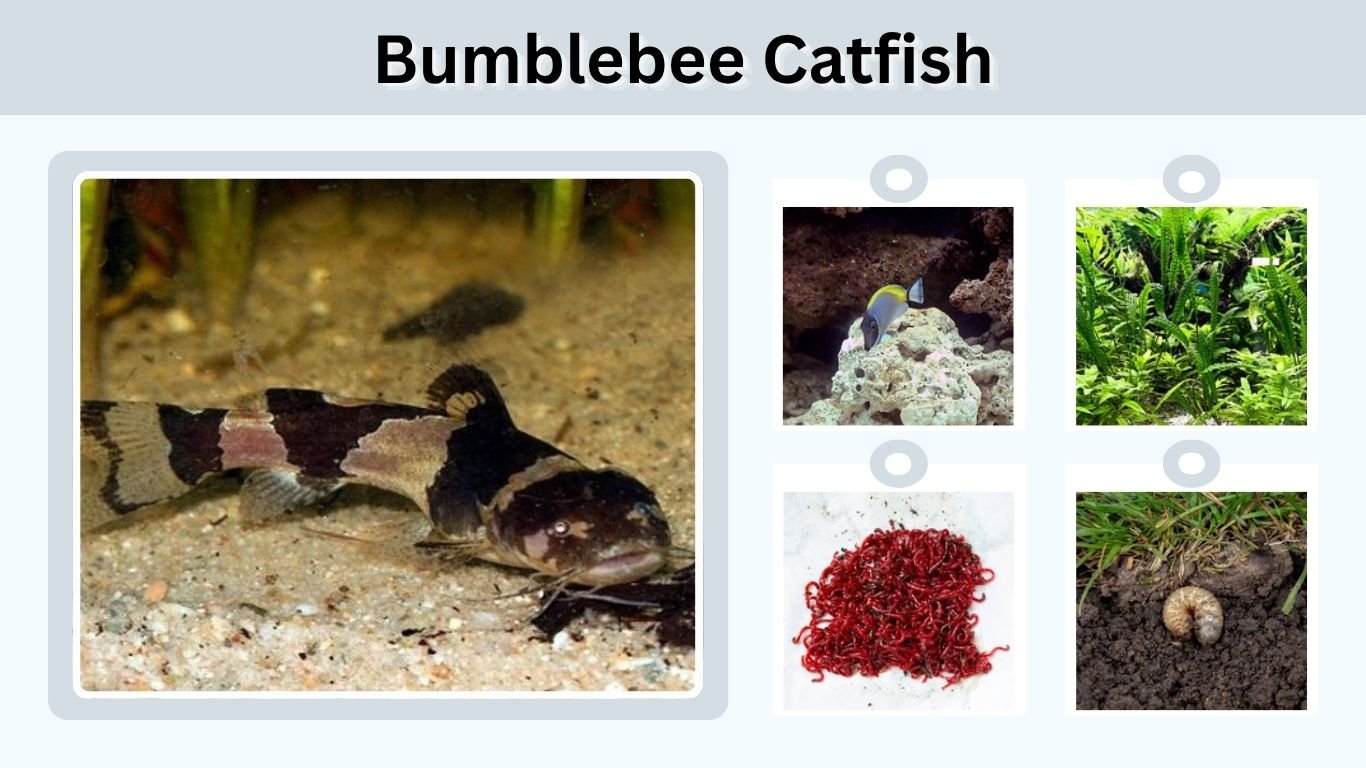
The bumblebee catfish is a small, nocturnal freshwater fish recognized by its dark body and contrasting cream, yellow, or orange markings. Its secretive behavior, broad head, and whisker-like barbels make it an interesting addition to a peaceful community aquarium.
However, the name bumblebee catfish applies to several different species. The South American bumblebee catfish remains small and relatively peaceful, while the Asian variety grows much larger and may eat smaller tank mates. Correct identification is therefore essential before choosing a tank.
Types of Bumblebee Catfish
The two species most frequently sold under this common name are the South American bumblebee catfish and the Asian bumblebee catfish.
| Feature | South American variety | Asian variety |
| Scientific name | Microglanis iheringi | Pseudomystus siamensis |
| Natural range | Venezuela, South America | Southeast Asia |
| Maximum recorded size | About 2.4 inches standard length | About 7 inches total length |
| Temperament | Shy and generally peaceful | More predatory and territorial |
| Suggested tank | 20 gallons or larger | Around 40 gallons or larger |
| Best tank mates | Peaceful medium-sized fish | Robust fish too large to swallow |
FishBase records Microglanis iheringi at approximately 6 cm standard length, while the Asian Pseudomystus siamensis can reach 18 cm total length. These differences explain why aquarium shops sometimes provide conflicting size and care information.
South American Bumblebee Catfish
The South American bumblebee catfish is the smaller and more community-friendly species. It has a broad, flattened head and irregular dark markings over a lighter brown, cream, or yellowish background.
It naturally inhabits fast-flowing freshwater areas with rocky or gravelly bottoms. FishBase reports that wild individuals feed heavily on insects. The species is usually harmless to similarly sized fish but may swallow fry or tiny tank mates that fit inside its mouth.
Asian Bumblebee Catfish
The Asian bumblebee catfish has irregular light bands over a dark gray or yellowish body. It comes from the Chao Phraya, Mekong, and other river systems in Southeast Asia.
This species grows considerably larger than the South American fish. It is also more likely to become territorial or eat smaller fish, particularly when it reaches its full adult size.
Bumblebee Catfish Identification
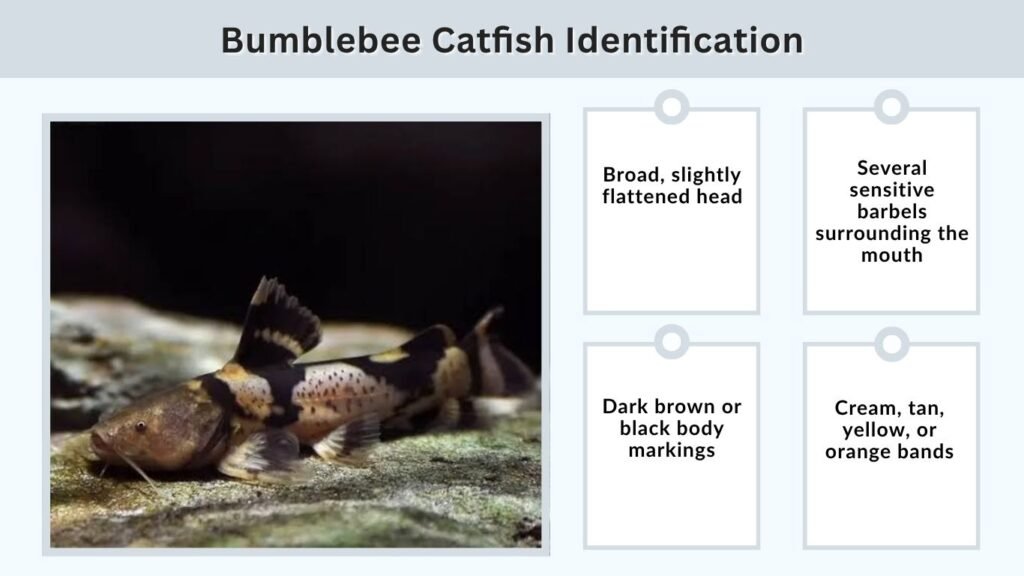
Look for the following features:
- Broad, slightly flattened head
- Several sensitive barbels surrounding the mouth
- Dark brown or black body markings
- Cream, tan, yellow, or orange bands
- Wide mouth designed for bottom feeding
- Rounded body with a narrowing tail
- Strong dorsal and pectoral-fin spines
- Nocturnal behavior and a preference for caves
Color alone cannot reliably identify the exact species. Compare the body pattern, adult size, origin, fin structure, and scientific name listed by the seller.
How Big Do Bumblebee Catfish Get?
A full-grown South American bumblebee catfish typically remains around 2–3 inches long. FishBase gives Microglanis iheringi a maximum recorded standard length of 6 cm, although some aquarium references report individuals approaching 3 inches.
The Asian bumblebee catfish can reach approximately 7 inches. Juveniles may look similar to the smaller South American species, which sometimes leads aquarists to place them in tanks they will eventually outgrow.
What Is a Giant Bumblebee Catfish?
“Giant bumblebee catfish” is another trade name applied to larger predatory catfish. It should not be confused with the dwarf South American species.
Never purchase a fish sold only as a “bumblebee catfish” without asking for its scientific name and expected adult size. A mislabeled juvenile may eventually become too large or predatory for a small community aquarium.
Bumblebee Catfish Tank Size
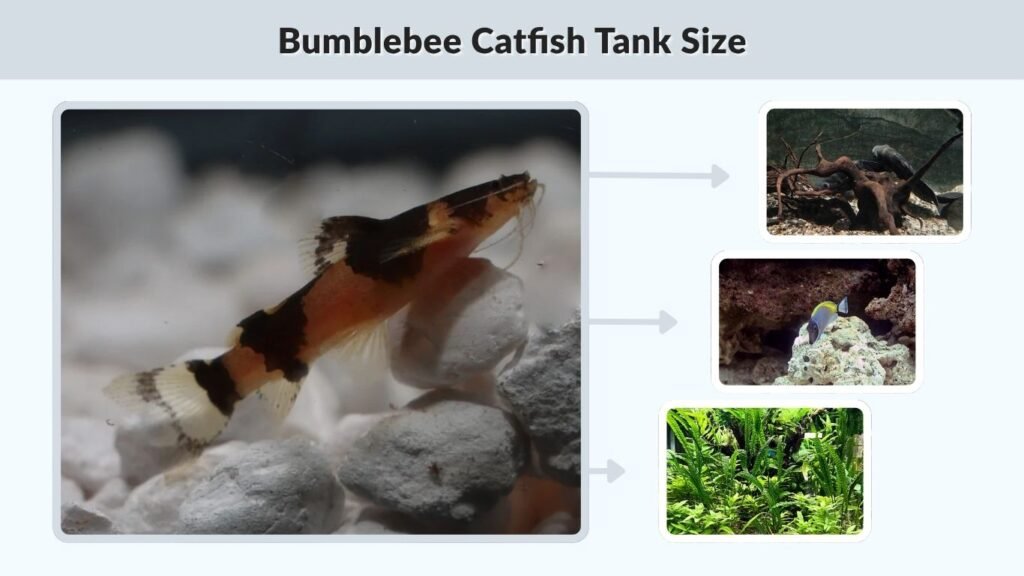
A 20-gallon aquarium is a practical minimum for one South American bumblebee catfish. A larger tank is preferable when keeping several individuals or a full community because it provides more bottom territory, hiding places, and stable water conditions.
The Asian species needs considerably more room. A single adult is better suited to an aquarium of around 40 gallons or more, while a group requires additional floor space and multiple separate shelters.
Ideal Tank Setup
Use fine sand or smooth gravel to protect the fish’s underside and barbels. Add:
- Driftwood tunnels
- Rock caves
- Ceramic shelters
- Dense plants
- Leaf litter
- Shaded areas
- Gentle to moderate water movement
Bumblebee catfish hide for much of the day and become active after the aquarium lights dim. Every fish should have access to at least one secure retreat.
Water Temperature and Parameters
The South American species naturally occurs in tropical freshwater. FishBase lists a broad range of approximately 75–82°F, a pH of 6.0–8.0, and soft to moderately hard water. In aquariums, stable conditions are more important than repeatedly changing the water to reach an exact number.
A suitable general range is:
| Water condition | Recommended range |
| Temperature | 72–79°F |
| pH | 6.0–7.5 |
| Hardness | Soft to moderately hard |
| Ammonia | 0 ppm |
| Nitrite | 0 ppm |
Use an established biological filter and perform regular partial water changes. Since these catfish spend most of their time near the bottom, accumulated waste and uneaten food should not be allowed to collect around their caves.
What Do Bumblebee Catfish Eat?
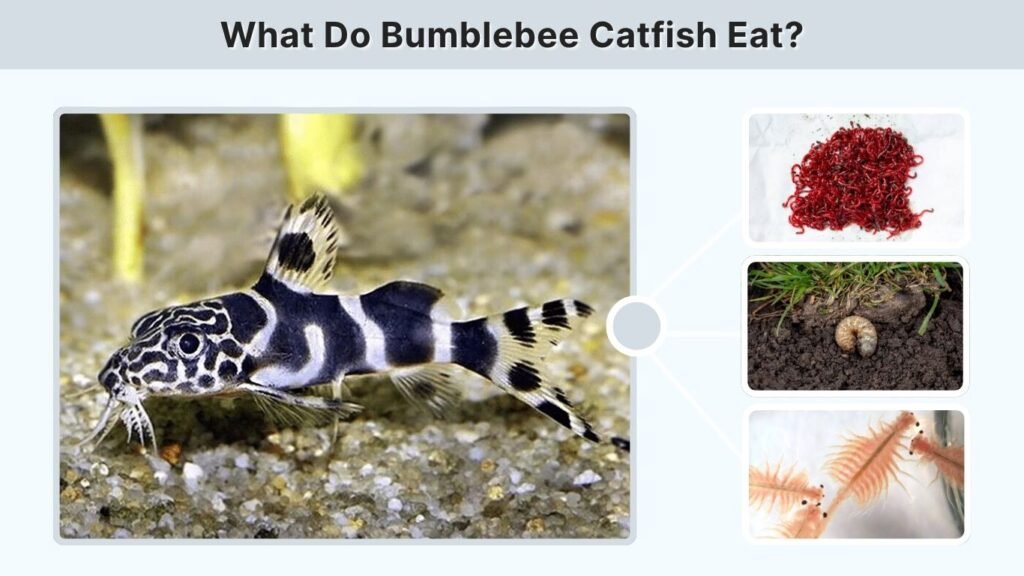
Bumblebee catfish are bottom-feeding carnivores or insect-focused omnivores. Wild South American bumblebee catfish feed on insects, while aquarium fish accept a wider range of sinking prepared and frozen foods.
Good foods include:
- Sinking carnivore pellets
- Bloodworms
- Blackworms
- Chopped earthworms
- Brine shrimp
- Mysis shrimp
- Insect larvae
- Small pieces of prawn
- Quality catfish wafers
Feed shortly before or after the aquarium lights go out. Make sure food reaches the bottom because faster daytime fish may consume everything before the catfish emerges.
Bumblebee catfish are not dependable algae eaters or aquarium cleaners. They still require targeted feeding even when scraps are available.
Are Bumblebee Catfish Aggressive?
South American bumblebee catfish are generally shy rather than openly aggressive. They spend much of the day inside caves and usually ignore peaceful fish that are too large to swallow.
However, any tiny fish, shrimp, or fry may be treated as food. The Asian species presents a greater risk because it grows larger and has a more predatory nature.
Suitable Tank Mates
Possible companions for the South American species include:
- Medium-sized tetras
- Rasboras too large to swallow
- Peaceful gouramis
- Corydoras
- Small plecos
- Peaceful barbs
- Other nonaggressive catfish
Avoid newly born fry, tiny nano fish, and dwarf shrimp when predation would be a concern. Large or aggressive cichlids may bully the smaller South American catfish, while the Asian species requires carefully selected, robust companions.
Bumblebee Catfish Behavior
These fish are nocturnal and highly reclusive. A new individual may disappear into a cave for several days and emerge only when the room becomes dark.
This behavior is normal. Dim lighting, floating plants, abundant cover, and a regular evening feeding schedule can encourage the fish to appear more often. Keeping several compatible individuals may also increase activity, provided each has enough territory and shelter.
Bumblebee Catfish Lifespan
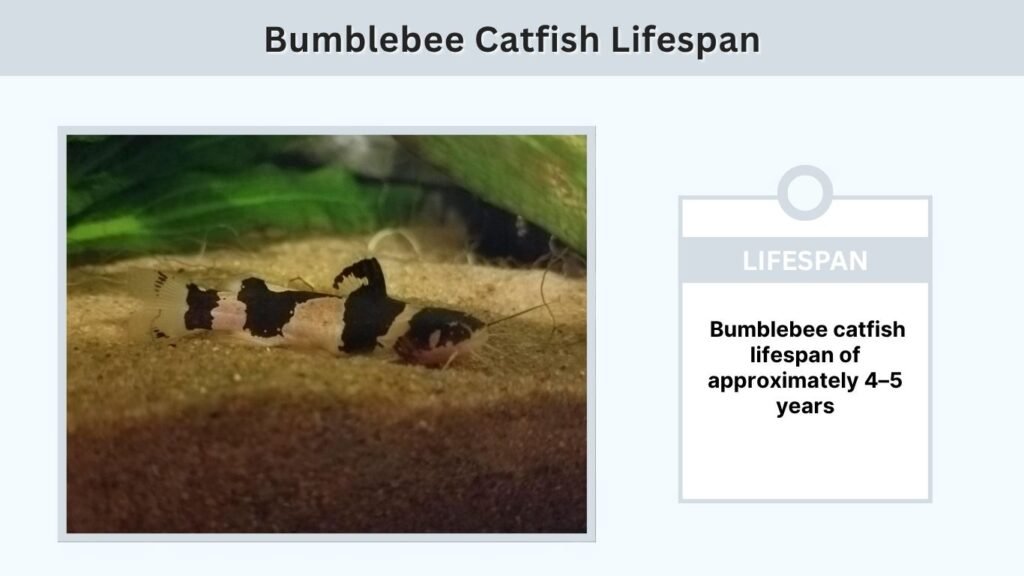
Aquarium care guides commonly estimate a bumblebee catfish lifespan of approximately 4–5 years, although dependable scientific longevity records are limited. Excellent water quality, proper feeding, low stress, and correct species identification provide the best chance of a long life.
Breeding Bumblebee Catfish
Successful home breeding is uncommon, and detailed information remains limited. Sellers should not claim that a round abdomen automatically means the fish is pregnant, since catfish may appear swollen after eating or because of health problems.
Provide clean water, nutritious foods, multiple caves, and compatible mature fish. However, aquarists should not expect routine breeding in an ordinary community setup.
FAQs
Can Bumblebee Catfish Live in a 10-Gallon Tank?
A 10-gallon tank is too restrictive for long-term care. Even the small South American variety benefits from at least 20 gallons, particularly when kept with other fish. The Asian species requires a substantially larger aquarium.
Do Bumblebee Catfish Eat Other Fish?
They may eat fish small enough to fit inside their mouths. The South American species is usually peaceful with appropriately sized tank mates, whereas the larger Asian variety poses a greater predation risk.
Can Bumblebee Catfish Live With Shrimp?
Adult shrimp may survive with a small South American bumblebee catfish, but shrimplets and dwarf shrimp can be eaten. Do not combine them when preserving an entire shrimp colony is important.
Do Bumblebee Catfish Need to School?
They are not strict schooling fish. One can be kept alone, although several may coexist when the aquarium provides sufficient floor space, food, caves, and visual barriers.
Can Bumblebee Catfish Live With Cichlids?
They may live with calm dwarf cichlids or other relatively peaceful species. Large, aggressive cichlids can injure or outcompete them, while tiny cichlids may be vulnerable to a full-grown Asian bumblebee catfish.