
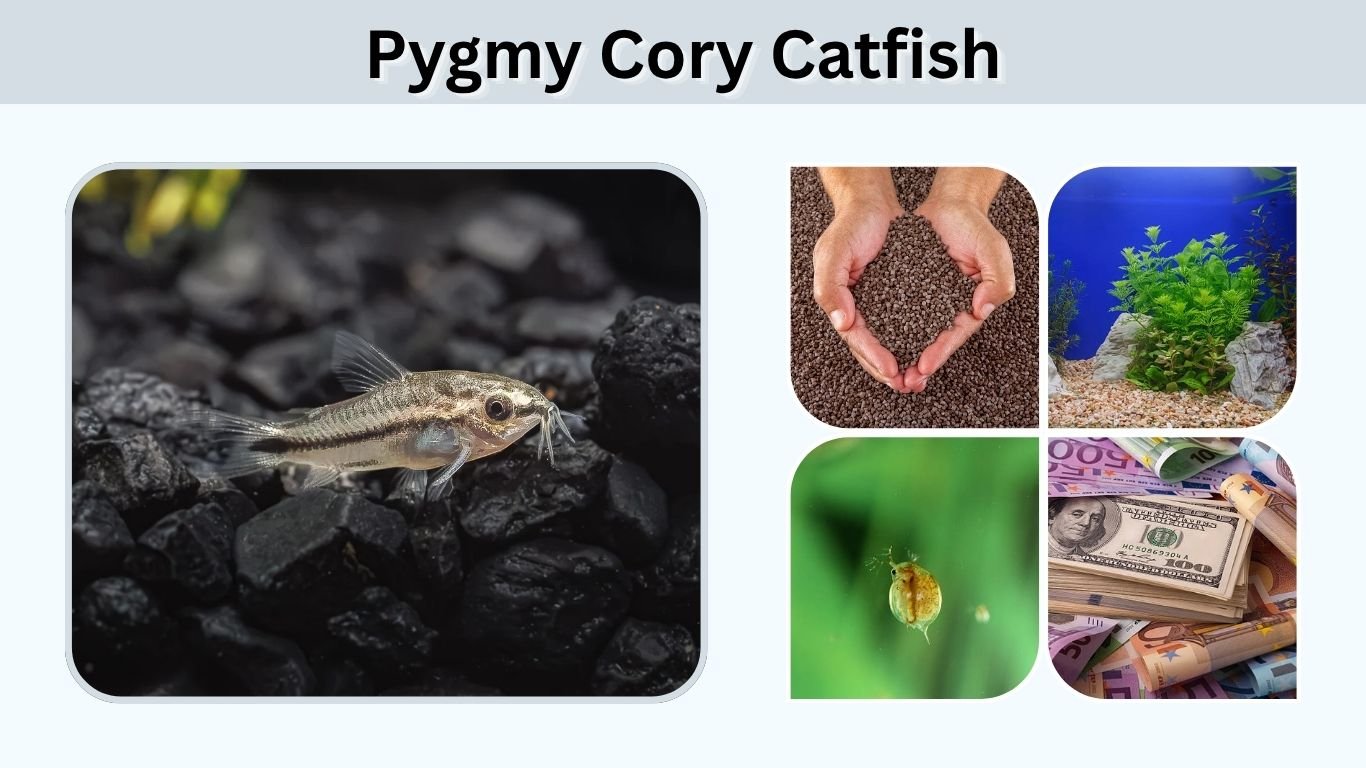
The pygmy cory catfish is a peaceful freshwater fish known for its tiny size, dark horizontal stripe, and energetic schooling behavior. Unlike many cory catfish that remain close to the substrate, pygmy corys regularly swim through the middle of the aquarium.
These social nano fish do best in groups and require clean water, gentle tank mates, soft substrate, and appropriately sized food. A 10-gallon aquarium can support a small school, although a larger tank provides more stable conditions and swimming room.
What Is a Pygmy Cory Catfish?
The pygmy cory catfish, commonly listed as Corydoras pygmaeus, is a small armored catfish native to the Madeira River basin in South America. It is a freshwater species that naturally lives in groups and spends time both near the substrate and in open water.
Pygmy Cory Identification
- Slender, silver-gray body
- Dark horizontal stripe from the snout to the tail
- Small black marking near the base of the tail
- Transparent or lightly marked fins
- Short barbels surrounding the mouth
- Armored plates covering the body
- Maximum length of approximately one inch
Females are generally slightly larger and rounder than males, especially when carrying eggs. Males tend to have slimmer bodies when viewed from above.
How Big Do Pygmy Cory Catfish Get?
A full-grown pygmy cory catfish usually reaches approximately 0.8–1 inch, or about 2–2.5 centimeters. FishBase records a maximum standard length of 2.1 centimeters, excluding part of the tail fin.
| Feature | Typical measurement |
| Adult length | 0.8–1 inch |
| Maximum standard length | About 2.1 cm |
| Suggested group | At least 8 |
| Minimum practical tank | 10 gallons |
| Expected lifespan | About 3–5 years |
Their small size makes them suitable for planted nano aquariums, but it also makes them vulnerable to large or predatory fish.
Pygmy Cory Catfish Tank Size
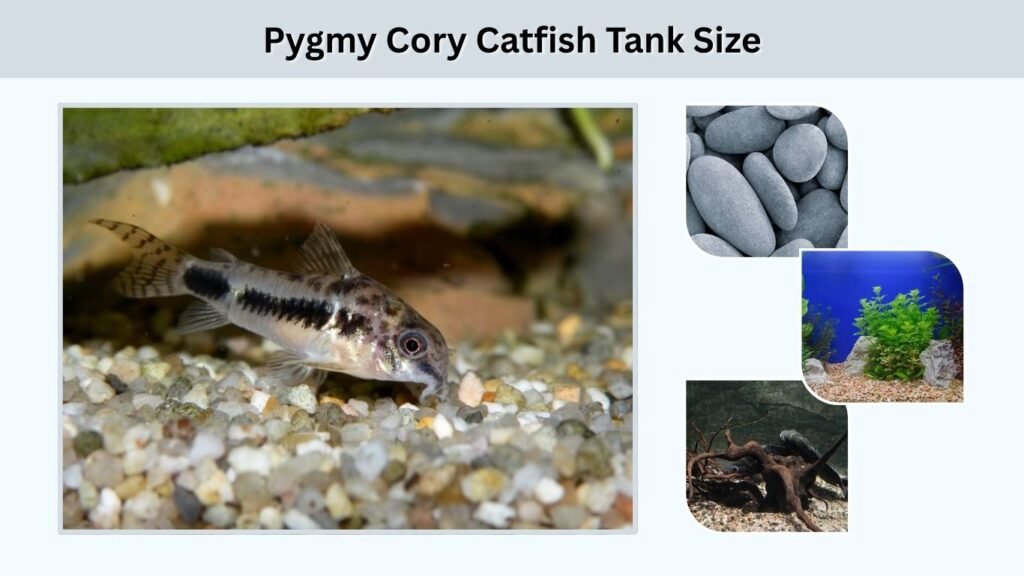
A 10-gallon aquarium is a practical minimum for a school of pygmy corys. Choose a tank that is longer rather than unusually tall because these fish appreciate horizontal swimming space.
Keep at least 8–12 pygmy corys together whenever the aquarium has enough capacity. A larger school usually behaves more confidently, swims in the open more frequently, and displays more natural group movement.
Can Pygmy Corys Live in a 10-Gallon Tank?
Yes, a properly filtered 10-gallon tank can hold a modest school. However, stocking must remain conservative. Adding too many other fish can cause unstable water quality, feeding competition, and overcrowding.
A 15- or 20-gallon planted aquarium provides more room for a larger school and makes water conditions easier to maintain.
Ideal Aquarium Setup
Provide a combination of open swimming areas and sheltered resting places:
- Fine sand or smooth, rounded gravel
- Live plants with broad leaves
- Driftwood and small roots
- Shaded areas
- Gentle to moderate filtration
- Open space along the front of the tank
- A secure lid
Fine sand allows the fish to search for food without damaging their delicate barbels. Avoid sharp gravel and dirty substrate, which may contribute to barbel injuries.
Water Temperature and Conditions
Pygmy corys naturally inhabit tropical freshwater. FishBase lists a temperature range of 72–79°F, a pH of 6.0–8.0, and tolerance for soft through relatively hard water.
| Water condition | Recommended range |
| Temperature | 72–79°F |
| pH | 6.4–7.5 |
| Hardness | Soft to moderately hard |
| Ammonia | 0 ppm |
| Nitrite | 0 ppm |
| Nitrate | Kept low |
Stable conditions are more important than repeatedly changing the pH or hardness. Add pygmy corys only after the aquarium has completed its nitrogen cycle.
Why Do Pygmy Corys Swim to the Surface?
An occasional rapid trip to the surface is usually normal. Pygmy corys can gulp atmospheric air and absorb oxygen through a specialized part of their digestive system. FishBase describes them as facultative air breathers.
Frequent gasping by the entire school may indicate poor oxygen levels, excessive heat, ammonia, nitrite, or another water-quality problem. Test the water when surface visits become unusually frequent.
What Do Pygmy Cory Catfish Eat?
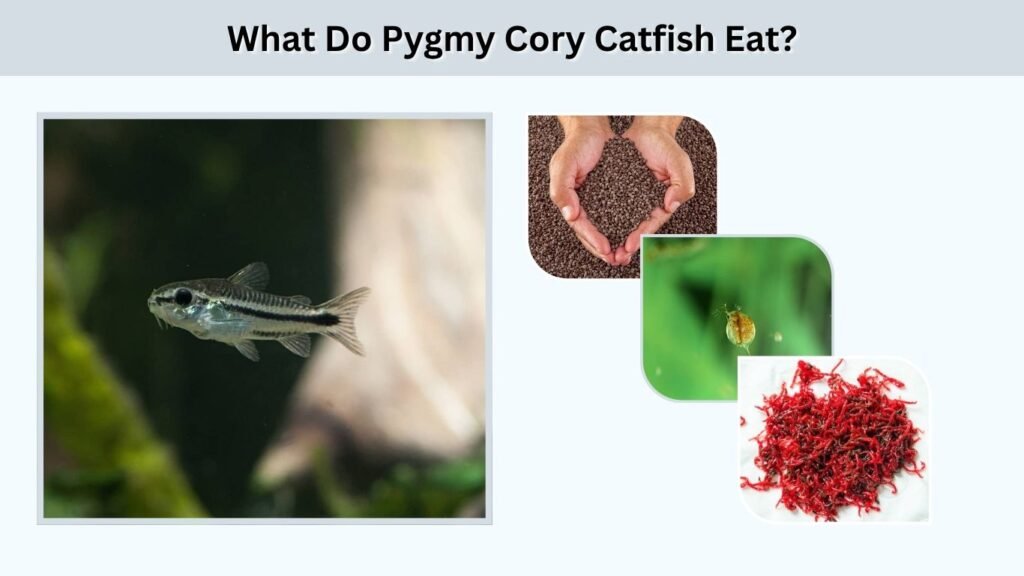
Pygmy corys are omnivorous micro-predators and scavengers. Their mouths are extremely small, so food must be tiny, soft, or easily broken apart.
Suitable foods include:
- Crushed sinking pellets
- Nano fish granules
- Powdered community food
- Frozen cyclops
- Baby brine shrimp
- Daphnia
- Finely chopped bloodworms
- Microworms
- Small insect larvae
Feed small portions once or twice daily. Watch closely to make sure food reaches the lower half of the aquarium before faster tank mates consume it.
Pygmy corys are not algae eaters and should never be expected to survive on scraps. They may pick up leftover food, but they still require intentional daily feeding.
Pygmy Cory Catfish Tank Mates
Pygmy corys are peaceful and should be housed with small, calm fish that will not eat, chase, or outcompete them.
Good tank mates may include:
- Chili rasboras
- Ember tetras
- Green neon tetras
- Celestial pearl danios
- Small peaceful gouramis
- Otocinclus catfish
- Kuhli loaches in larger tanks
- Snails
- Adult dwarf shrimp
Aquarium Co-Op reports that pygmy corys can coexist with peaceful nano fish, otocinclus, adult shrimp, and some calm bettas. However, individual betta temperament varies significantly.
Can Pygmy Cory Catfish Live With Bettas?
They can live with a calm betta in a well-planted aquarium, but the combination is not guaranteed. Some bettas ignore them, while others chase or attack small fish.
A 10-gallon or larger tank with plants and visual barriers offers the best chance of success. Separate the fish when the betta repeatedly chases the school or prevents them from eating.
Can They Live With Kuhli Loaches?
Pygmy corys and kuhli loaches are generally peaceful toward each other. However, both occupy the lower part of the aquarium and may compete for sinking food.
This combination works better in a larger tank with multiple feeding areas, abundant cover, and enough floor space for both social groups.
Can Pygmy Corys Live With Shrimp?
Adult dwarf shrimp are usually safe, but pygmy corys may accidentally eat very young shrimplets while searching for tiny foods. Dense moss and plants increase the number of hiding places available to baby shrimp.
Pygmy Cory vs. Otocinclus Catfish
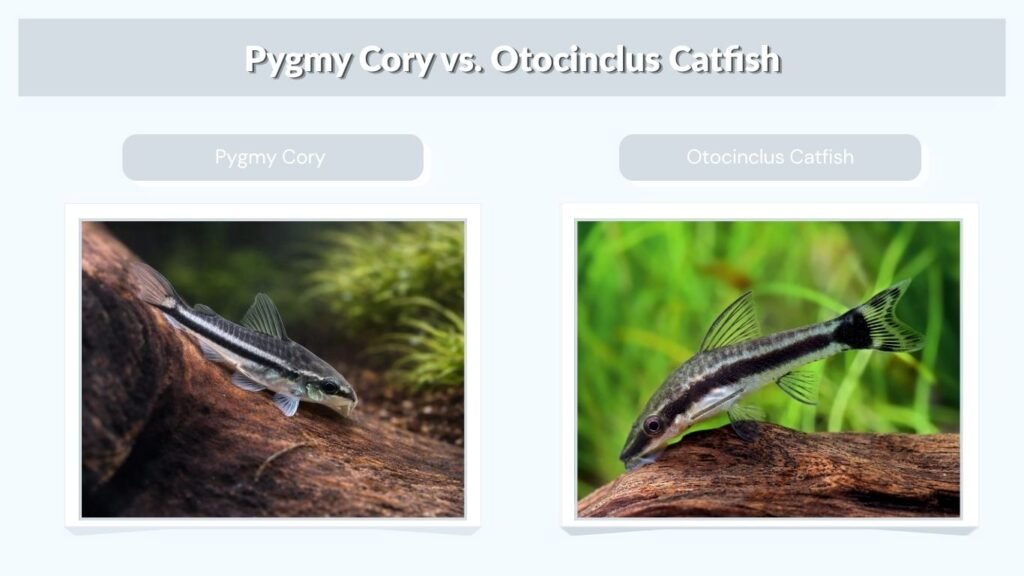
Pygmy corys and otocinclus are both peaceful schooling fish, but they serve different roles in an aquarium.
| Feature | Pygmy cory | Otocinclus |
| Adult size | About 1 inch | Usually larger |
| Main food | Tiny sinking and frozen foods | Algae, biofilm, and vegetables |
| Swimming area | Bottom and midwater | Plants, wood, and glass |
| Algae control | Very limited | Effective on soft algae |
| Social needs | Schooling | Social group |
| Best aquarium | Stable planted tank | Mature algae-rich tank |
Choose otocinclus primarily for algae and biofilm grazing. Choose pygmy corys for schooling activity and bottom-to-midwater movement. They can coexist when the aquarium is large enough and each species receives the correct food.
Pygmy Cory vs. Salt and Pepper Pygmy Cory
The salt and pepper pygmy cory is usually Corydoras habrosus, a different species from Corydoras pygmaeus.
The true pygmy cory has a strong horizontal stripe and frequently swims in midwater. The salt and pepper cory has a spotted or mottled pattern and spends more time close to the substrate.
They have broadly similar peaceful temperaments, but each species should be kept with a group of its own kind rather than being expected to form one complete school together.
Pygmy Cory Catfish Lifespan
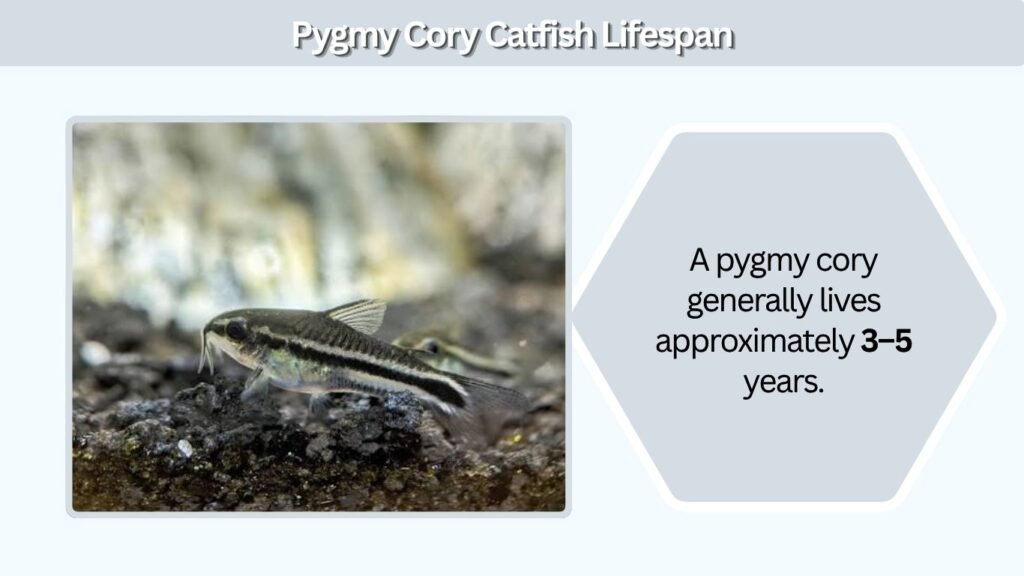
A pygmy cory generally lives approximately 3–5 years in a well-maintained aquarium. Lifespan depends on genetics, water quality, diet, stress, disease prevention, and whether the fish is maintained in a suitable school.
Clean water, stable temperature, nutritious food, and peaceful companions give the fish the best chance of reaching its expected lifespan.
Breeding Pygmy Cory Catfish
Pygmy corys can breed in home aquariums. During spawning, the female holds two to four eggs between her pelvic fins while the male fertilizes them. She then attaches the sticky eggs to plants, glass, or another suitable surface. This process may continue until many eggs have been deposited.
Adults may eat eggs and fry, so breeders often transfer the eggs to a separate container with matching aquarium water and gentle aeration.
Cory eggs commonly hatch in approximately three to seven days, depending on species and temperature. Newly hatched fry initially consume their yolk sacs before requiring microscopic or powdered foods.
Buying Healthy Pygmy Cory Catfish
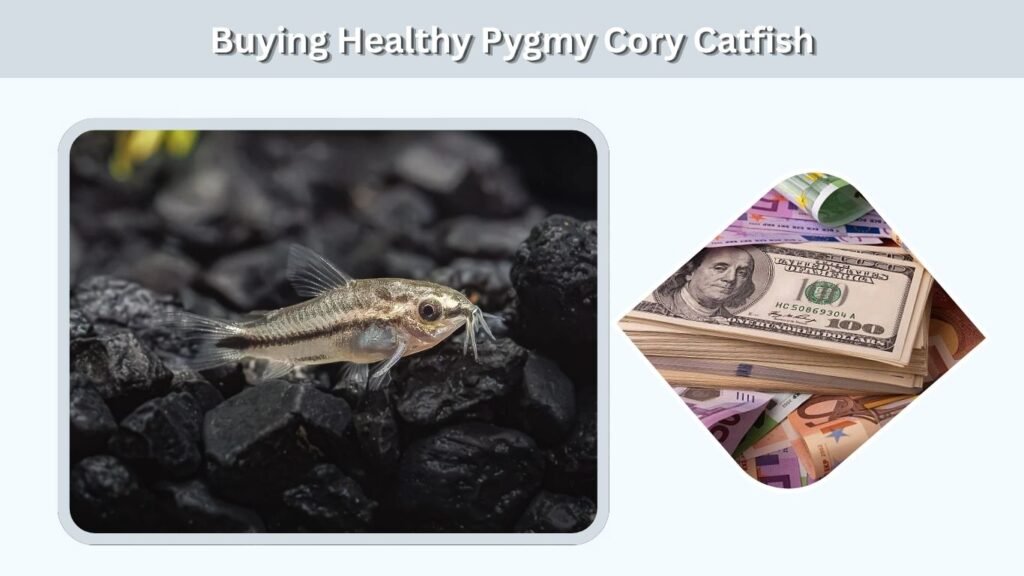
When choosing pygmy corys for sale, look for:
- Rounded rather than sunken bellies
- Clear eyes
- Intact barbels and fins
- Smooth breathing
- Active schooling behavior
- No white spots, sores, or red patches
- Fish that respond when food is offered
Avoid buying only one or two because pygmy corys depend on a proper group for security. Quarantine new fish before adding them to an established aquarium.
FAQs
Are Pygmy Cory Catfish Good for Beginners?
Yes, provided the aquarium is fully cycled and stable. Their small size makes them more sensitive to ammonia, sudden changes, and aggressive tank mates than some larger cory species.
Do Pygmy Corys Clean the Tank?
They eat some leftover food but are not a substitute for aquarium maintenance. They do not remove waste, and they are poor algae eaters. Regular water changes, substrate cleaning, and targeted feeding remain necessary.
How Many Pygmy Corys Should Be Kept Together?
Keep at least eight whenever possible. A group of 8–12 usually appears more confident and displays stronger schooling behavior than a group of only three or four.
Do Pygmy Corys Need Sand?
Sand is not absolutely required, but it is an excellent choice. Fine, smooth substrate protects their barbels and allows them to search for food naturally without scraping their mouths.
Are Pygmy Cory Catfish Aggressive?
No. They are among the most peaceful freshwater aquarium fish. Their main risk comes from being bullied, swallowed, or outcompeted by larger and faster tank mates.