
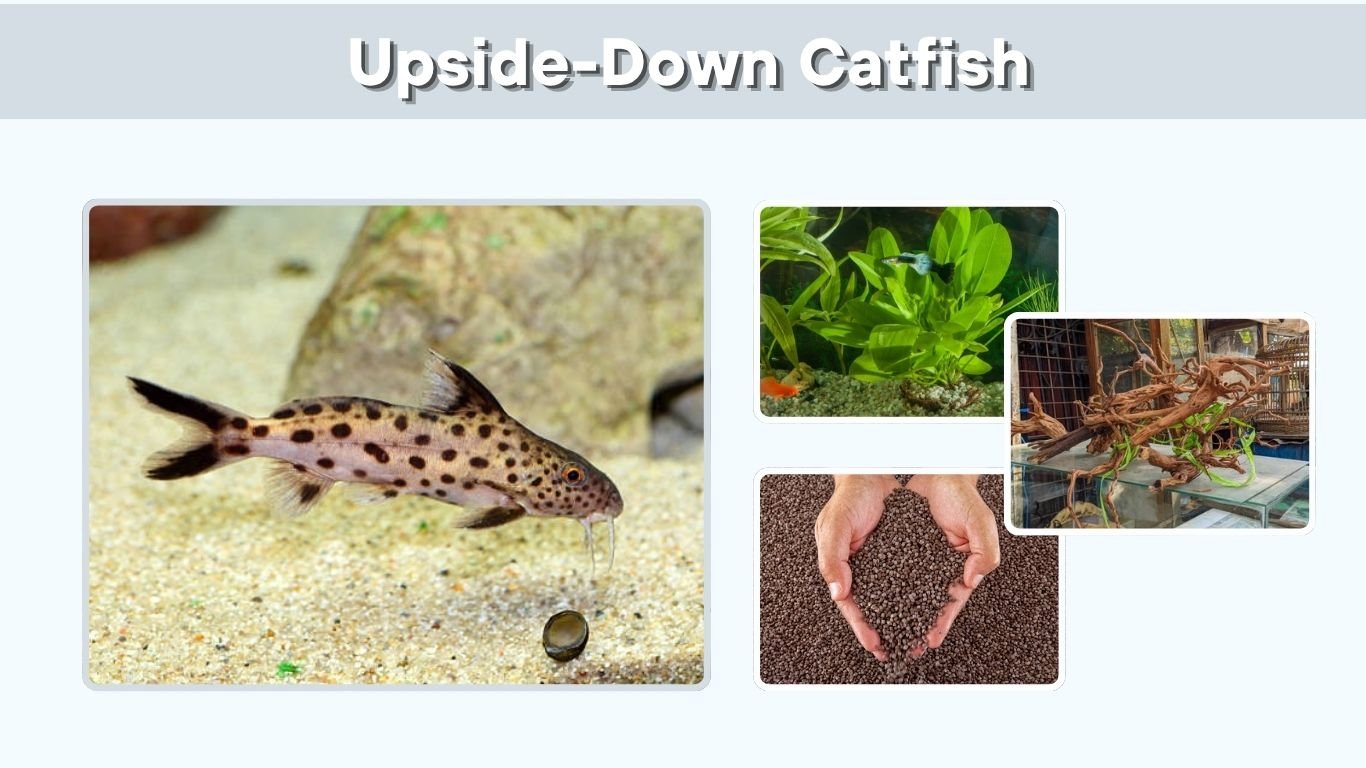
The upside-down catfish is a small freshwater fish famous for swimming with its belly facing the water’s surface. Unlike most fish, this position is normal and healthy for the species. Its manageable size, peaceful temperament, spotted pattern, and unusual behavior make it an interesting addition to a properly maintained community aquarium. However, buyers must identify it carefully because several larger and more aggressive catfish are sold under similar names.
What Is an Upside-Down Catfish?
The true upside-down catfish is scientifically known as Synodontis nigriventris. It belongs to the African catfish family Mochokidae and is also called the blotched upside-down catfish.
The species is native to the middle Congo River basin, including the Kasai and Ubangi drainage systems. It is a tropical freshwater fish that generally becomes more active during the evening and at night.
Identification
A true upside-down catfish has:
- A light brown or gray-brown body
- Irregular dark brown blotches
- Large eyes
- Three pairs of whisker-like barbels
- A deeply forked tail
- A prominent adipose fin
- Sharp dorsal and pectoral fin spines
- A darker belly than back
Its unusual coloration is called reverse countershading. Most upright-swimming fish have dark backs and pale bellies. The upside-down catfish has a darker underside, helping it blend into the surface when viewed from below. Research has confirmed that its ventral skin contains a particularly dense distribution of dark pigment cells.
Why Do Upside-Down Catfish Swim Upside Down?
Swimming inverted helps this catfish feed efficiently around the water’s surface and along the undersides of submerged branches, leaves, and rocks. It can collect insects and other food without repeatedly rolling its body.
Scientific research found that the fish experiences less drag near the surface when swimming upside down than when swimming upright. The position also helps it reach the surface for air breathing more efficiently. However, it can swim normally when searching along the bottom or moving rapidly through deeper water.
Its upside-down posture is therefore an adaptation, not evidence of a damaged swim bladder.
How Big Do Upside-Down Catfish Get?
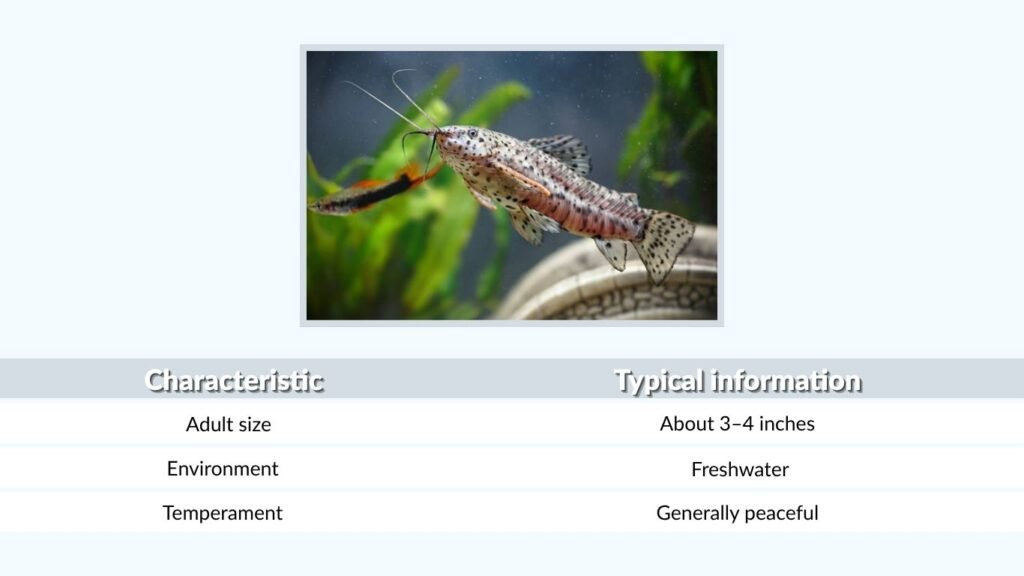
The true Synodontis nigriventris remains relatively small. FishBase records a maximum total length of approximately 9.6 centimeters, or about 3.8 inches.
| Characteristic | Typical information |
| Adult size | About 3–4 inches |
| Environment | Freshwater |
| Temperament | Generally peaceful |
| Activity | Mainly nocturnal |
| Diet | Omnivorous |
| Social needs | Best kept in a group |
| Minimum tank length | About 80 centimeters |
A fish sold as an upside-down catfish that grows far beyond four inches may be a different species.
Upside-Down Catfish Tank Size
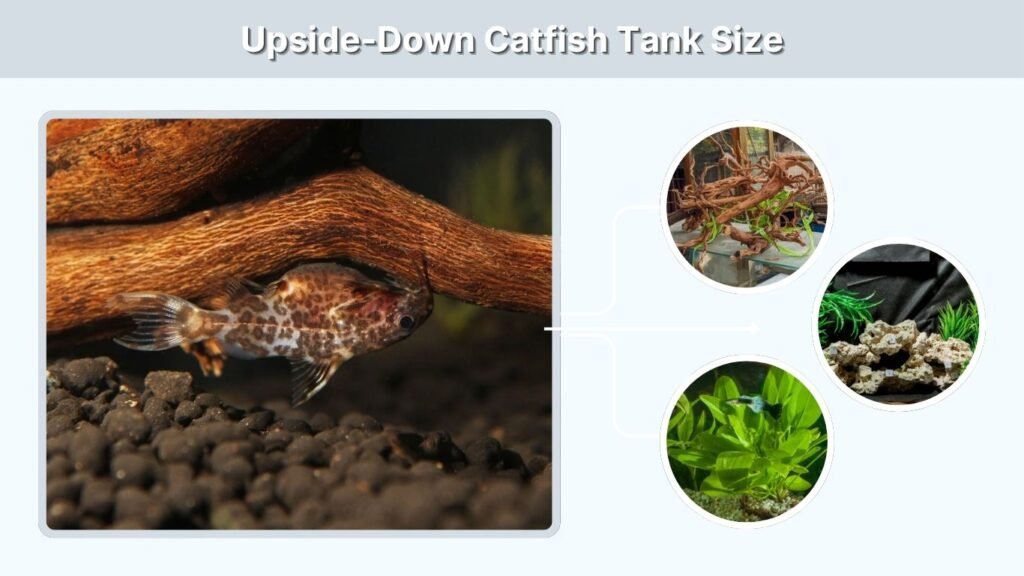
FishBase recommends an aquarium at least 80 centimeters long and keeping the species in groups of five or more. For a proper group, a 30-gallon long aquarium or larger is a practical starting point. A larger tank is better when keeping active tank mates or several bottom-dwelling species.
Keeping only one fish may cause it to remain hidden. A group usually feels more secure and may become more active around shaded areas.
Aquarium Setup
The tank should provide both open swimming space and numerous sheltered areas. Suitable decorations include:
- Driftwood arches
- Rock caves
- Broad-leaved plants
- Smooth stones
- Sheltered overhangs
- PVC caves hidden among plants
The fish frequently rests upside down beneath driftwood, leaves, and rock ledges. Bright, exposed aquariums may encourage it to hide, so subdued lighting and shaded retreats are helpful.
Use sand or smooth, rounded gravel. Rough decorations can damage the barbels or body as the fish explores narrow spaces.
Water Temperature and Conditions
The species tolerates a reasonably broad range but performs best in stable tropical conditions.
| Water parameter | Recommended range |
| Temperature | 72–79°F or 22–26°C |
| pH | 6.0–8.0 |
| Hardness | Approximately 5–12 dH |
| Ammonia | 0 ppm |
| Nitrite | 0 ppm |
These catfish benefit from clean, well-oxygenated water and consistent maintenance. Test the water regularly, avoid sudden temperature changes, and perform partial water changes before waste accumulates. Fish may develop abnormal swimming, appetite loss, or other health problems when environmental conditions deteriorate.
What Do Upside-Down Catfish Eat?
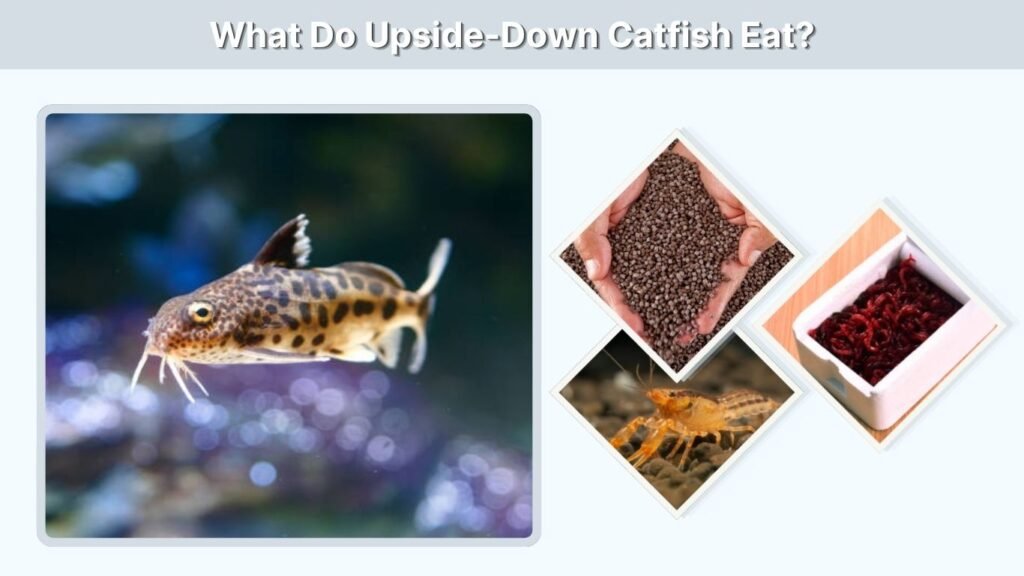
Upside-down catfish are omnivores. In their natural habitat, they feed mainly at night on insects, crustaceans, and plant material. Their inverted posture gives them easy access to insects and other organisms around the surface.
Foods for an Aquarium
Offer a varied diet containing:
- Quality sinking catfish pellets
- Floating or slow-sinking flakes
- Insect-based foods
- Frozen bloodworms
- Frozen or live brine shrimp
- Daphnia
- Spirulina wafers
- Blanched zucchini or cucumber
Feed after the aquarium lights dim so the catfish can eat without competing with active daytime fish. Place food near caves, driftwood, or shaded areas where the group gathers.
Do Upside-Down Catfish Eat Algae?
They may graze on soft algae and plant material, but they should not be purchased as primary algae cleaners. They still require prepared food and animal-based protein.
Will They Eat Other Fish?
The true upside-down catfish is not an active fish hunter, but any omnivorous catfish may consume extremely small fry, eggs, or weakened fish when given the opportunity. Avoid keeping them with newly hatched guppies or other animals small enough to fit in their mouths.
Best Upside-Down Catfish Tank Mates
These catfish generally work well in peaceful tropical community tanks. Suitable companions include:
- Congo tetras
- Larger peaceful rasboras
- African butterflyfish
- Peaceful barbs
- Dwarf cichlids with mild temperaments
- Gouramis
- Rainbowfish
- Similar-sized peaceful catfish
Choose tank mates that share comparable temperature and water requirements. Avoid large predatory fish, highly aggressive cichlids, and species that repeatedly nip barbels or fins.
Goldfish are not ideal companions because they generally prefer cooler conditions, create substantial waste, and may eventually grow large enough to disturb or attempt to swallow smaller catfish.
Are Upside-Down Catfish Aggressive?
True upside-down catfish are generally peaceful, although minor chasing or competition for caves can occur within a group. Providing several shelters prevents one individual from controlling the only secure resting place.
Their sharp fin spines provide defense against predators. Avoid catching them with a coarse net because the spines can become tangled. Guiding the fish into a rigid plastic container is often safer for both the fish and handler.
True vs Burmese Upside-Down Catfish
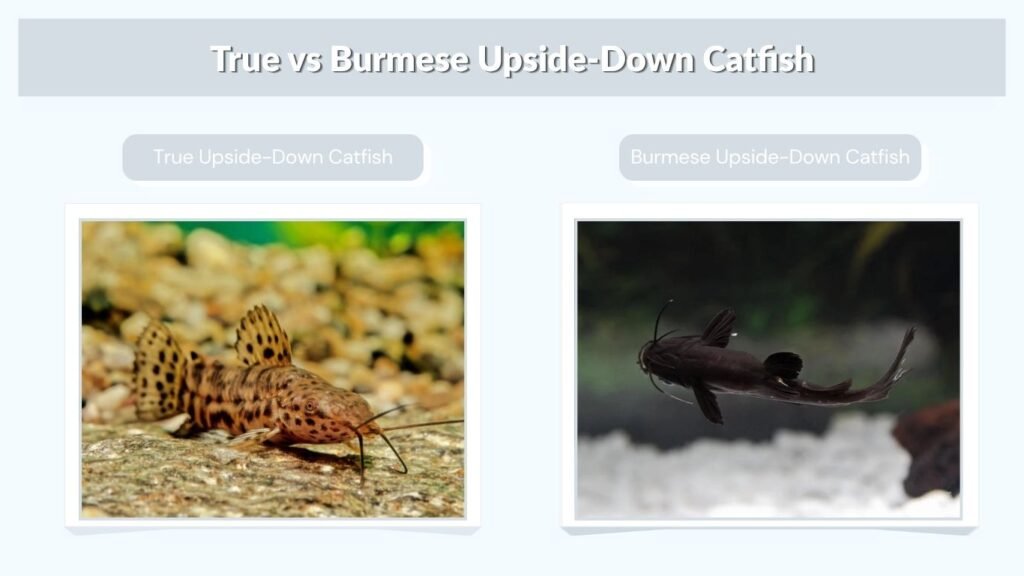
Not every fish sold under this common name is Synodontis nigriventris.
| Feature | True upside-down catfish | Burmese upside-down catfish |
| Scientific name | Synodontis nigriventris | Mystus leucophasis |
| Origin | Central Africa | Myanmar |
| Adult size | Around 3–4 inches | Much larger |
| Color | Brown with dark blotches | Usually dark or nearly black |
| Temperament | Generally peaceful | Territorial and potentially aggressive |
| Tank needs | Medium community tank | Large tank with robust companions |
The Burmese or Asian upside-down catfish is a much larger species from the Irrawaddy and Sittaung river basins. It requires a spacious aquarium and sturdy tank mates rather than a small community setup.
“Black upside-down catfish” commonly refers to the Burmese species, although sellers may use the name inconsistently. Always request the scientific name before purchasing.
Breeding and Life Cycle
Upside-down catfish are egg-laying fish, but successful breeding in ordinary community aquariums is uncommon. Adults need suitable spawning shelters, stable water conditions, and a nutritious diet. Newly hatched young initially swim in a conventional position before developing their characteristic inverted behavior. FishBase confirms that the species is oviparous, although detailed breeding records remain limited.
Upside-Down Catfish Lifespan
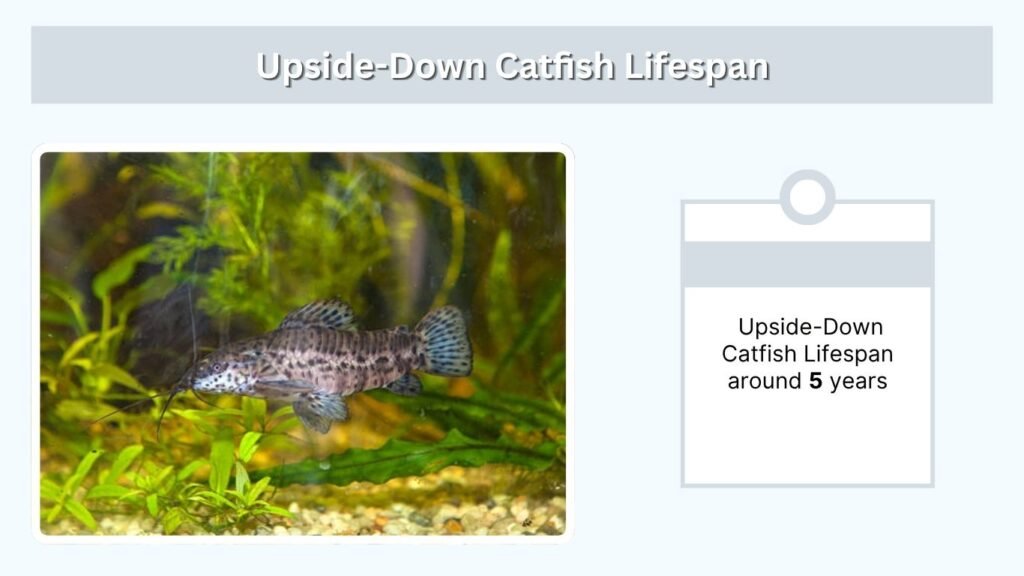
Published aquarium references do not agree on one dependable lifespan. Some report around five years, while other hobby references suggest considerably longer lives. Because validated species-wide longevity data are limited, owners should treat this fish as a long-term commitment and expect several years of care rather than relying on one exact maximum age.
When Upside-Down Swimming Means Illness
Upside-down swimming is normal for Synodontis nigriventris. It is not normally healthy behavior for Corydoras, plecos, goldfish, or most other aquarium fish.
A fish that suddenly floats upside down, rolls sideways, struggles to dive, or cannot remain upright may have a buoyancy problem, poor water quality, physical injury, infection, or another medical condition. Merck Veterinary Manual lists floating, drifting, and swimming in unusual positions among common signs of fish illness.
Test ammonia, nitrite, nitrate, temperature, and pH immediately. Do not automatically add antibiotics, salt, or household remedies without identifying the cause. Persistent symptoms, swelling, sores, appetite loss, rapid breathing, or problems affecting several fish should be evaluated by an aquatic veterinarian.
Buying an Upside-Down Catfish
Before purchasing, confirm the scientific name is Synodontis nigriventris. Select fish with clear eyes, an undamaged body, intact barbels, normal breathing, and no white spots or swollen abdomen.
Because this is a social species, plan to purchase a suitable group rather than one isolated individual. Also confirm that the aquarium can accommodate the fish at its full adult size.
FAQs
Is it normal for an upside-down catfish to swim upright?
Yes. It may briefly swim upright while feeding along the bottom, moving quickly, or changing position. Regularly alternating positions does not necessarily indicate illness.
How many upside-down catfish should be kept together?
A group of at least five is recommended. A properly sized group usually displays more natural social behavior and greater confidence than a solitary fish.
Are upside-down catfish nocturnal?
Yes. They feed mainly at night and often spend daylight hours resting beneath plants, rocks, or driftwood. Shaded shelters can make them feel secure enough to appear more frequently.
Can upside-down catfish live with guppies?
They can usually live with adult guppies in a sufficiently large aquarium. However, newborn fry may be eaten, particularly at night when the catfish are most active.
Why is my Cory catfish floating upside down?
Persistent inverted floating is not normal for a Corydoras. It may indicate a buoyancy disorder, poor water conditions, injury, or illness. Test the aquarium water promptly and seek aquatic veterinary help when the problem continues.