
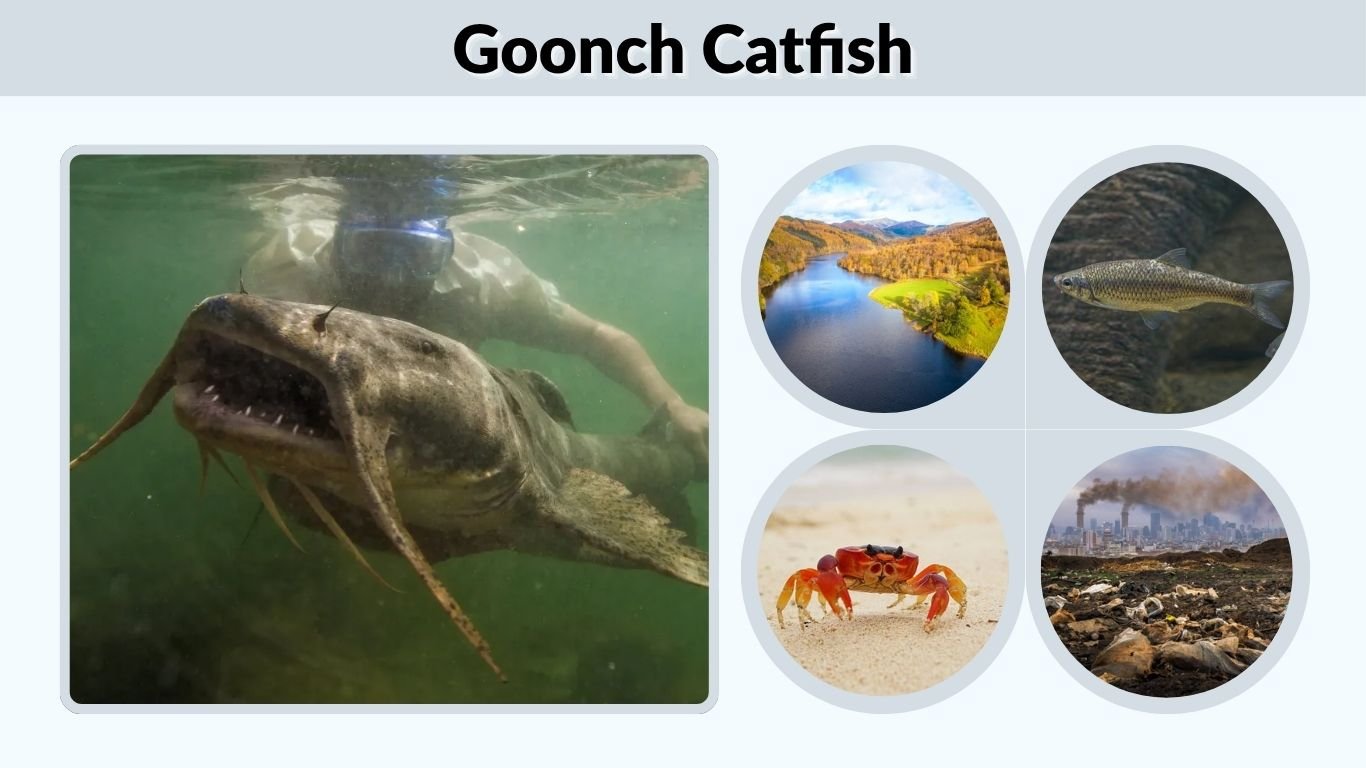
The goonch catfish is a powerful river predator recognized by its broad head, flattened body, enormous mouth, and sharp teeth. Also called the giant devil catfish, it inhabits fast-flowing rivers across the Indian subcontinent. Stories describing it as a “man-eating catfish” have made the species famous, particularly after its appearance on River Monsters.
Although juvenile goonch are occasionally sold for aquariums, their eventual size, predatory nature, strong-current requirements, and waste production make them unsuitable for ordinary home tanks. This guide covers their appearance, size, habitat, diet, behavior, aquarium care, and alleged danger to humans.
Goonch Catfish Overview
The name “goonch” is commonly associated with the fish historically called Bagarius yarrelli. However, a taxonomic review published in 2021 treated B. yarrelli as the same species as Bagarius bagarius. Consequently, both scientific names still appear in fish guides and the aquarium trade.
| Characteristic | Information |
| Common name | Goonch catfish |
| Other names | Giant devil catfish, giant goonch |
| Scientific name | Bagarius bagarius; formerly B. yarrelli |
| Family | Sisoridae |
| Habitat | Large, fast-flowing rivers |
| Maximum reported length | Up to about 7.5 feet |
| Diet | Fish, crustaceans and other aquatic animals |
| Temperament | Predatory and territorial |
| Aquarium level | Expert or public-aquarium level |
| Native range | Indian subcontinent |
What Does a Goonch Catfish Look Like?
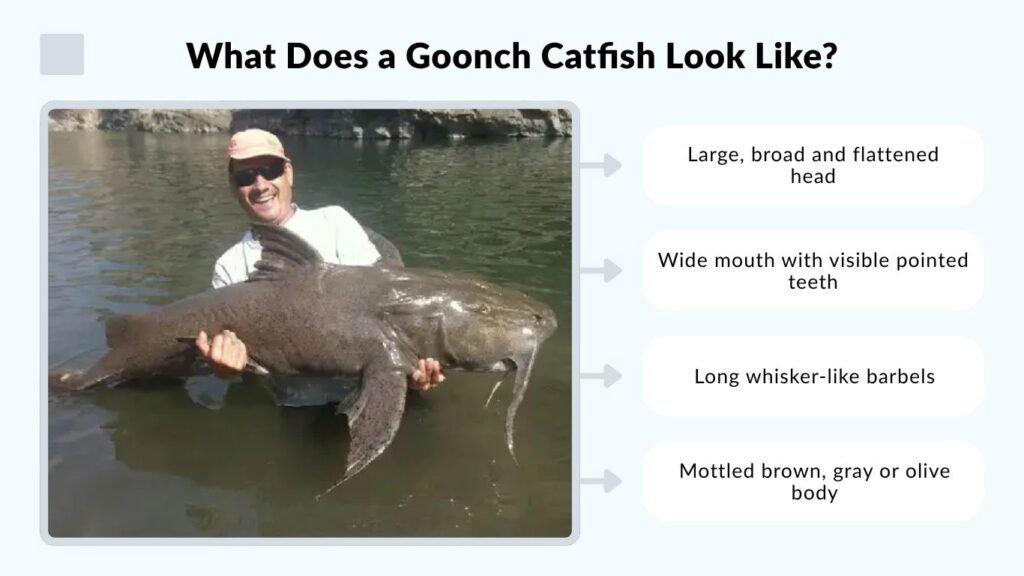
Goonch catfish have a prehistoric appearance. Their wide, flattened heads help them remain close to the riverbed while powerful currents move above them. The body gradually narrows toward a deeply forked tail.
Their natural coloration combines olive, gray, brown, cream, and black markings. This mottled pattern provides camouflage among rocks, gravel, and submerged debris.
Identification Features
- Large, broad and flattened head
- Wide mouth with visible pointed teeth
- Long whisker-like barbels
- Mottled brown, gray or olive body
- Strong, muscular tail
- Large pectoral fins
- Low, elongated body shape
- Deeply forked tail fin
- Small eyes positioned high on the head
The mouth faces forward rather than directly downward, distinguishing the goonch from many peaceful bottom-feeding catfish.
How Big Do Goonch Catfish Get?
The goonch is one of Asia’s largest freshwater catfish. FishBase lists a reported maximum total length of approximately 230 centimetres, or around 7.5 feet. However, exceptionally large historical measurements are difficult to verify, and most wild specimens encountered today are considerably smaller.
A young goonch measuring only four to six inches may appear manageable in a fish shop. It can nevertheless grow into a huge, heavy-bodied predator requiring far more room than almost any domestic aquarium provides.
Growth depends on:
- Species or regional form
- Food availability
- Water quality
- River conditions
- Age and genetics
- Fishing pressure
Claims about the “world-record goonch” vary because some catches were never weighed on certified equipment. Photographs alone cannot establish an accurate record.
Where Do Goonch Catfish Live?
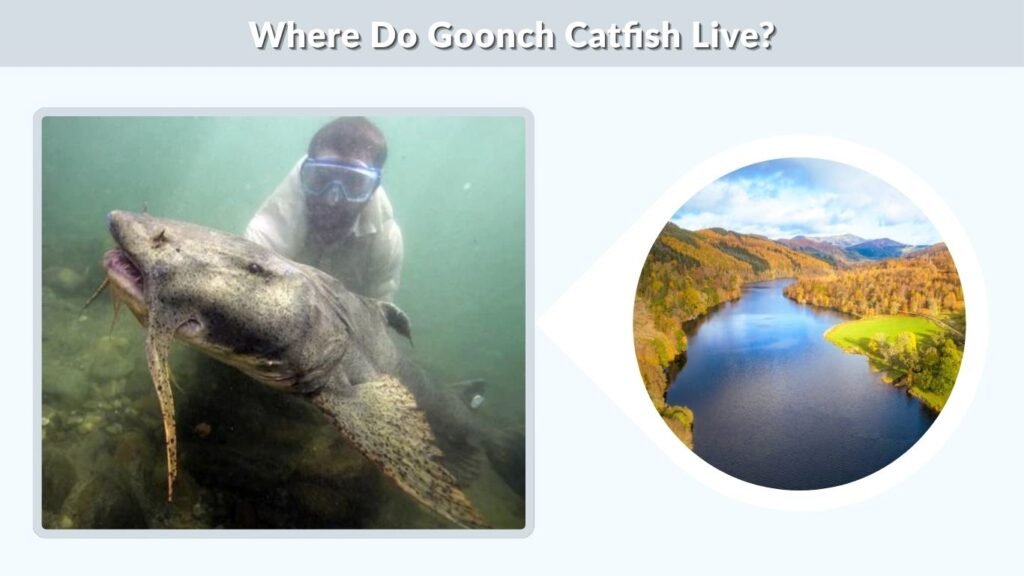
Goonch catfish are associated with major river systems of the Indian subcontinent. Their range includes waters connected to India, Nepal, Bangladesh and Pakistan, including parts of the Ganges and Indus drainage systems.
They prefer large rivers with:
- Strong currents
- Rocky or gravel bottoms
- Deep pools
- High dissolved oxygen
- Submerged ledges and boulders
- Areas beside rapids or fast channels
Their flattened shape and broad fins help them maintain position near the bottom without being swept downstream.
Recent taxonomic work has separated some Southeast Asian fish formerly identified as giant goonch into other Bagarius species. Therefore, older descriptions may exaggerate the true geographic range of B. bagarius.
What Do Goonch Catfish Eat?
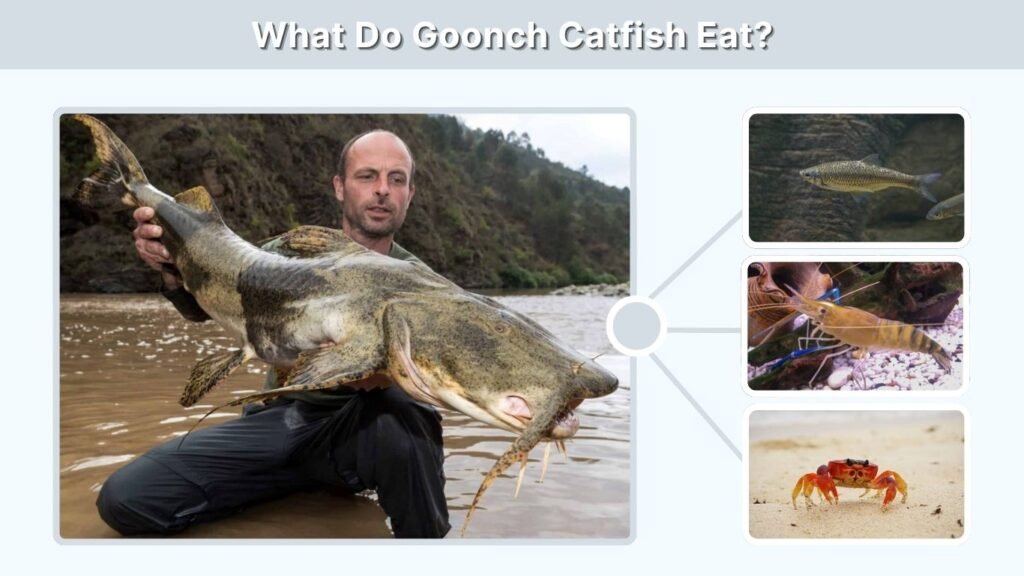
Goonch catfish are predatory carnivores. Young fish consume aquatic insects, larvae, shrimp, small crustaceans and smaller fish. As they grow, fish become an increasingly important part of their diet.
Common Foods
- Small and medium-sized fish
- Freshwater shrimp
- Crabs and other crustaceans
- Aquatic insect larvae
- Frogs or other small aquatic animals
- Carrion when available
Their wide mouths allow them to swallow relatively large prey. They may remain concealed near rocks and attack fish moving through the current.
In captivity, they should not be routinely fed live feeder fish. Feeders can transmit parasites, cause injuries and provide poor nutrition. Large pieces of shrimp, mussel, fish fillet, earthworms and quality carnivore pellets are safer choices.
Goonch Catfish Teeth and Mouth
Unlike many catfish with small gripping teeth, goonch catfish possess rows of sharp, pointed teeth. These teeth help them seize slippery prey in turbulent water.
Their mouth is wide, powerful and positioned at the front of the head. The long barbels around it detect movement, food and chemical signals in water where visibility may be poor.
The teeth can cause a severe bite if a fish is handled carelessly. Anglers and aquarium keepers should never place their hands close to the mouth of a large specimen.
Are Goonch Catfish Dangerous?
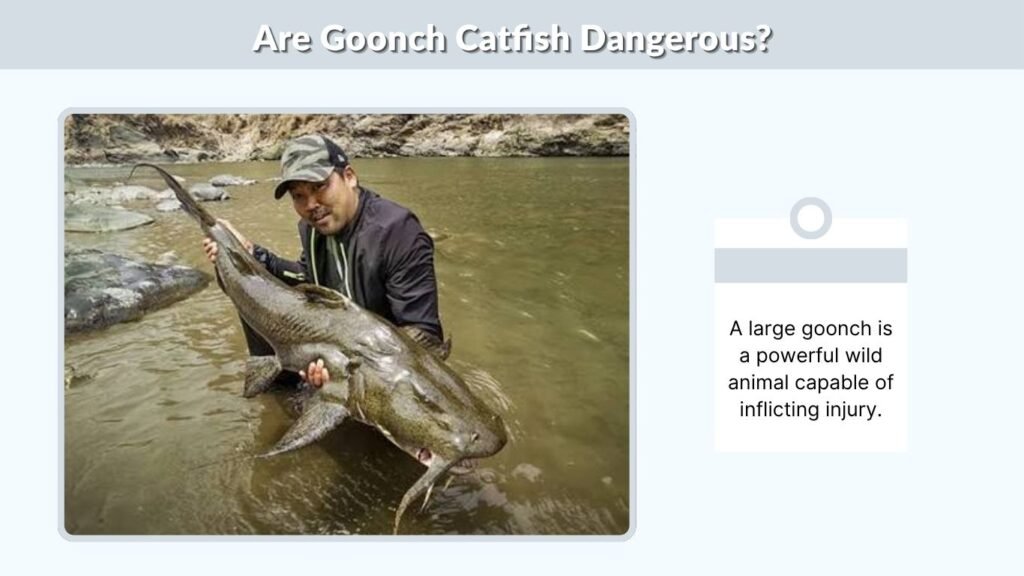
A large goonch is a powerful wild animal capable of inflicting injury. However, there is an important difference between being physically capable of harming someone and deliberately hunting humans.
Stories from the Kali River claimed that giant goonch developed a taste for human flesh after consuming remains from riverside funeral practices. These accounts became internationally famous through documentaries and the television program River Monsters.
Do Goonch Catfish Eat Humans?
There is no strong scientific evidence demonstrating that goonch catfish routinely attack, kill or consume living humans. Reported disappearances and drowning incidents did not provide enough physical evidence to identify a fish as the cause.
A goonch may scavenge animal or human remains if available, as many large opportunistic fish do. That does not prove that it actively hunts people.
Nevertheless, swimmers should be cautious in unfamiliar fast rivers because of currents, submerged rocks, deep pools, crocodiles and other hazards. A very large fish could bite defensively if cornered, hooked or handled.
Goonch Catfish in River Monsters
The goonch gained worldwide attention after angler and presenter Jeremy Wade investigated reported attacks in the Kali River along the India–Nepal border.
The episode presented the possibility that an unusually large catfish was connected to local deaths. Wade eventually caught a substantial goonch, confirming that large specimens lived in the river. However, catching a large predator did not prove that it had killed or eaten anyone.
The program transformed the goonch into one of the world’s best-known “monster fish,” but the human-eating theory remains speculative.
Can Goonch Catfish Live in an Aquarium?
Juvenile goonch catfish occasionally appear for sale, including ordinary, golden, platinum and albino-looking varieties. Their small sale size can be misleading.
A full-grown goonch is unsuitable for a normal home aquarium. It requires an enormous custom system, indoor pond or public aquarium with exceptional filtration.
Aquarium Requirements
A suitable enclosure needs substantial floor space because the fish spends most of its time near the bottom. Powerful pumps are required to produce clean, highly oxygenated, moving water.
Provide large smooth rocks and secure structures without narrow spaces where the fish could become trapped. All decorations must be heavy enough to resist being displaced.
FishBase reports tropical conditions around 18–25°C, with neutral to slightly alkaline water documented for the species. Stable temperature and excellent oxygenation are more important than attempting to recreate one exact measurement.
Tank Mates
Most fish are unsuitable tank mates. Smaller individuals may be eaten, while similarly large bottom dwellers can be attacked during territorial disputes.
Even a young goonch can become aggressive as it grows. Keeping one with expensive ornamental fish is highly risky.
Platinum, Golden and Albino Goonch Catfish
Platinum, golden and albino goonch are unusual color forms sold by specialist exotic-fish dealers. These names do not normally represent separate species.
A platinum fish may appear pale cream or silvery, while a golden specimen has yellow or orange coloration. True albino fish generally lack dark pigment and may have pinkish or reddish eyes.
Rare coloration does not produce a smaller or easier fish. These specimens retain the same demanding care requirements, predatory behavior and growth potential as normally colored goonch.
Conservation Status
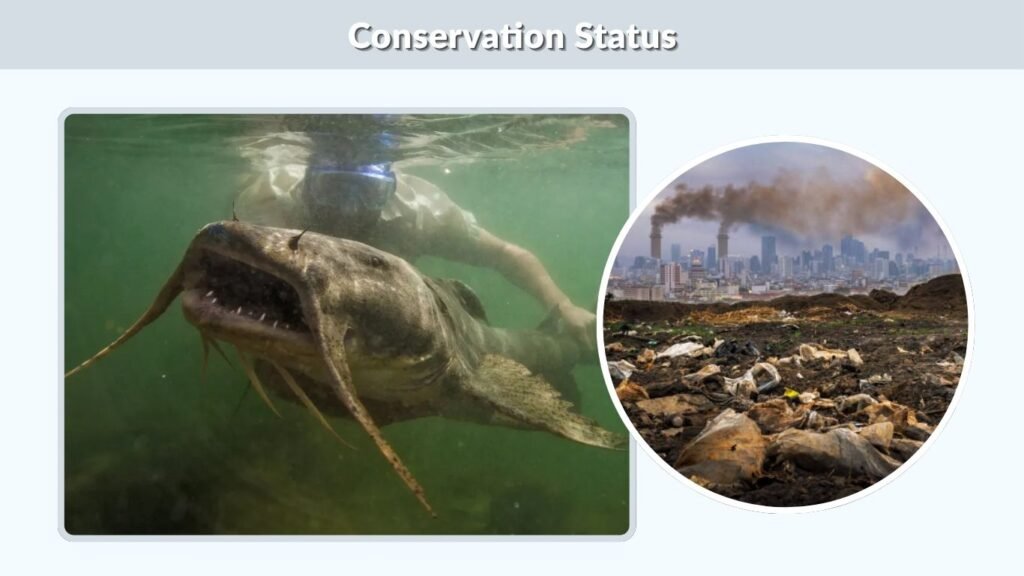
Wild goonch populations face pressure from overfishing, destructive fishing practices, dams, river modification, pollution and habitat fragmentation. Research focusing on Bangladesh reports substantial declines and describes the fish as critically endangered nationally.
Large river predators often mature slowly and occur at lower densities than smaller fish. Removing breeding-size adults can therefore have long-lasting effects on local populations.
FAQs
What is a goonch catfish?
A goonch is a large predatory catfish belonging to the genus Bagarius. It inhabits major rivers of the Indian subcontinent and has a broad head, mottled body, long barbels, strong fins and sharp teeth adapted for capturing prey in fast-flowing water.
What is the biggest goonch catfish ever caught?
Various enormous catches have been reported, but there is no universally accepted sport-fishing world record supported by consistent certified documentation. FishBase lists a maximum reported length of approximately 230 centimetres, although most captured specimens are much smaller.
Can a goonch catfish eat a human?
A very large goonch could scavenge human remains, but there is no convincing scientific proof that the species regularly hunts or consumes living people. The famous man-eating stories are based mainly on local reports, speculation and television investigations.
How long do goonch catfish live?
Their exact maximum lifespan is not well documented. As a large, slow-growing river fish, a goonch may potentially live for several decades under favorable conditions. However, reliable long-term studies and verified captive lifespan records are limited.
Can you buy a goonch catfish?
Juveniles are occasionally sold by specialist exotic-fish dealers, sometimes as platinum, golden or albino forms. Buyers should avoid purchasing one unless they can provide a public-aquarium-scale enclosure, powerful filtration, high oxygen levels and long-term professional care.