
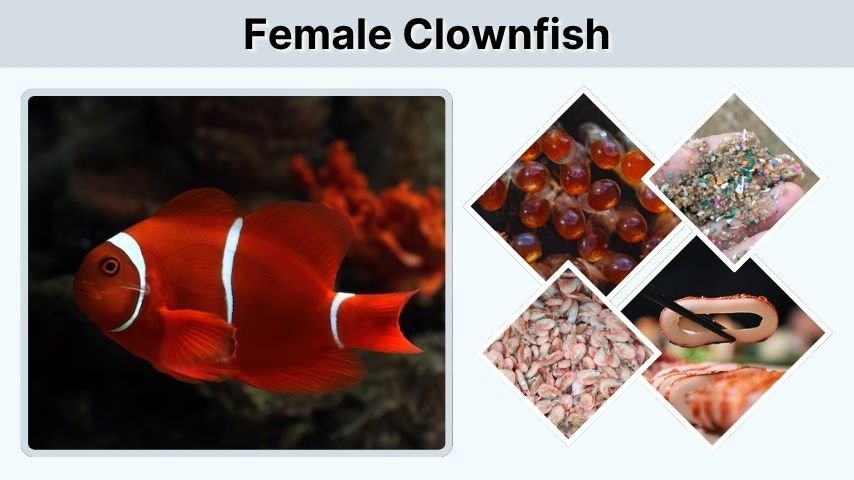
Female clownfish defend by using bold territorial behavior, chasing, nipping, body blocking, and staying close to their host anemone or chosen nesting site. In a clownfish pair, the female is usually larger, dominant, and more aggressive than the male. She helps protect the territory, while the male often performs more direct egg care after spawning. This behavior is normal in both wild reefs and aquariums.
What Is a Female Clownfish?
A female clownfish is the dominant breeding fish in a clownfish pair or group. In clownfish society, size and rank are very important. The largest fish becomes the female, the next largest usually becomes the breeding male, and smaller fish remain lower-ranking juveniles or non-breeding males.
Clownfish are known for a special reproductive system called protandrous sequential hermaphroditism. This means they start life functionally male and can later change into female if the social group needs a new dominant female. Scientific literature describes clownfish as sequential hermaphrodites that change sex from male to female, not the other way around.
How Do Female Clownfish Defend Themselves?
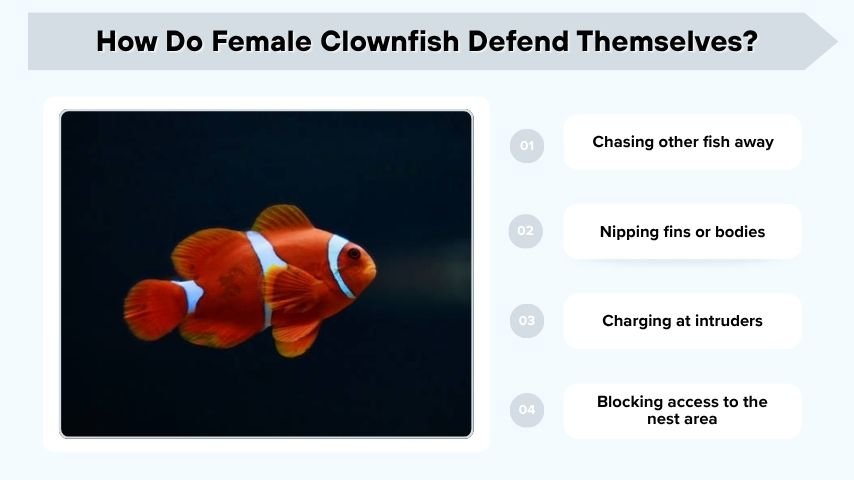
Female clownfish defend themselves mostly through territorial aggression and by staying near protective shelter. In the wild, this shelter is usually a sea anemone. In aquariums, it may be an anemone, coral, rock, flowerpot, corner, powerhead, or another chosen territory.
A female clownfish may defend by:
- Chasing other fish away
- Nipping fins or bodies
- Charging at intruders
- Blocking access to the nest area
- Spreading fins to look larger
- Staying close to the anemone or eggs
- Pushing the male or smaller clownfish into place
- Attacking hands, tools, or fish that come too close
This behavior can look intense, especially in a small aquarium. A female clownfish may bite an aquarist’s hand during cleaning if she feels her territory or eggs are threatened.
Why Are Female Clownfish So Defensive?
Female clownfish are defensive because their survival and breeding success depend on keeping a safe territory. In the wild, clownfish live closely with host anemones, which offer protection from many predators. In return, clownfish defend their small home area and maintain their place in the social group.
The female is the most dominant member of the group. She has to protect her territory, maintain control over the male and any smaller clownfish, and guard the breeding area. This is why female clownfish are often more aggressive than males.
Defense becomes stronger when:
- The pair is breeding
- Eggs are present
- Another clownfish enters the territory
- A new fish is added to the tank
- The tank is too small
- The female has claimed an anemone or coral
- A hand or cleaning tool enters the nesting area
Female Clownfish Defense Behaviors
Female clownfish use several clear warning and defense behaviors. Some are harmless displays, while others can lead to injury if tank mates cannot escape.
| Defense Behavior | What It Looks Like | What It Means |
|---|---|---|
| Chasing | Female swims quickly after another fish | Territory defense or dominance |
| Nipping | Small bites at fins or body | Warning or aggression |
| Body blocking | Female blocks access to an area | Protecting nest or host site |
| Charging | Sudden rush toward intruder | Strong warning display |
| Biting hands | Attacks during tank cleaning | Defensive response |
| Staying near eggs | Female patrols close to nest | Breeding protection |
| Pushing male | Female chases or nudges male | Pair hierarchy behavior |
How Do Female Clownfish Defend Their Eggs?
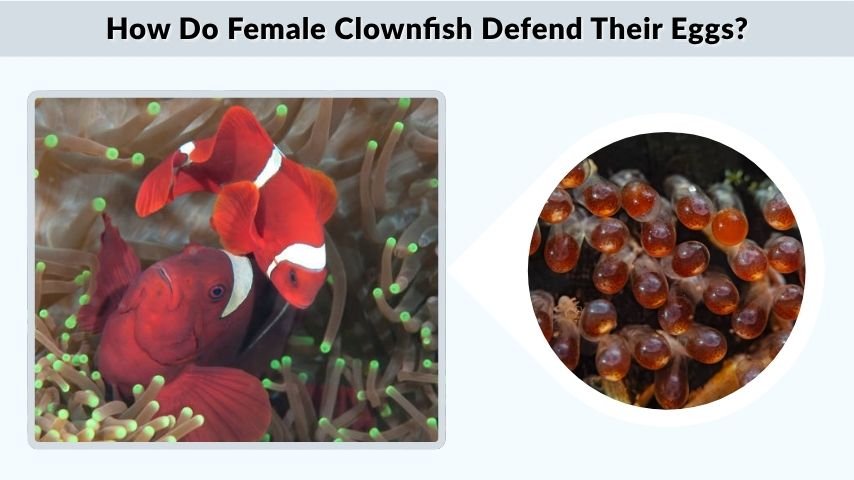
Female clownfish help defend the nesting area, but the male usually does much of the direct egg care. After the female lays eggs and the male fertilizes them, the male often fans the eggs, cleans them, and removes unhealthy eggs. The female stays nearby and helps protect the territory from threats. Aquarium breeding guides often describe the male as the more active egg caretaker, while the female plays a stronger territorial role.
A female clownfish may become more aggressive after spawning. She may chase other fish, guard the area, and attack anything that comes close to the egg clutch. In an aquarium, this can include peaceful tank mates or the owner’s hand.
Do Female Clownfish Eat Their Eggs?
Female clownfish can eat their eggs, but it is not always the female. Either parent may eat eggs under certain conditions. Egg eating often happens when eggs are infertile, fungus-infected, damaged, stressed, or unlikely to survive.
Common reasons clownfish eat their eggs include:
- First-time breeding pair behavior
- Poor water quality
- Infertile eggs
- Fungus on eggs
- Stress from tank mates
- Too much disturbance near the nest
- Weak parents or poor nutrition
- Sudden changes in lighting or water conditions
Sometimes new breeding pairs eat early clutches before learning proper care. If the pair is healthy and the environment is stable, they may improve with later spawns.
Why Is My Female Clownfish Chasing the Male?
A female clownfish chasing the male is often normal dominance behavior. The female is the boss of the pair. She may chase, nip, or push the male to maintain the hierarchy.
In a stable pair, this chasing is usually brief. The male may submit by twitching, turning sideways, or moving away. This submissive behavior helps reduce conflict.
However, chasing can become a problem if the male is constantly hiding, has torn fins, stops eating, or cannot escape. In that case, the tank may be too small, the pair may be incompatible, or the female may be overly aggressive.
Are Female Clownfish Bigger Than Males?
Yes, female clownfish are usually bigger than males. In a pair, the larger dominant fish becomes female, while the smaller fish remains male. This size difference is one of the easiest ways to tell male and female clownfish apart.
Female clownfish may also look broader or heavier-bodied, especially when mature or carrying eggs. Males are usually smaller, less aggressive, and more involved in egg tending after spawning.
Male vs Female Clownfish
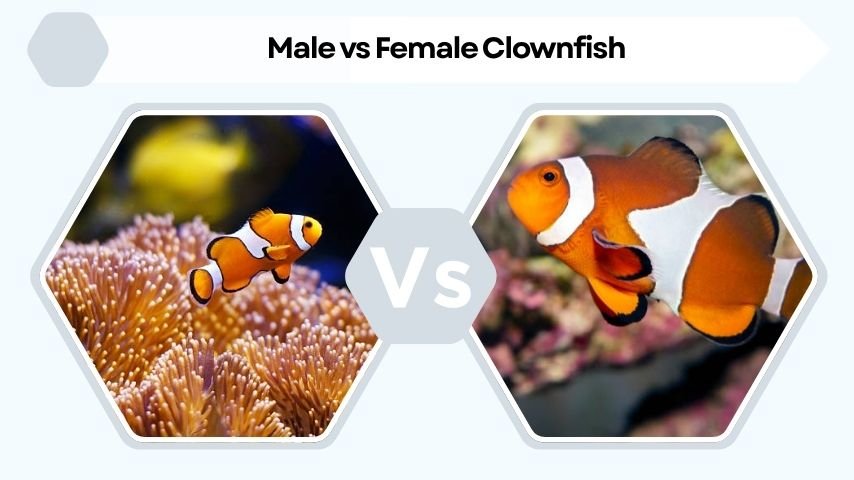
Male and female clownfish can look very similar, especially when young. Behavior and size are often more useful than color.
| Feature | Female Clownfish | Male Clownfish |
|---|---|---|
| Size | Usually larger | Usually smaller |
| Rank | Dominant fish | Second-ranking fish |
| Aggression | More territorial | Usually less aggressive |
| Egg role | Lays eggs and guards territory | Fertilizes and tends eggs |
| Sex change ability | Does not change back to male | Can become female |
| Pair behavior | May chase or nip male | Often submits or twitches |
| Defense role | Strong territory defender | Helps guard and care for eggs |
Do Male Clownfish Become Female?
Yes, male clownfish can become female. When the dominant female dies or is removed, the largest male may change into a female. Then the next-ranking fish may become the breeding male.
This process helps clownfish maintain a breeding pair in a small territory. Instead of leaving the safety of the anemone to find a new mate, the social group reorganizes. Research on clownfish sex change describes this as a male-to-female transition controlled by social structure and reproductive hierarchy.
Can a Female Clownfish Turn Into a Male?
No, a female clownfish does not normally turn back into a male. Clownfish sex change is one-directional: male to female. Once a clownfish becomes female, it generally remains female.
This is important for aquarium keepers. If you place two established female clownfish together, they will not simply adjust by one turning male. Instead, they may fight severely because both are dominant females.
Are All Clownfish Born Female?
No, clownfish are not born female. They begin life as immature fish and develop within a social hierarchy. In practical aquarium terms, clownfish are often described as starting male and later changing to female if they become the dominant fish.
The largest fish in a group becomes female. The second-largest becomes male. Smaller fish remain immature or non-breeding until the hierarchy changes.
What Happens When the Female Clownfish Dies?
When the female clownfish dies, the dominant male can change into a female. If there are smaller clownfish in the group, the largest of them may become the new breeding male.
In the wild, this system is useful because clownfish do not need to abandon their anemone to find a new female. The group can form a new breeding pair from within its existing hierarchy.
In an aquarium, if a female dies and only one male remains, that male may eventually become female. If you later add a much smaller juvenile clownfish, the larger fish may become or remain female, while the smaller fish becomes male.
How to Tell If a Clownfish Is Male or Female
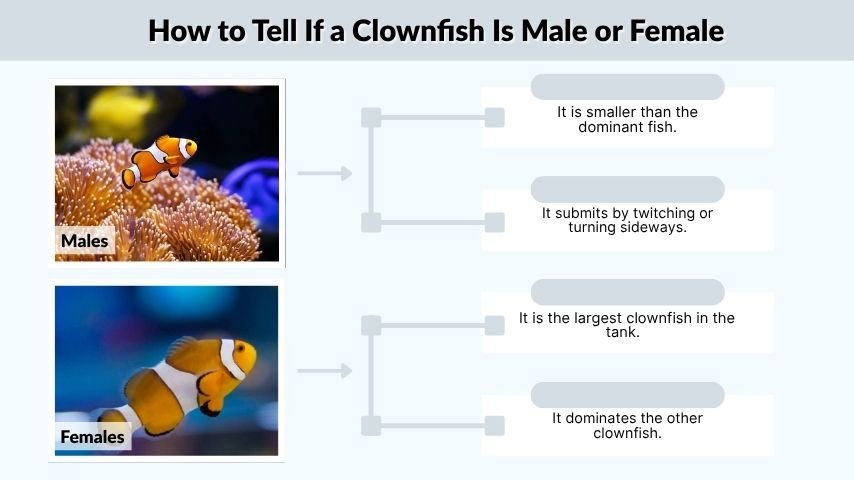
The easiest way to tell male and female clownfish apart is by looking at size and behavior. The female is usually the larger, more dominant fish. She may chase the male, defend the territory, and become more aggressive during breeding.
A male is usually smaller and more submissive. He may twitch or shake in front of the female, which is a common submission display. During breeding, he often spends more time cleaning and fanning the eggs.
Signs Your Clownfish Is Female
- It is the largest clownfish in the tank.
- It dominates the other clownfish.
- It chases or nips the smaller fish.
- It guards a territory strongly.
- It may become aggressive near eggs.
- It does not show submissive twitching as often.
Signs Your Clownfish Is Male
- It is smaller than the dominant fish.
- It submits by twitching or turning sideways.
- It avoids direct fights with the female.
- It helps clean the nesting site.
- It may fan and tend eggs after spawning.
Can You Keep Two Female Clownfish Together?
Keeping two female clownfish together is risky. Since female clownfish are dominant and territorial, two females may fight until one is badly injured or killed. They do not switch back to male to form a peaceful pair.
If you want a clownfish pair, the safer method is to keep one larger clownfish with a much smaller juvenile. The larger fish will usually become or remain female, and the smaller one will become male.
Avoid adding two large clownfish of similar size unless they are already a bonded pair.
Female Clownfish Laying on Side: Is It Normal?
A female clownfish laying on her side can be normal or concerning depending on context. Clownfish sometimes sleep in odd positions, especially near their chosen host area. They may rest sideways near a corner, rock, coral, or anemone.
However, laying on the side can also signal stress or illness if the fish is breathing heavily, not eating, has clamped fins, has white spots, or cannot swim normally.
Check water quality first. Ammonia and nitrite should be zero. Also check salinity, temperature, pH, and nitrate. If the fish looks sick, consider quarantine and treatment.
How to Reduce Female Clownfish Aggression
Female clownfish aggression cannot be removed completely because it is natural behavior. However, you can reduce stress and injury risk.
Try these steps:
- Provide enough tank space.
- Avoid adding similar-sized clownfish.
- Keep only a bonded pair unless the tank is large.
- Add hiding places and rock structure.
- Avoid disturbing eggs.
- Feed a balanced diet.
- Do not overcrowd the tank.
- Remove bullied fish if injuries appear.
If a female clownfish attacks your hand during maintenance, use tools carefully and avoid cleaning directly over the nest when eggs are present.
What Do Female Clownfish Eat?
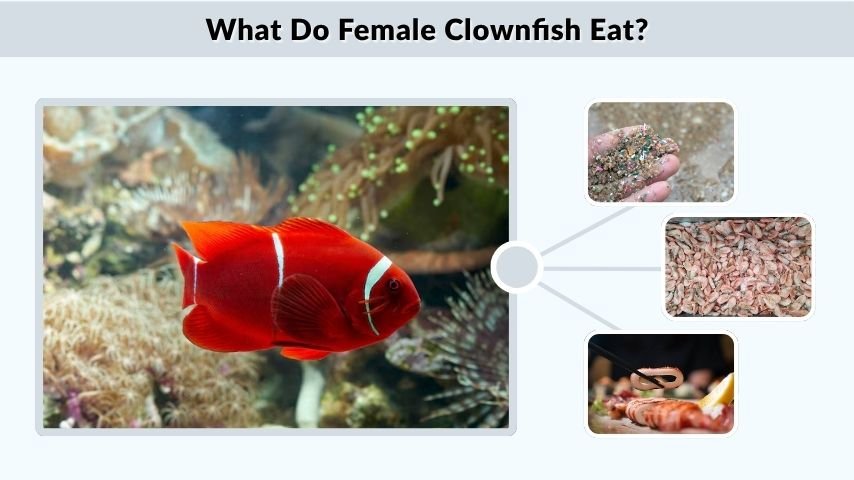
Female clownfish eat the same foods as males. They are omnivores and should receive a varied marine diet. Good foods include marine pellets, flakes, frozen mysis shrimp, brine shrimp, chopped seafood, copepods, and algae-based foods.
A breeding female needs excellent nutrition because egg production uses energy. Poor diet can lead to weak eggs, poor spawning results, or egg eating.
FAQs
How do female clownfish defend themselves?
Female clownfish defend by chasing, nipping, charging, body blocking, and guarding their host area or nest site. They are usually the largest and most dominant fish in the pair, so they take a strong role in protecting territory from other fish, hands, or aquarium tools.
Do male clownfish become female?
Yes, male clownfish can become female. If the dominant female dies or is removed, the largest male can change into the new female. This male-to-female sex change is part of clownfish social hierarchy and helps maintain a breeding pair.
Can a female clownfish turn into a male?
No, a female clownfish does not normally turn back into a male. Clownfish sex change goes one way: male to female. This is why keeping two established female clownfish together can lead to serious fighting instead of pairing.
Do female clownfish eat their eggs?
Female clownfish may eat eggs, but males can also do it. Egg eating often happens when eggs are infertile, damaged, infected, or when the pair is stressed. New breeding pairs may eat early clutches before they become better parents.
How can you tell if a clownfish is male or female?
The female is usually the larger, more dominant fish. She may chase the male and defend territory. The male is usually smaller, more submissive, and may twitch in front of the female. During breeding, the male often tends the eggs more directly.