
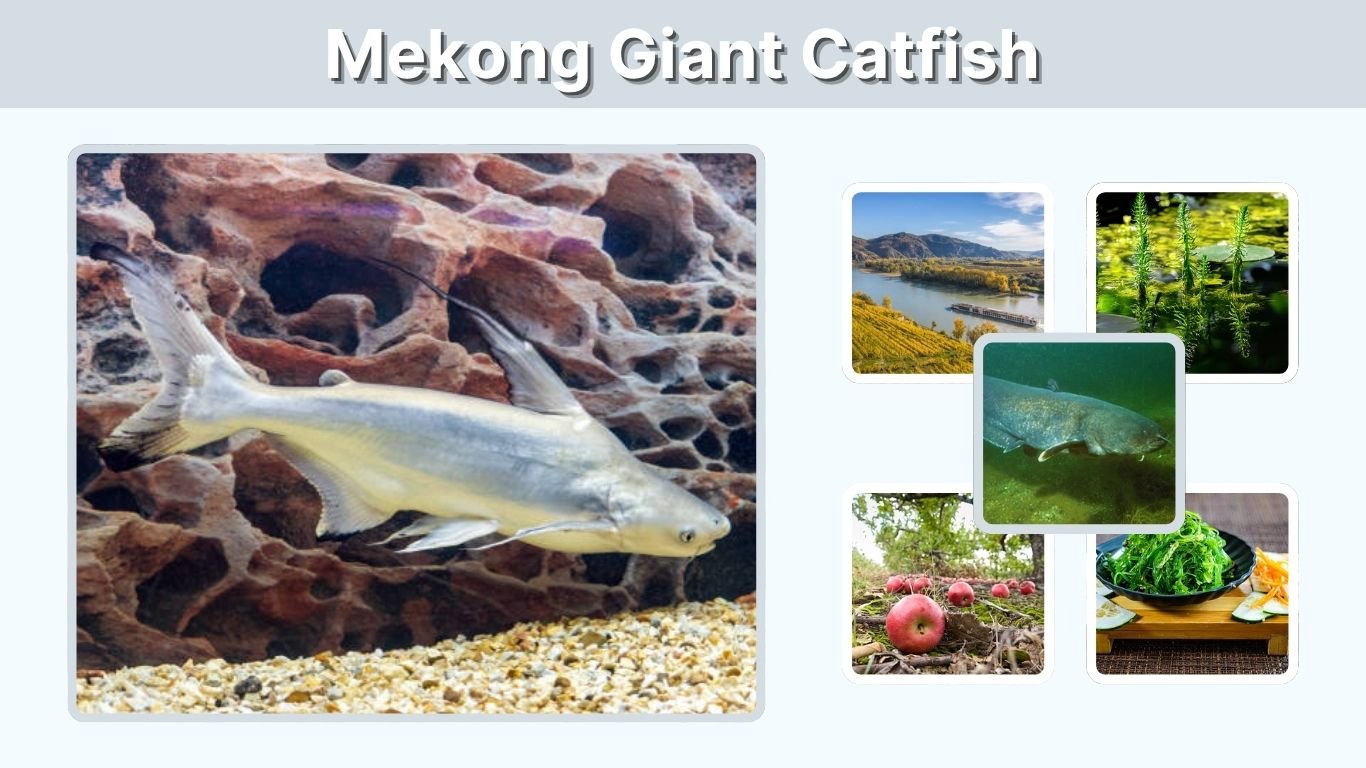
The Mekong giant catfish is one of the world’s largest freshwater fish. Known scientifically as Pangasianodon gigas, this enormous, mostly toothless catfish is native only to Southeast Asia’s Mekong River basin. Adults can approach 10 feet in length and weigh hundreds of pounds, yet they primarily consume algae, plant material, and detritus. Despite its extraordinary size, the species is not considered dangerous to people. Unfortunately, overfishing, river development, habitat loss, and blocked migration routes have pushed it close to extinction.
Mekong Giant Catfish Overview
The Mekong giant catfish belongs to the Pangasiidae family, commonly called shark catfishes. Its broad head, smooth body, small eyes, and deeply forked tail create a powerful but streamlined appearance.
| Feature | Details |
| Scientific name | Pangasianodon gigas |
| Family | Pangasiidae |
| Habitat | Large freshwater rivers |
| Native range | Mekong River basin |
| Maximum length | Around 10 feet |
| Verified record weight | 646 pounds |
| Adult diet | Primarily algae and plant matter |
| Conservation status | Critically Endangered |
The species is endemic to the Mekong basin and has become rare throughout much of its former range.
Mekong Giant Catfish Identification
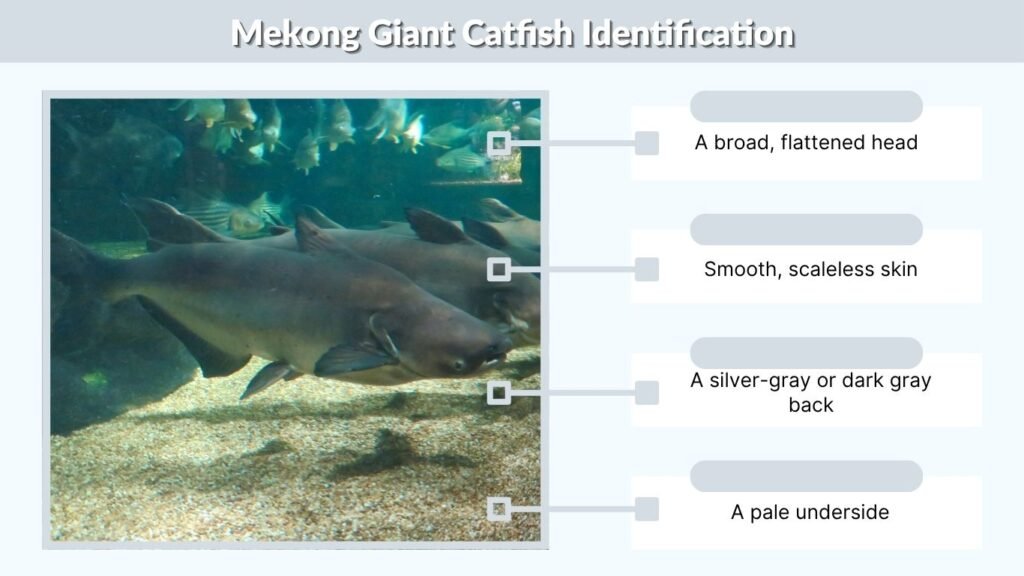
Unlike many familiar catfish, mature Mekong giant catfish have almost no visible barbels or whiskers. Adults also lose the functional teeth present during their early development.
Adult Appearance
A full-grown fish typically has:
- A broad, flattened head
- Smooth, scaleless skin
- A silver-gray or dark gray back
- A pale underside
- Small, low-positioned eyes
- A deeply forked tail
- Short fins without long filaments
- Few visible barbels
- No functional teeth
The body is thick and elongated, becoming especially deep around the head and shoulders. Adults can be distinguished from other large Mekong catfish by their lack of teeth and near absence of barbels.
Baby and Juvenile Appearance
Young Mekong giant catfish differ noticeably from adults. Juveniles have more developed barbels, teeth, and gill structures that gradually become reduced as the fish grows.
Their eyes also appear higher relative to the mouth. As the fish matures, the eyes seem lower on the head, the barbels shrink, and the teeth disappear.
How Big Is the Mekong Giant Catfish?
The Mekong giant catfish is among the heaviest exclusively freshwater fish ever documented. FishBase reports a maximum length of approximately 3 metres, although it notes that this figure requires confirmation. A maximum published weight of 350 kilograms is also listed.
Average and Full-Grown Size
Most individuals encountered today are smaller than the historic giants. However, mature fish can still exceed 6 feet and weigh more than 200 pounds.
The species grows exceptionally quickly under suitable conditions. Some individuals may reach approximately 150–200 kilograms within six years, although growth depends on food, habitat, water conditions, and population health.
The 646-Pound Mekong Giant Catfish
In June 2005, fishers in northern Thailand captured an enormous female weighing 293 kilograms, or 646 pounds. It measured approximately 2.7 metres, or 8 feet 11 inches.
The fish was recognized as the largest exclusively freshwater fish specimen documented at that time. It remained the best-known freshwater heavyweight record until a 300-kilogram giant freshwater stingray captured in Cambodia received the broader record in 2022. Therefore, the 646-pound catfish is now a former world-record holder, not the current record holder.
Mekong Giant Catfish Habitat
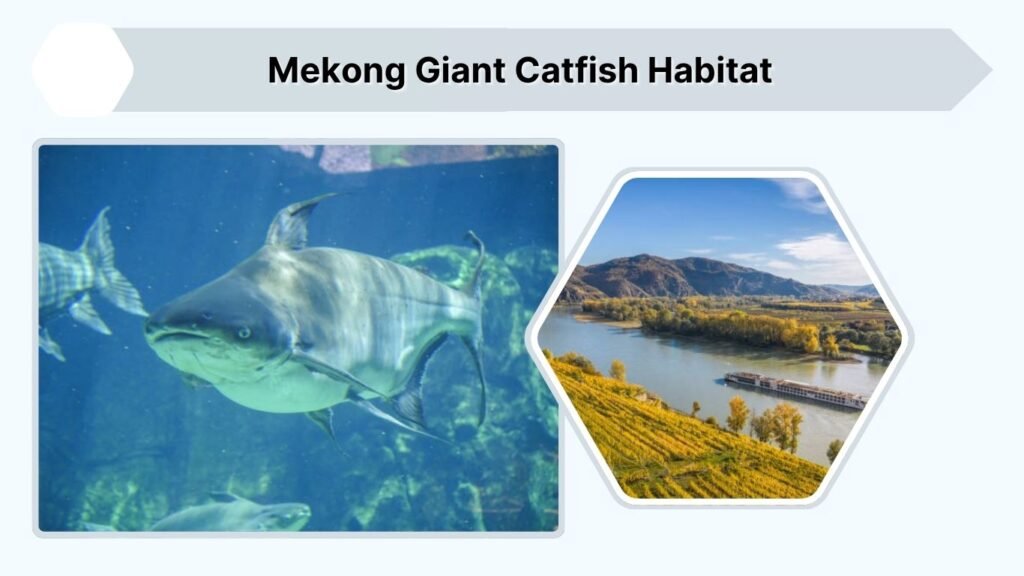
This species lives in the main channels of medium and large rivers. It is strongly associated with the Mekong River system and depends on connected habitats that allow long seasonal movements.
Natural Range
Historically, Mekong giant catfish occurred along extensive parts of the river, from Vietnam and Cambodia through Laos and Thailand toward southern China.
Its present distribution is much more restricted and poorly understood. Rare captures are still reported in Cambodia, Thailand, and sections of the wider Mekong system.
Migration and Spawning Habitat
The Mekong giant catfish is a migratory freshwater species. It travels through river channels in response to seasonal water changes, feeding opportunities, and breeding needs.
Exact spawning grounds and migration routes remain incompletely understood. Researchers believe that rapids, deep pools, floodplains, and free-flowing river sections may all be important at different life stages. Dams and other barriers can prevent fish from reaching essential breeding and feeding areas.
What Do Mekong Giant Catfish Eat?

Despite their intimidating size, adult Mekong giant catfish are primarily herbivorous. They feed near the river bottom rather than hunting large animals.
Adult Diet
Their natural food includes:
- Algae
- Aquatic plants
- Detritus
- Organic material
- Plant matter from flooded forests
- Fallen fruit during high-water periods
Adults graze along the riverbed and consume available vegetation. FishBase reports that they may feed heavily on fruit when seasonal flooding gives them access to flooded forests.
Juvenile Diet
Young fish may consume a somewhat broader range of food while their teeth and gill structures are still present. Their feeding anatomy changes as they grow, eventually becoming adapted to a mainly plant-based adult diet.
Mekong giant catfish raised in captivity may accept foods they would not normally consume in the wild. Captive feeding behavior should therefore not be treated as a perfect representation of their natural diet.
Are Mekong Giant Catfish Dangerous?
Mekong giant catfish are not known as aggressive fish and do not normally attack people. Mature individuals lack functional teeth and primarily consume plant material.
Their huge weight and muscular bodies could cause accidental injury if a captured or stranded fish struggled beside a boat. However, they are not active human predators, and stories describing deliberate Mekong giant catfish attacks are unsupported.
Mekong Giant Catfish Behavior
Much of the species’ natural behavior remains mysterious because the fish is rare, migratory, and difficult to observe in the Mekong’s deep, murky water.
Movement and Feeding
Adults are believed to spend much of their time in large river channels, moving between feeding, refuge, and spawning habitats. Seasonal water levels likely influence when and where they travel.
The fish can also grow rapidly, an adaptation that may help young individuals become too large for many predators within a relatively short period.
Breeding
Wild breeding behavior has rarely been observed directly. The fish is believed to migrate toward suitable upstream spawning areas before releasing eggs into the water.
Because spawning grounds remain poorly documented, protecting the entire connected river system is important. Saving one isolated stretch may not be enough if adults cannot complete their migration.
Mekong Giant Catfish Lifespan
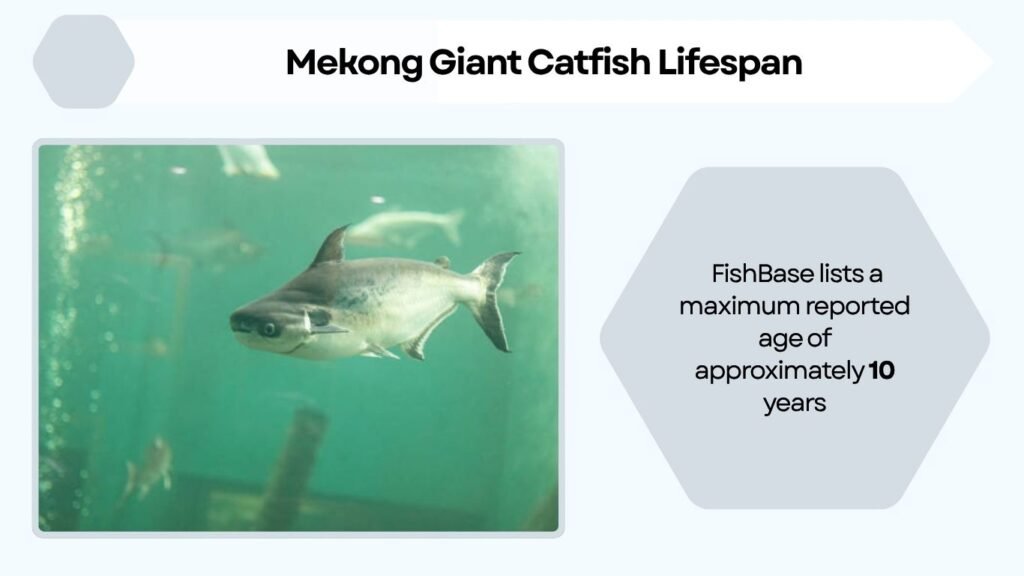
The exact natural lifespan is uncertain. FishBase lists a maximum reported age of approximately 10 years, but the rarity of the species and limited long-term tracking make it difficult to establish a dependable maximum lifespan.
Large size does not automatically prove that the fish lives for many decades. More tagging, age analysis, and long-term observation are needed to understand how long wild individuals survive.
Why Is the Mekong Giant Catfish Endangered?
The Mekong giant catfish is classified as Critically Endangered, and WWF identifies it as a CITES Appendix I species. Its population has experienced a severe long-term decline, although the exact number remaining in the wild is unknown.
Main Threats
The species faces several connected pressures:
- Historic overfishing
- Accidental capture in fishing gear
- Dam construction
- Blocked migration routes
- Loss of spawning habitat
- Altered river flows
- Destruction of rapids
- Pollution and habitat degradation
- Climate-related changes in water patterns
Large migratory fish are particularly vulnerable because they depend on habitats located far apart. A barrier in one section of the river can interrupt an entire breeding migration.
How Many Are Left?
No reliable total population figure is available. The fish occupies a vast river system, spends time in deep water, and is rarely observed, making a precise count extremely difficult.
There have been encouraging signs. In December 2024, six rare individuals were caught, measured, tagged, and released in Cambodia within five days. Researchers described the event as unusual and potentially hopeful, although it did not prove that the overall population had recovered.
Can Mekong Giant Catfish Live in an Aquarium?
Mekong giant catfish are unsuitable for private home aquariums. Their enormous adult size, rapid growth, strong swimming ability, and migratory nature require far more space than a conventional fish tank can provide.
Some large public facilities and managed fishing lakes keep captive-bred individuals. However, buying one as an ordinary pet raises serious welfare, conservation, and legal concerns. The species’ CITES Appendix I status means international commercial trade is highly restricted.
Mekong Giant Catfish vs Wels Catfish
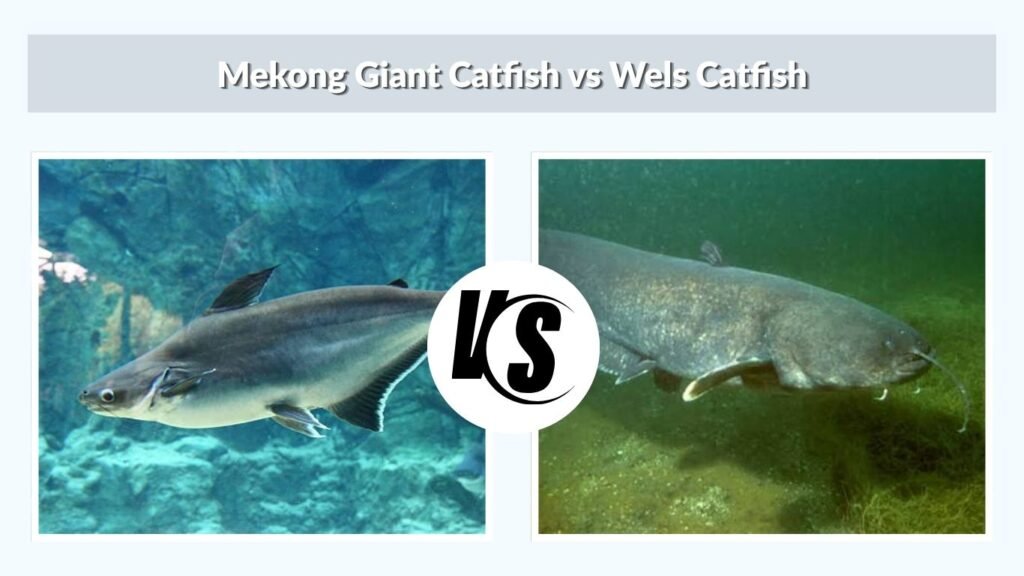
Both are enormous freshwater catfish, but they differ greatly in diet, appearance, and distribution.
| Feature | Mekong Giant Catfish | Wels Catfish |
| Scientific name | Pangasianodon gigas | Silurus glanis |
| Native region | Mekong basin | Europe and western Asia |
| Diet | Mainly plant matter | Predatory carnivore |
| Teeth | Adults lack functional teeth | Numerous small teeth |
| Barbels | Nearly absent in adults | Long, prominent barbels |
| Body shape | Deep and streamlined | Long and broad-headed |
| Conservation concern | Critically Endangered | Generally widespread |
The Wels catfish actively eats fish and other animals. The Mekong giant catfish, despite reaching a comparable size, is primarily a plant-eating river grazer.
FAQs
Is the Mekong giant catfish the world’s largest freshwater fish?
It was the former record holder based on the 646-pound specimen caught in Thailand in 2005. A 661-pound giant freshwater stingray documented in Cambodia in 2022 later received the record for the largest freshwater fish specimen.
Does the Mekong giant catfish have teeth?
Small juveniles initially possess teeth, but these structures disappear as they grow. Adults are essentially toothless and feed mainly on algae, detritus, vegetation, and other plant material rather than hunting large animal prey.
Can a Mekong giant catfish eat a person?
No. It is not a human-eating predator. Adults lack functional teeth and primarily consume vegetation. Its size makes it physically powerful, but there is no credible evidence that Mekong giant catfish deliberately hunt or consume people.
What are the predators of Mekong giant catfish?
Young fish may be vulnerable to larger predatory fish and other aquatic animals. A healthy full-grown individual has few natural predators because of its immense size. Human fishing and human-caused habitat changes represent far greater threats to the species.
Why is the Mekong giant catfish important?
It is a flagship species representing the ecological health and connectivity of the Mekong River. Protecting its migration routes and habitats can also benefit many other fish species and the communities that depend on the river’s fisheries.