
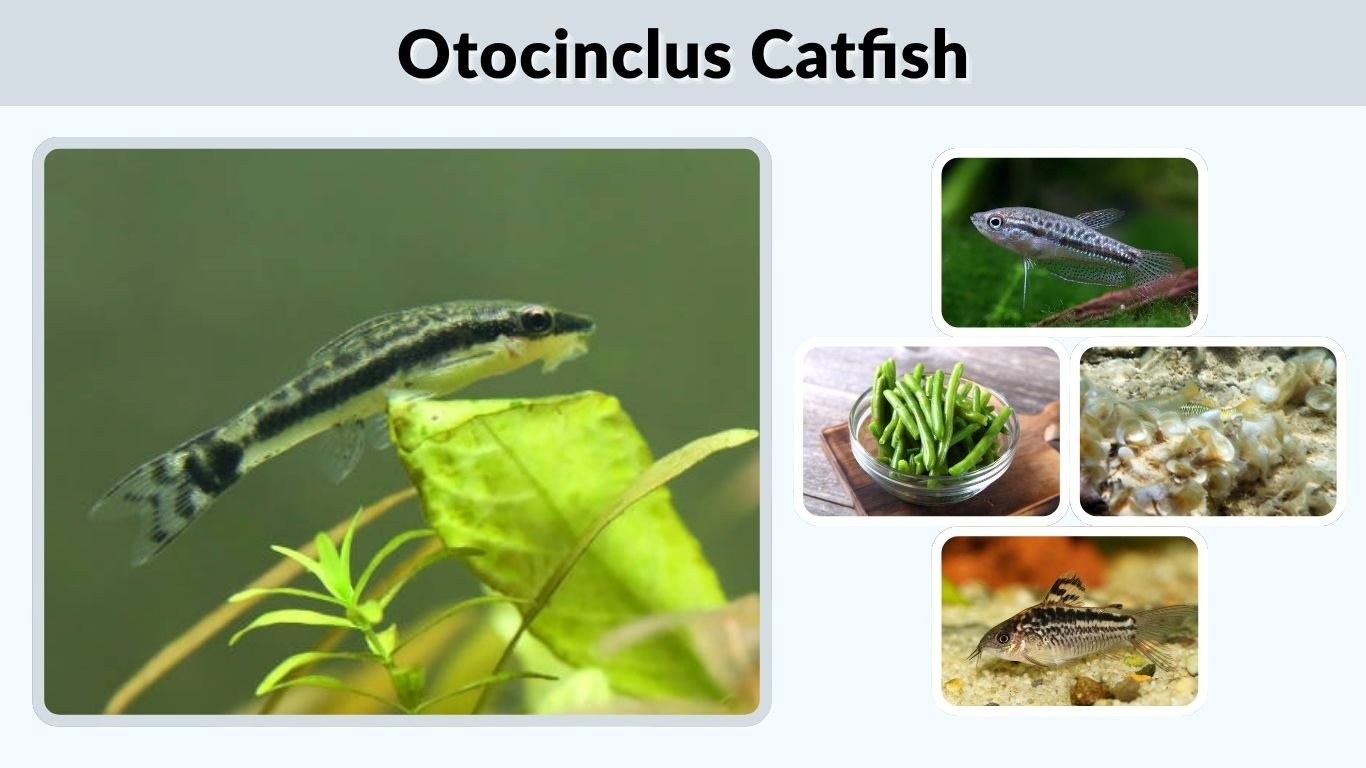
Otocinclus catfish are tiny, peaceful freshwater fish valued for their ability to graze on soft algae and biofilm. Commonly called otos, dwarf suckers, or dwarf suckermouth catfish, they are especially popular in planted community aquariums. However, they are more sensitive than their “cleanup fish” reputation suggests. Otos need a mature aquarium, stable water, peaceful companions, plenty of natural grazing surfaces, and supplemental food. This guide covers Otocinclus size, lifespan, diet, tank requirements, group size, compatible tank mates, breeding, common varieties, and the main reasons newly purchased fish sometimes die.
What Is an Otocinclus Catfish?
Otocinclus is a genus of small, armored catfish belonging to the family Loricariidae. These freshwater fish originate from South America and are closely associated with aquatic vegetation, submerged branches, leaf litter, and other surfaces covered in algae and microorganisms. They are commonly pronounced “oh-toh-SINK-lus.”
Identification
- Small, slender body covered with bony plates
- Underslung, suction-cup-shaped mouth
- Brown, gray, olive, or silvery coloration
- Dark horizontal stripe along each side
- Pale cream or white belly
- Clear or lightly marked fins
- Large eyes positioned near the top of the head
- Frequently rests on glass, plants, rocks, and driftwood
Natural Habitat
Wild Otocinclus inhabit small and medium-sized South American streams, often with moderate water movement. They gather around marginal grasses, fine-leaved aquatic plants, submerged branches, and sandy areas containing leaf litter. Some wild groups may contain thousands of individuals.
Common Types of Otocinclus
Several species appear in the aquarium trade, and accurately identifying them can be difficult. Common examples include Otocinclus vittatus, O. macrospilus, O. vestitus, O. hoppei, and the striking zebra oto, O. cocama. Many ordinary pet-store otos are sold under incorrect or overly general scientific names.
Otocinclus Size and Lifespan
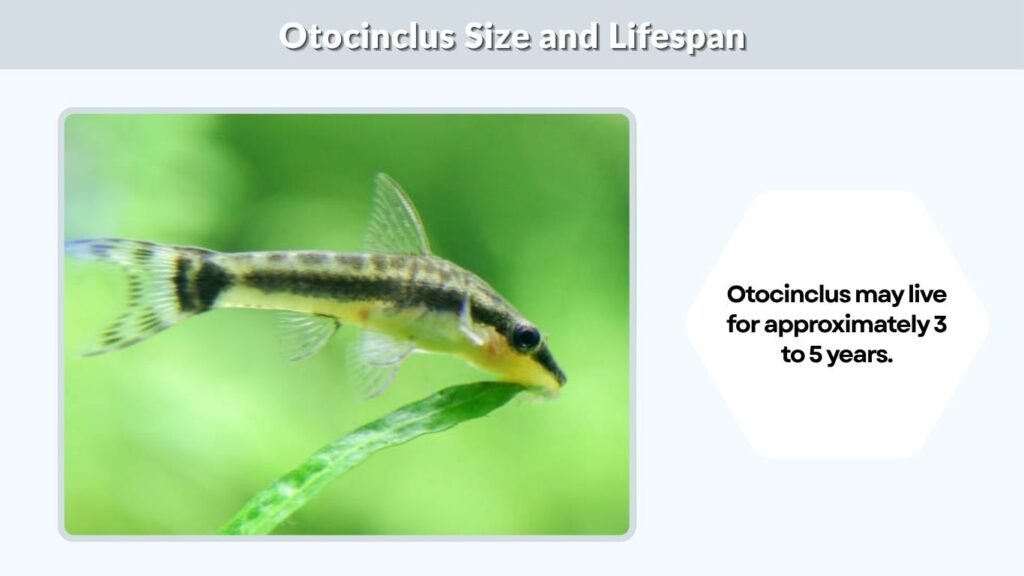
Otos are among the smallest catfish commonly kept in home aquariums. Their compact size makes them suitable for planted community tanks, but small size does not mean they should be placed in an unstable bowl or newly established nano aquarium.
How Big Do Otocinclus Catfish Get?
Most commonly sold Otocinclus reach approximately 1.2 to 2 inches, or 3 to 5 centimeters, when fully grown. Exact adult size depends on the species. Across the genus, known species range from roughly 2.4 to 5.5 centimeters.
How Long Do Otocinclus Live?
A properly maintained Otocinclus may live for approximately three to five years, and some can live longer under excellent conditions. Poor acclimation, starvation, unstable water, and stress frequently shorten their lives, particularly during the first few weeks after purchase.
Otocinclus Tank Size and Water Conditions
The ideal Otocinclus aquarium is mature, planted, well oxygenated, and biologically stable. A new tank may look clean, but it usually lacks the established biofilm and natural microorganisms these fish spend much of the day eating.
| Care requirement | Recommended conditions |
| Practical tank size | 15–20 gallons or larger |
| Temperature | 70–79°F or 21–26°C |
| pH | 6.0–7.5 |
| Ammonia | 0 ppm |
| Nitrite | 0 ppm |
| Water movement | Gentle to moderate |
| Group size | About 4–6 or more |
| Tank age | Fully cycled and mature |
| Temperament | Peaceful and social |
Published care ranges allow some variation, but sudden parameter changes are more dangerous than a stable value near either end of the acceptable range.
Can Otocinclus Live in a 10-Gallon Tank?
A mature 10-gallon aquarium may support a small group when it contains abundant plants, biofilm, supplemental food, gentle filtration, and very few competing fish. However, a 15- or 20-gallon tank is usually safer because it provides more stable water and greater grazing area.
Adding too many otos to a small aquarium can cause food shortages. A smaller number of well-fed fish is healthier than a large group slowly exhausting the tank’s algae and biofilm.
Aquarium Setup
Include live plants, smooth rocks, driftwood, broad leaves, and shaded hiding places. Allow some algae to grow on the side and back panels instead of cleaning every surface. Sponge filters or protected filter intakes are useful, especially if breeding occurs.
Otocinclus can swallow air and absorb oxygen through a specialized digestive structure. Occasional trips to the surface can therefore be natural, but repeated gasping may indicate poor oxygenation or unsafe water conditions.
What Do Otocinclus Catfish Eat?
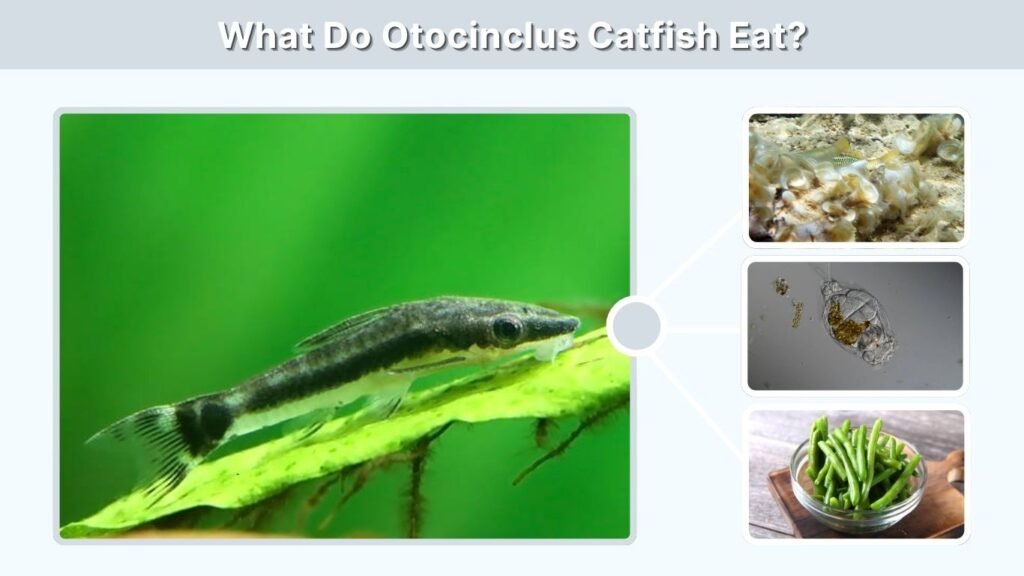
Otocinclus are often described simply as herbivores or algae eaters, but their natural food is more complex. They graze on aufwuchs—the thin biological layer growing on plants, wood, stones, and other submerged surfaces.
Natural Food
Aufwuchs contains soft algae, diatoms, microorganisms, tiny crustaceans, insect larvae, and organic material. Otos continually scrape this layer with their specialized mouths. They generally prefer soft growth and should not be expected to eliminate long hair algae or every type of aquarium algae.
Best Supplemental Foods
Suitable options include sinking algae wafers, spirulina-based foods, softened green beans, blanched zucchini, and gel foods designed for grazing fish. Place food near their preferred surfaces after the aquarium lights dim if faster tank mates steal it.
Different individuals accept different foods, so owners should try several options. Remove uneaten vegetables before they decay. A healthy, well-fed oto normally develops a gently rounded, pearl-like belly rather than a pinched or hollow abdomen.
Do Otocinclus Clean the Entire Aquarium?
No fish should be purchased as a substitute for maintenance. Otos can reduce certain soft algae and biofilm, but they do not remove fish waste, prevent ammonia, clean the substrate completely, or eliminate every algae species. Regular water changes and responsible feeding remain necessary.
Otocinclus Behavior and Group Size
Otos are peaceful, active grazers that rest on leaves, glass, wood, and stones. They may appear inactive for periods before moving rapidly to another feeding surface.
Are Otocinclus Schooling Fish?
Otocinclus naturally live socially and are commonly described as schooling or shoaling fish. A group of about four to six is a reasonable starting point, while larger groups can display more natural behavior in spacious, food-rich aquariums. However, every fish must have sufficient grazing material and supplemental food.
Can You Keep One Otocinclus?
A single oto may survive, but keeping one is not ideal. Solitary fish can become shy or stressed and cannot interact normally with their own kind. Add a suitable group only when the aquarium is mature enough to feed all of them.
Otocinclus Tank Mates
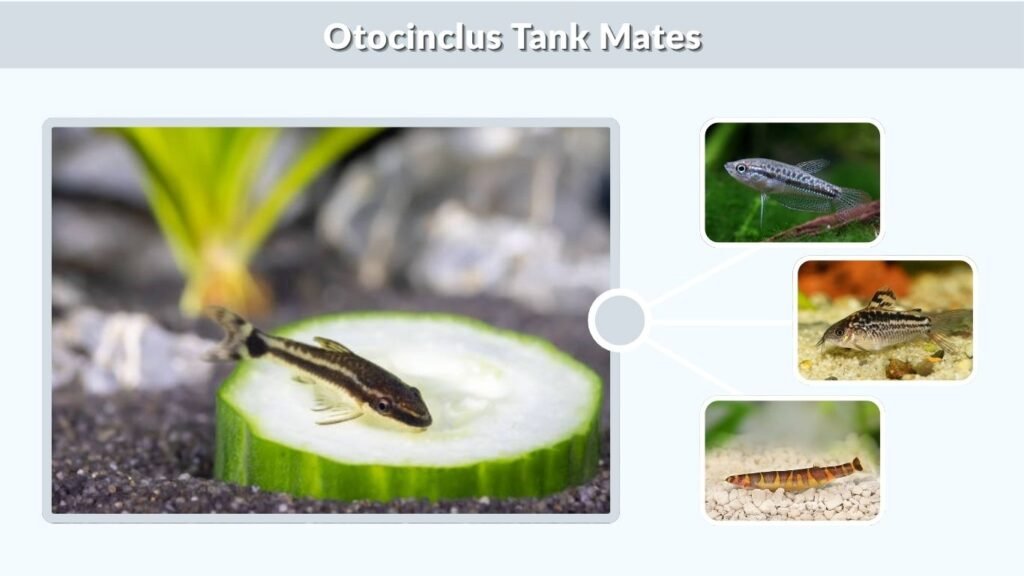
Otocinclus are suitable for peaceful community aquariums. Their companions should tolerate similar water conditions and should not bully them or consume all sinking food before the otos can feed.
Compatible Tank Mates
Good companions include small tetras, rasboras, peaceful livebearers, pygmy gouramis, corydoras, kuhli loaches, snails, Amano shrimp, cherry shrimp, and other nonaggressive fish. Otos generally leave adult and young shrimp alone because they are adapted to grazing rather than hunting.
Can Otocinclus Live With Bettas?
Otos and bettas can share an appropriately sized planted tank when the betta has a calm temperament. The otos should be introduced as a group, and owners must watch for chasing or harassment. A highly territorial betta may not accept them.
Can Otocinclus Live With Goldfish?
They are not recommended with goldfish. Goldfish generally prefer cooler conditions, produce heavy waste, grow much larger, and may outcompete or injure small otos. Their long-term temperature and aquarium requirements are poorly matched.
Otocinclus Breeding
Breeding Otocinclus in captivity is possible but less predictable than breeding many common community fish. Most individuals available commercially have traditionally been collected from the wild.
Male vs. Female Otocinclus
Females are generally broader and larger, particularly when carrying eggs. Males tend to appear slimmer when viewed from above. These differences are subtle, so identifying sex from a single young fish can be difficult.
Eggs and Fry
During spawning, the female places small adhesive eggs on leaves, glass, rocks, or other aquarium surfaces. The adults do not guard the eggs. Hatching may occur in around three days under suitable conditions, although temperature affects development. Fry require extremely small foods, including green water, soft algae, microorganisms, and finely powdered fry food. Gentle sponge filtration prevents them from being pulled into the filter.
Why Do Otocinclus Catfish Die?
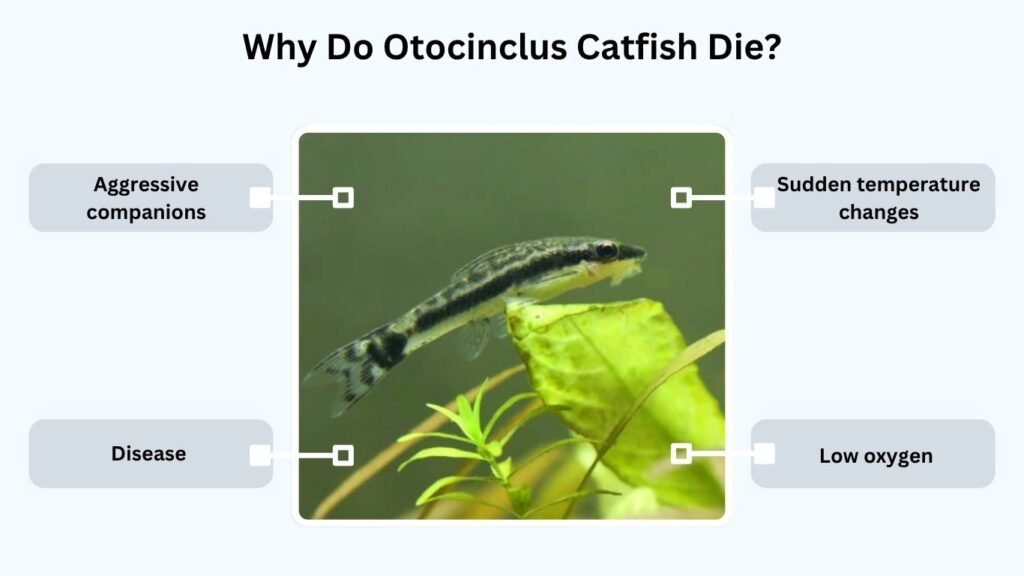
Many losses occur shortly after purchase because otos may have experienced collection, shipping, repeated transfers, and inadequate feeding before reaching the aquarium.
Common Causes
Starvation is one of the greatest risks. A fish with a severely sunken belly may have been without suitable food for too long and may struggle to recover. Other causes include adding otos to a new tank, ammonia or nitrite exposure, sudden temperature changes, low oxygen, aggressive companions, disease, and competition from other algae eaters.
Choose active fish that are visibly grazing and have rounded bellies. Avoid specimens with hollow abdomens, rapid breathing, clamped fins, damaged skin, or unusual inactivity. Acclimate them carefully and ensure food is already available when they enter the tank.
FAQs
Are Otocinclus catfish good for beginners?
They are better for aquarists who already understand cycling, water testing, and stable aquarium maintenance. Their peaceful nature is beginner-friendly, but their sensitivity to immature tanks and starvation makes them less forgiving than many commonly recommended beginner fish.
How many Otocinclus should be kept together?
A group of four to six is a practical minimum for many aquariums. Larger groups can work when the tank has sufficient space, algae, biofilm, and supplemental food. Never add more otos than the aquarium can feed.
Do Otocinclus eat algae wafers?
Many do, but some newly imported fish may initially ignore prepared foods. Try several plant-based wafers, gel foods, softened vegetables, and naturally algae-covered surfaces until you determine what the group accepts.
Are Otocinclus safe with shrimp?
Yes. Otos are among the safest fish for shrimp aquariums because they graze on algae and biofilm rather than actively hunting shrimp. Any fish may consume extremely tiny organisms opportunistically, but serious predation is uncommon.
What is the difference between Otocinclus and plecos?
Both are armored suckermouth catfish, but otos remain much smaller and are highly social. Many plecos become considerably larger, create more waste, and may require wood, caves, protein, or specialized diets depending on the species.