
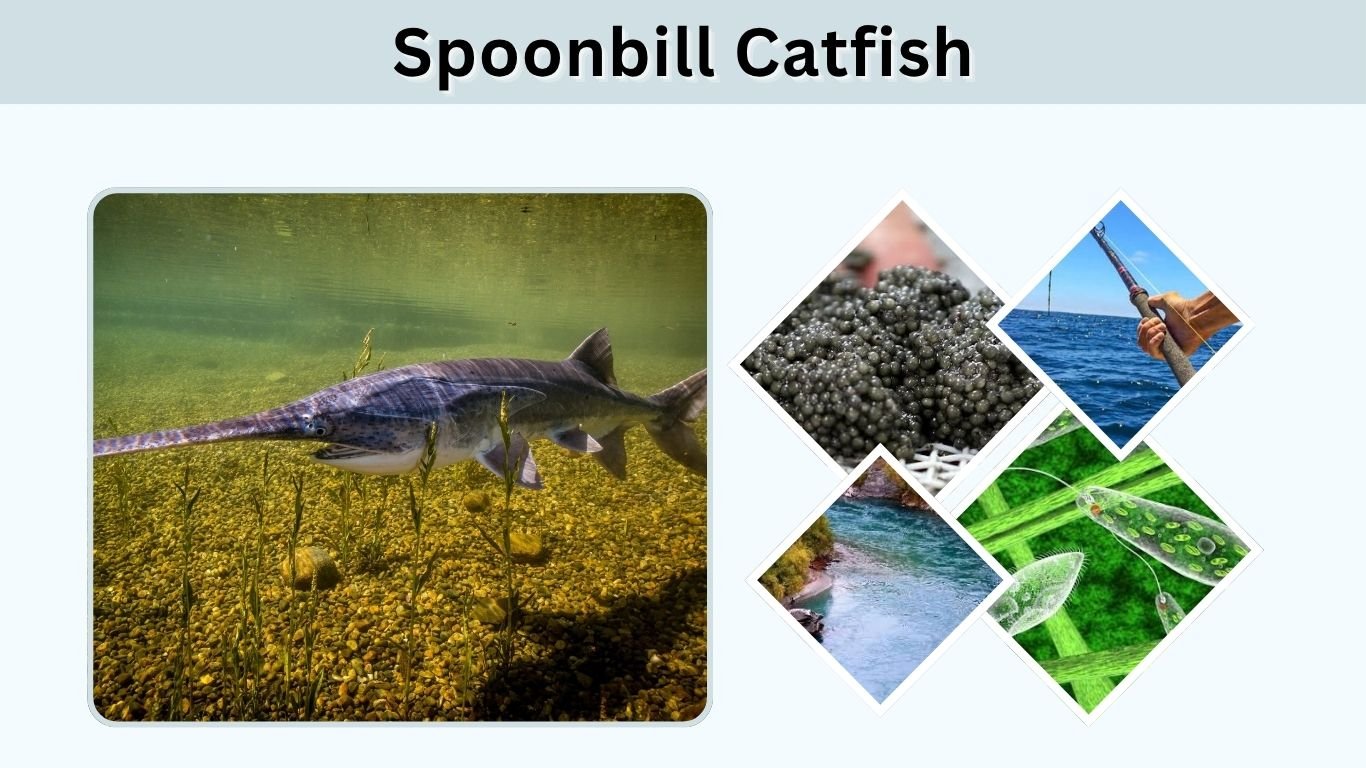
The spoonbill catfish is actually the American paddlefish, Polyodon spathula. Despite its regional name, it is not a catfish. This remarkable freshwater fish has a long, flattened snout, a smooth body, and a huge mouth designed for filtering microscopic food from the water. Spoonbills inhabit large rivers and reservoirs across the central United States. They can grow to enormous sizes, are harvested as food in some states, and are often pursued by snagging because they rarely take conventional bait.
What Is a Spoonbill Catfish?
“Spoonbill catfish,” “spoon-billed catfish,” and “spoonbill” are regional names for the American paddlefish. The standard scientific name is Polyodon spathula.
Paddlefish belong to the family Polyodontidae and are related more closely to sturgeons than to catfish. Their ancestors existed in North America approximately 125 million years ago, making them members of an ancient fish lineage.
| Classification | Name |
| Common name | American paddlefish |
| Regional name | Spoonbill catfish |
| Scientific name | Polyodon spathula |
| Family | Polyodontidae |
| Order | Acipenseriformes |
| Fish type | Freshwater filter feeder |
Is a Spoonbill Really a Catfish?
No. True catfish belong to the order Siluriformes and usually possess whisker-like barbels around their mouths. Paddlefish belong to the order Acipenseriformes and lack the typical barbels and body structure of catfish.
The inaccurate “catfish” name probably developed because spoonbills are large, smooth-bodied freshwater fish commonly encountered in the same river systems as catfish.
What Does a Spoonbill Catfish Look Like?
A spoonbill is easily recognised by the long, flattened projection extending from its head. This structure is called a rostrum and can make up roughly one-third of the fish’s total length.
Important identification features include:
- A long, paddle-shaped rostrum
- Smooth skin with very few scales
- Grey, blue-grey, or olive upper body
- Pale or white underside
- Deeply forked tail
- Small eyes near the base of the rostrum
- Very large mouth beneath the head
- Skeleton composed largely of cartilage
Young paddlefish possess tiny teeth, but these disappear as the fish matures. Adults do not need teeth because they do not bite or chew large prey.
What Is the Spoon-Shaped Nose For?
The rostrum is covered with sensory receptors capable of detecting weak electrical signals in the water. These receptors help the fish locate concentrations of plankton, including in dark or muddy river water.
The paddle is not primarily used to dig into the bottom, strike prey, or defend the fish. It functions mainly as an advanced sensory organ that helps the spoonbill find food and navigate while swimming.
Spoonbill Catfish Size
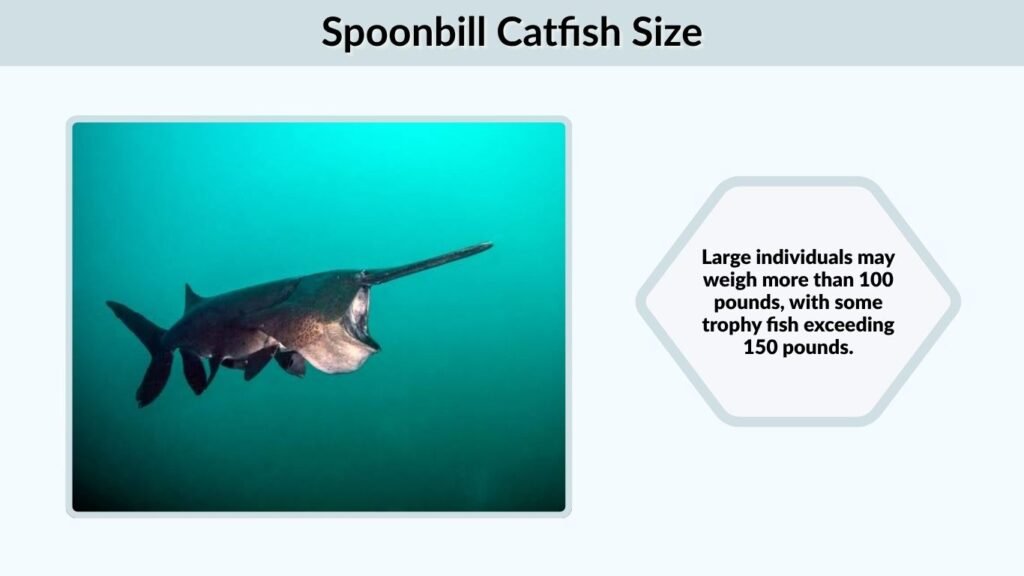
American paddlefish are among North America’s largest freshwater fishes. Adults commonly measure several feet long, and exceptionally large specimens can reach approximately seven feet.
Large individuals may weigh more than 100 pounds, with some trophy fish exceeding 150 pounds. Females generally become larger than males because they mature later and may live longer.
Exact state and world fishing records can change. Records may also be separated according to rod-and-reel, snagging, bowfishing, or other legal methods, so current wildlife-agency listings should be consulted before claiming that a fish is a record.
What Do Spoonbill Catfish Eat?

Spoonbill catfish are filter feeders that primarily consume plankton rather than fish, frogs, or other large prey.
Their diet consists mainly of:
- Zooplankton
- Copepods
- Water fleas
- Tiny crustaceans
- Microscopic aquatic animals
- Small insect larvae
A paddlefish swims through open water with its mouth extended. Water passes across closely arranged structures called gill rakers, which trap tiny food particles before the water exits through the gill openings.
Because spoonbills feed on microscopic organisms, they normally ignore worms, minnows, cut bait, and conventional fishing lures.
Spoonbill Catfish Habitat and Range
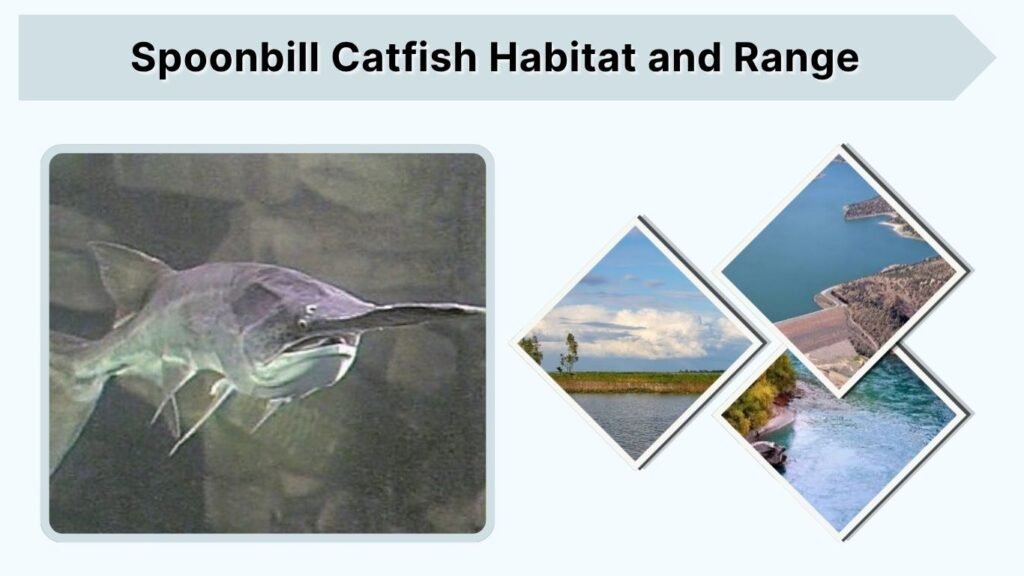
Spoonbills need large freshwater environments that provide open water, suitable currents, and abundant plankton.
Common habitats include:
- Large rivers
- Deep reservoirs
- River-connected lakes
- Slow-flowing channels
- Deep pools and backwaters
- Areas below dams
- Major river tributaries
The species is native mainly to the Mississippi, Missouri, and Ohio river systems and their connected tributaries. Populations occur in states including Missouri, Oklahoma, Arkansas, Louisiana, Kentucky, Tennessee, Indiana, Ohio, and Mississippi. Some populations reproduce naturally, while others are supported by stocking and restoration programs.
Spoonbill Catfish in Louisiana
Louisiana has paddlefish in suitable river systems, but harvest is regulated. The current statewide regulation page specifies location restrictions, a maximum length, a daily limit, and a prohibition against harvesting them by snagging. Regulations can change, so anglers must check the latest Louisiana Department of Wildlife and Fisheries rules before fishing.
Spoonbill Catfish in Alabama
Paddlefish occur in Alabama, but recreational harvest is currently prohibited. State rules require paddlefish to be returned immediately to the water with as little harm as possible.
Spoonbill Catfish in Arkansas and Missouri
Arkansas and Missouri support notable paddlefish populations and regulated fishing opportunities. Arkansas lists a statewide paddlefish daily limit, although special waters may have additional permit or season requirements. Missouri permits snagging during designated seasons and under location-specific rules.
Spoonbill Catfish Life Cycle
Paddlefish grow slowly and take several years to reach reproductive maturity. Females generally mature later than males and may not produce eggs every year.
During spring, mature fish migrate toward flowing water and gravel-covered spawning grounds. Successful spawning depends on suitable water temperature, river flow, and access to clean gravel.
Females release eggs into the water, where males fertilise them externally. The sticky eggs attach to gravel until they hatch. Young fish are then carried downstream toward quieter nursery areas, where food is more readily available.
Paddlefish can migrate hundreds of miles to reproduce, which makes uninterrupted river routes important to their survival.
How to Catch Spoonbill Catfish
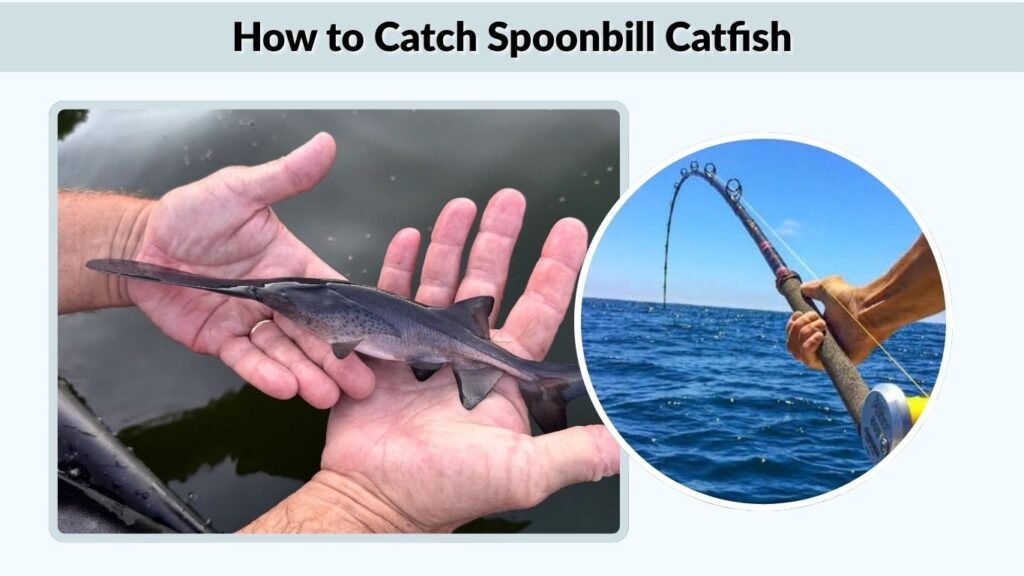
Conventional bait fishing is usually ineffective because paddlefish feed on microscopic plankton. In states where it is legal, anglers often catch them by snagging.
Snagging involves pulling a large hook through the water until it makes external contact with a fish. Typical equipment includes a heavy rod, powerful reel, strong line, large hook, and substantial sinker.
However, snagging is not permitted everywhere. Louisiana prohibits harvesting paddlefish by snagging, Alabama requires immediate release, and Missouri allows snagging only under specific seasons and location-based rules. Anglers should confirm the current regulations for the exact water before attempting to catch one.
Can You Eat Spoonbill Catfish?
Legally harvested paddlefish can be eaten. Its meat can be cut into fillets or steaks and prepared by grilling, smoking, baking, or frying.
When cleaning a spoonbill:
- Keep the fish cold after harvest.
- Remove the head, internal organs, skin, and cartilage.
- Separate the pale meat from dark or strongly flavoured tissue.
- Cut the usable meat into steaks or boneless portions.
- Check local fish-consumption advisories for the water where it was caught.
The FDA recommends cooking finfish to an internal temperature of 145°F, or until the flesh is opaque and separates easily with a fork.
Spoonbill Catfish Eggs and Caviar
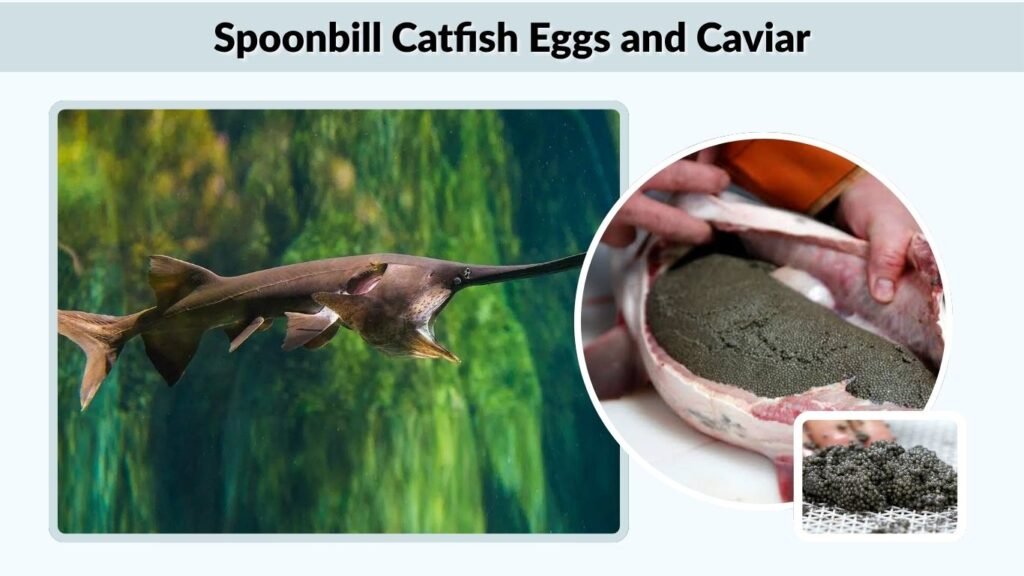
Female spoonbills produce large quantities of dark eggs that may be processed into paddlefish caviar. This roe has commercial value and is one reason paddlefish populations require careful protection.
Fishing rules may restrict the possession, transportation, processing, or sale of paddlefish eggs. Recreationally harvested fish and roe should never be sold unless the applicable laws expressly allow it.
Removing only the eggs and discarding the fish may also be illegal. Alabama, for example, specifically prohibits wasting paddlefish after removing the roe.
Spoonbill Catfish vs Shovelbill Catfish
“Spoonbill catfish” refers to the American paddlefish. “Shovelbill catfish” is a less precise name that may be used for unrelated catfish with flattened or shovel-shaped heads.
| Feature | Spoonbill catfish | Shovelbill catfish |
| Standard identity | American paddlefish | Varies by region |
| Scientific name | Polyodon spathula | Depends on the species |
| Snout | Long and paddle-shaped | Usually shorter and flattened |
| Feeding method | Filters plankton | Often hunts or scavenges |
| True catfish | No | Usually yes |
| Typical habitat | Large North American rivers | Depends on the species |
The two names should not be treated as interchangeable.
FAQs
Are spoonbill catfish endangered?
The species is not uniformly classified the same way across its entire range. It remains relatively secure in some river systems but is listed as endangered, threatened, or a species of concern in several states because of habitat changes, dams, pollution, and overharvest.
Are spoonbill catfish good to eat?
Many anglers eat legally harvested spoonbill. The meat can be cut into steaks or fillets and cooked in several ways. Proper cleaning, rapid chilling, thorough cooking, and checking local contaminant advisories are important.
Do spoonbill catfish have bones?
Their skeleton is composed largely of cartilage rather than hard bone. This is one reason paddlefish are often compared physically with sharks, although paddlefish are freshwater ray-finned fishes and are not closely related to sharks.
What bait catches spoonbill catfish?
Ordinary bait is generally ineffective because spoonbills filter microscopic plankton from the water. Where regulations permit it, snagging is the most common capture method. Anglers must follow local seasons, gear restrictions, permits, and harvest limits.
Can you keep a spoonbill catfish as a pet?
A paddlefish is unsuitable for a normal home aquarium because it can grow several feet long and requires extensive open water for continuous swimming and filter feeding. Possession may also be regulated, so it should not be collected from the wild without legal authorisation.